
Register: formal & informal in context— C1 Grammar Exercises
Published March 23, 2026
Exercise 1 — Gap Fill Select
In a business email, it is more to use 'Dear Sir or Madam' rather than 'Hey there'.
When speaking with close friends, it is common to use language like contractions and idioms.
In academic writing, it is to avoid slang and use precise vocabulary.
Using phrases like 'What's up?' is considered in a professional setting.
Emails to colleagues can be less formal, but it’s still important to maintain a tone.
In informal conversations, it is common to use expressions like 'gonna' or 'wanna'.
When writing a formal report, avoid using language such as 'kids' instead of 'children'.
In casual texts, it’s acceptable to use like emojis and abbreviations.
Using overly complex vocabulary in a friendly chat may sound or unnatural.
In formal speeches, it is advisable to use phrases such as 'I would like to express' instead of 'I wanna say'.
Three versions of the same message, written by the same person on the same day:
- Sorry, can't make tomorrow. Catch you next week?
- I won't be able to make tomorrow's meeting; could we reschedule for next week?
- I regret that I will be unable to attend tomorrow's meeting and would respectfully request that we reschedule the discussion for the following week.
The propositional content is identical. The register is not. Each version is calibrated to a different relationship, channel, and purpose, and at C1 level, register competence is what separates English that is grammatically correct from English that is contextually appropriate.
What register actually is
Register is the systematic variation of language choices to suit context. It is not a binary of formal versus informal but a continuum, ranging from intimate (text messages, banter) through neutral (news writing, business email) to highly formal (legal documents, academic prose). Movement along this continuum involves coordinated shifts across four interlocking dimensions.
- Lexical: vocabulary choice, particularly the trade-off between Latinate single-word verbs and Anglo-Saxon phrasal verbs.
- Syntactic: sentence complexity, nominalisation, passive constructions, cleft sentences, and inversion.
- Grammatical: contractions, modal nuance, hedging, person reference (I/we vs one/the writer).
- Discoursal: connectors and discourse markers signalling logical relationships.
A consistent register signals fluency. Mixing dimensions (Latinate vocabulary stitched together with chatty contractions, or formal hedges followed by phrasal verbs) produces the mismatched English that C1 examiners and professional readers flag immediately.
Lexical register: word choice
English carries roughly two vocabulary layers, the older Anglo-Saxon stock (short, concrete, often forming phrasal verbs) and the Latinate/Romance overlay (longer, abstract, single-word). Formal register draws on the Latinate layer; informal register draws on the Anglo-Saxon and especially on phrasal verbs.
| Informal / Anglo-Saxon | Formal / Latinate |
|---|---|
| get | obtain, receive, acquire |
| put off | postpone, defer |
| ask for | request |
| find out | discover, ascertain |
| set up | establish |
| look into | investigate, examine |
| think about | consider, contemplate |
| go up / go down | increase / decrease, rise / decline |
| get worse / get better | deteriorate / improve |
| start / stop | commence, initiate / cease, terminate |
| help | assist, facilitate |
| show | demonstrate, indicate |
| tell | inform, notify |
| about | concerning, regarding |
| need | require, necessitate |
The choice is not always Latinate-equals-better. Utilise instead of use in a personal email reads as pretentious; commence instead of start in casual speech sounds theatrical. The skill is matching the choice to the context, not climbing the formality ladder for its own sake.
Syntactic register: how sentences are built
Formal register typically features longer sentences, denser clausal embedding, and a preference for the abstract over the concrete. Three syntactic moves do most of the work.
Nominalisation
Turning verbs and adjectives into nouns shifts the sentence from active narration to abstract analysis.
| Informal (verbal) | Formal (nominalised) |
|---|---|
| The government decided to invest in education, and people reacted strongly. | The government's decision to invest in education provoked a strong public reaction. |
| Prices went up, and consumers complained. | The rise in prices prompted complaints from consumers. |
Passive voice and impersonal constructions
Removing the agent shifts focus from who did what to what happened, which suits academic and bureaucratic prose. See passive voice: advanced forms for the full range.
- Informal We tested the hypothesis using two methods.
- Formal The hypothesis was tested using two methods.
- Informal Researchers think the data is unreliable.
- Formal The data is widely considered to be unreliable.
Fronting, inversion, and cleft sentences
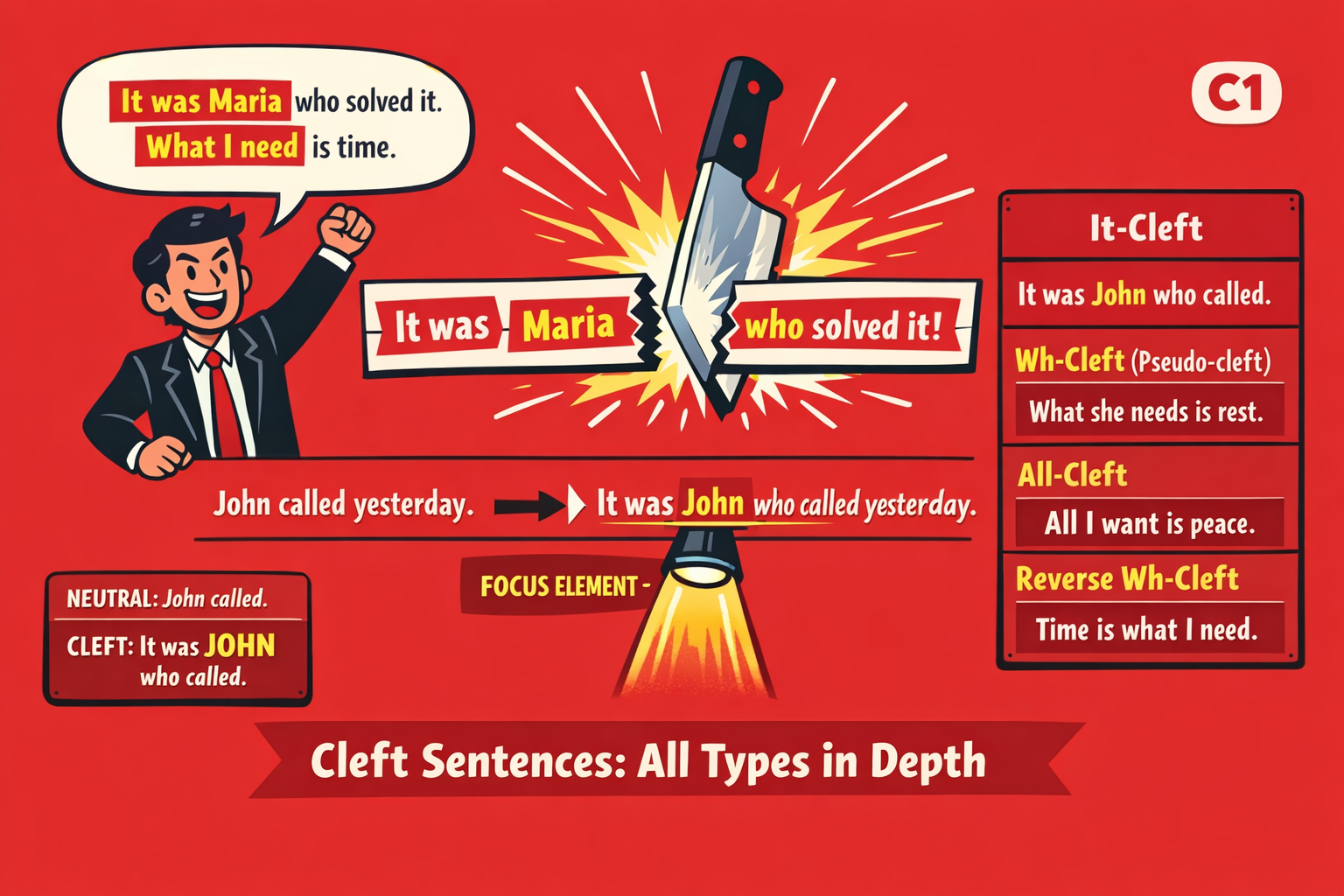
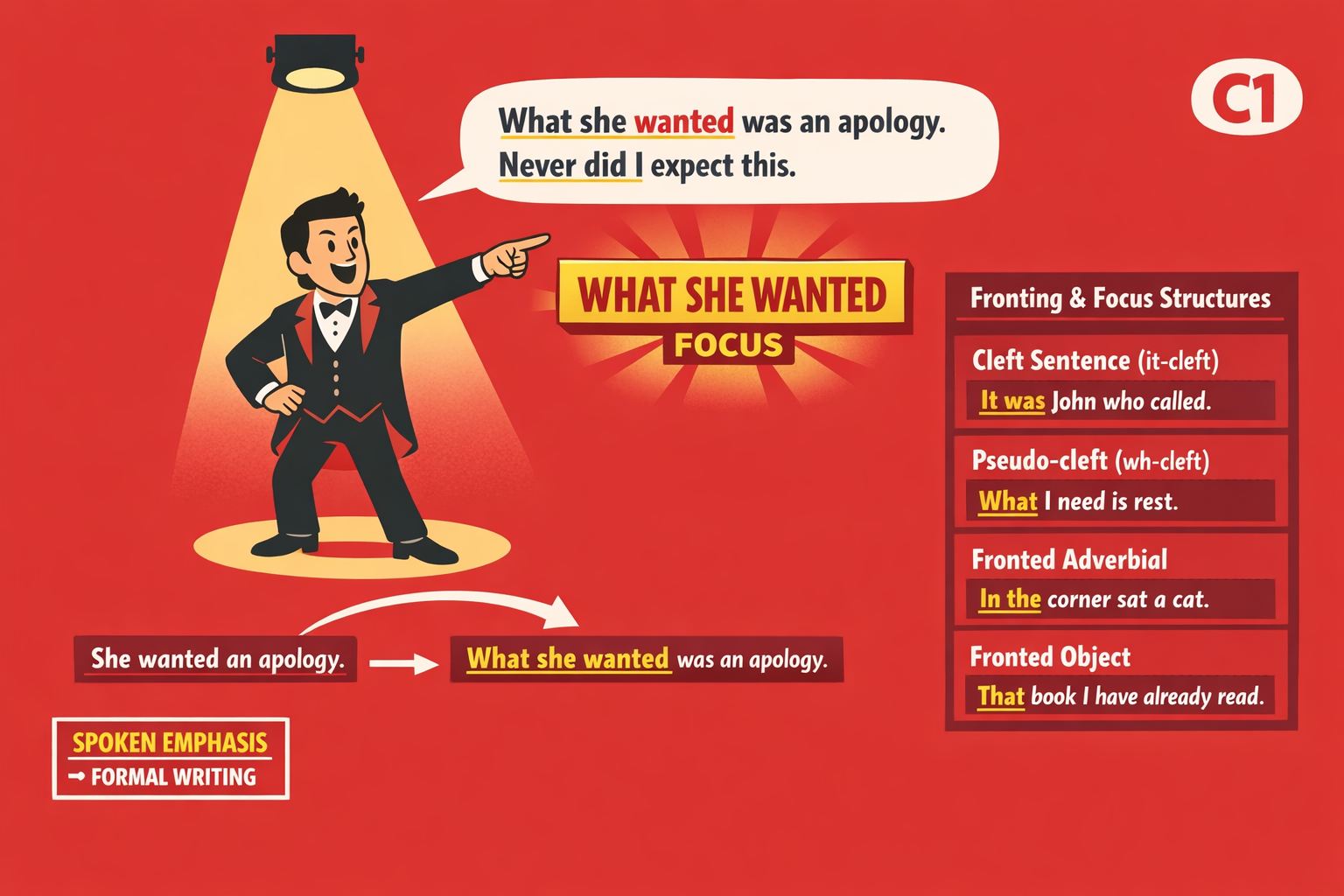
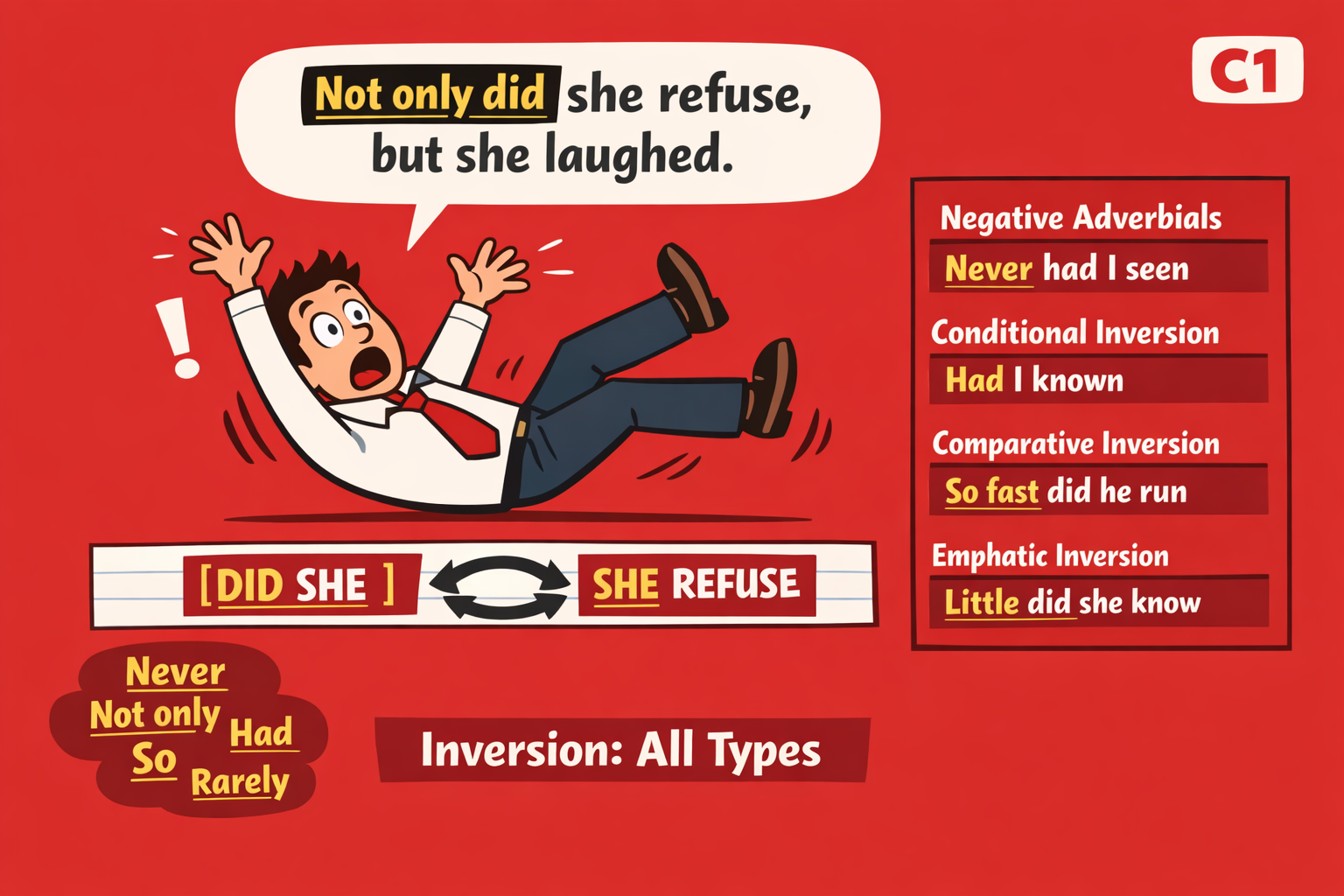
Sentence-structure marking, including inversion after negative adverbials, fronting for emphasis, and cleft constructions for focus, almost always signals formal or literary register.
- Neutral The committee has rarely faced such opposition.
- Formal Rarely has the committee faced such opposition.
- Neutral The new policy caused most of the controversy.
- Formal It was the new policy that caused most of the controversy.
Grammatical signals
| Informal | Formal |
|---|---|
| I'm, don't, won't, can't, it's | I am, do not, will not, cannot, it is |
| got, gonna, wanna | have / received, going to, want to |
| you (general use, e.g. you can see that…) | one / the reader / the observer |
| I think / I feel | It can be argued / the evidence suggests |
| really, very, totally | significantly, considerably, markedly |
| kind of, sort of, a bit | somewhat, to some extent, marginally |
Hedging is itself a register marker. Formal academic writing prefers the results suggest over the results prove, it appears that over it is, and there is a tendency for over X always causes Y. The hedging signals scholarly caution; its absence in academic prose reads as overclaiming.
Discourse markers across registers
Connectors are perhaps the clearest single signal of register because writers tend to choose them unconsciously. For deeper coverage of the inventory, see discourse markers.
| Informal | Neutral | Formal |
|---|---|---|
| but, though | however | nevertheless, notwithstanding |
| so | therefore | consequently, hence, thus |
| also, plus | in addition | furthermore, moreover |
| like, say | for example | for instance, to illustrate |
| anyway | in any case | be that as it may |
| then, after that | subsequently | thereafter |
| so basically | in summary | to summarise, in conclusion |
Reading the context
Register choice is governed by four contextual variables, and the C1 user weighs them simultaneously rather than reaching for a default formality level.
- Audience: peer, supervisor, examiner, stranger, public.
- Channel: text message, email, formal letter, academic paper, public speech.
- Purpose: apologise, inform, persuade, argue, complain, request.
- Relationship: close, professional, hierarchical, transactional.
A cover letter to a stranger demands formal register even though emails are usually neutral. A condolence note to a colleague stays warm even within professional convention. A complaint to a regulator gains force from formal register; a complaint to a friend about a regulator does not. The variables interact.
Common register errors at C1
| Error | Example | Issue |
|---|---|---|
| Mixed register | The committee will endeavour to look into this matter, and we won't put up with any further delays. | Latinate endeavour clashes with phrasal verbs look into and put up with, plus the contraction won't. Pick one register and hold it. |
| Over-formality | I shall endeavour to ascertain the time of our meeting and revert in due course. (in a casual office message) | Stilted, archaic, and reads as parody in a casual context. Use I'll check the time and let you know. |
| Phrasal verbs in academic prose | The researchers set up an experiment to find out what was going on. | Three phrasal verbs in one sentence is too informal for academic writing. Prefer established an experiment to investigate the phenomenon. |
| Personal pronouns in academic argument | I think the data shows that I'm right about this. | First-person assertion replaces evidence-based hedging. Prefer The data appears to support this interpretation. |
| Contractions in formal writing | The court doesn't recognise this precedent, and it won't be applied here. | Contractions belong to neutral and informal registers. Formal legal and academic writing requires the full forms does not and will not. |
Try it yourself
- We're gonna look into the issue and see what we can come up with.
- Lots of people don't like the new rules.
- The boss told us to wrap things up by Friday.
- We found out the data was wrong, so we had to start over.
- Anyway, the project's on hold for now because of budget stuff.
- We will investigate the issue and propose a solution.
- A significant number of individuals object to the new regulations.
- We were instructed to conclude the work by Friday.
- It was discovered that the data was inaccurate; consequently, the analysis had to be repeated.
- The project has, in any case, been suspended owing to budgetary constraints.
Quick summary
- Register is a continuum, not a binary, governed by audience, channel, purpose, and relationship.
- Shifts in register occur across four dimensions (lexical, syntactic, grammatical, and discoursal), and consistency across all four is what marks fluent register control.
- Formal register favours Latinate vocabulary, nominalisation, passive constructions, full forms, hedging, and formal connectors; informal register favours phrasal verbs, contractions, personal voice, and direct connectors.
- Mixing registers within a single text is the most visible C1 error, more visible than vocabulary gaps or grammatical slips.
- Climbing the formality ladder is not the goal. Matching the register to the context is.
Frequently asked questions
What is the difference between formal and informal English?
Formal English is structured, vocabulary-dense, and impersonal, favoured in academic writing, legal documents, official communication, and public speeches. Informal English is direct, contraction-heavy, and personal, used in conversation, text messages, social media, and casual emails. The difference shows up across four dimensions simultaneously: vocabulary (Latinate vs phrasal verbs), sentence structure (complex vs simple), grammar (full forms vs contractions), and discourse markers (furthermore vs plus).
Can I use contractions in academic writing?
Generally no. Academic writing convention requires the full forms do not, cannot, it is, will not. Contractions are accepted in informal academic genres such as reflective journals or some humanities essays, but they remain inappropriate in research papers, dissertations, and formal exam writing. When in doubt for an academic submission, expand all contractions.
Are phrasal verbs always informal?
Most phrasal verbs are informal or neutral, and academic and legal writing prefers their Latinate equivalents: investigate over look into, postpone over put off, establish over set up. However, some phrasal verbs are register-neutral and appear freely in formal texts: point out, carry out, bring about, set out. The rule is contextual: check whether a Latinate single-word equivalent exists, and if it does, the formal register usually requires it.
Should I use "I" in academic essays?
It depends on the discipline and the assignment. Hard sciences and traditional academic writing avoid first person and prefer impersonal constructions: It can be argued that…, The evidence suggests…, This essay examines…. Humanities and social sciences are increasingly tolerant of I in argumentative essays, particularly when staking a clear analytical position. Check the style guide of the discipline or the explicit instructions of the assignment before deciding.
What's the difference between formal and neutral register?
Neutral register is the everyday written and spoken English of professional life, including business emails, journalism, non-specialist articles, polite conversation. It avoids slang and contractions are used selectively, but it does not deploy the heavy nominalisation, hedging, and Latinate vocabulary characteristic of formal register. Formal register goes further: full forms throughout, dense noun phrases, passive constructions, and formal discourse markers (nevertheless, consequently, furthermore) rather than neutral ones (however, therefore, in addition).
How do I choose the right register?
Read the four contextual variables before drafting: audience (who is reading), channel (where they will read it), purpose (what you want from them), and relationship (how close you are). A casual peer over Slack accepts contractions, phrasal verbs, and direct address; a hiring committee over a formal letter requires full forms, Latinate vocabulary, and impersonal constructions. The C1 skill is recognising that register choice is a calibration to context, not a default setting.
Related topics
- Nominalisation: converting verbs and adjectives into noun phrases, the syntactic engine of formal register.
- Passive voice: advanced forms, covering the impersonal constructions that anchor formal academic style.
- Discourse markers: full inventory of connectors across registers.
- Formal and informal English (B2), the foundation that this C1 topic builds on.

Comments