
Quantifiers— A2 Grammar Exercises
Published March 14, 2026
Exercise 1 — Multiple Choice
I have ____ friends in my new city.
Do you have ____ milk left in the fridge?
There isn't ____ sugar in my coffee.
I saw ____ people at the concert last night.
She has ____ homework to do this weekend.
I don't have ____ time to finish my project.
Are there ____ apples left in the basket?
He drinks ____ coffee every morning.
I don't see ____ birds in the sky today.
Can I have ____ water, please?
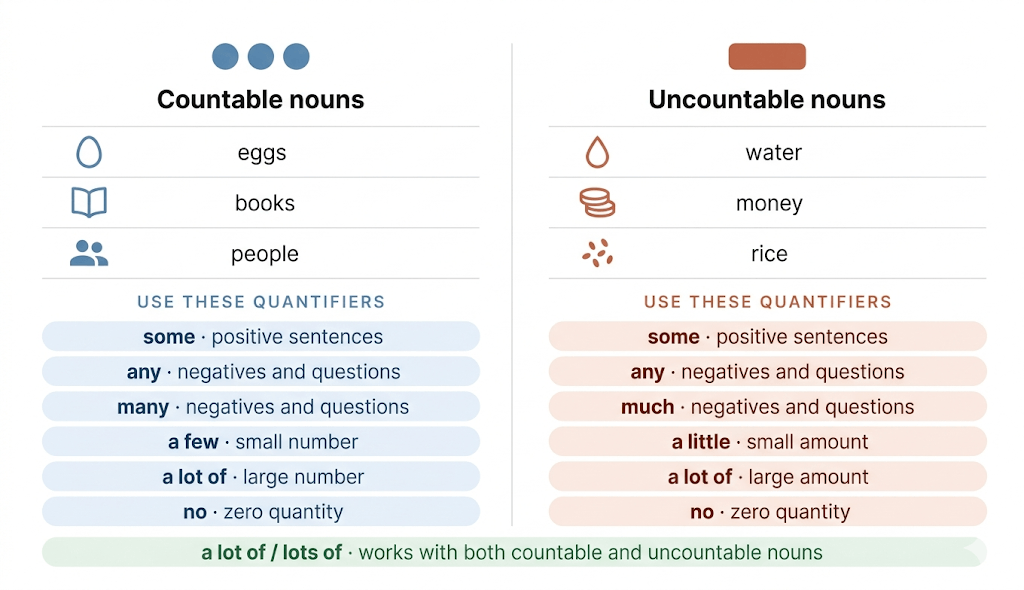
Quantifiers tell you how much or how many of something there is. The one you choose depends on two things: whether the noun is countable or uncountable, and whether the sentence is positive, negative, or a question.
Overview
| Quantifier | Use with | Where |
|---|---|---|
| some | Countable plural + uncountable | Positive sentences, offers, requests |
| any | Countable plural + uncountable | Negative sentences, questions |
| much | Uncountable only | Negative sentences, questions |
| many | Countable plural only | Negative sentences, questions |
| a lot of / lots of | Countable plural + uncountable | Positive sentences |
| a little | Uncountable only | Positive — small amount |
| a few | Countable plural only | Positive — small number |
| no | Countable plural + uncountable | Zero quantity (replaces not any) |
Some and any
Some and any both work with countable plural nouns and uncountable nouns. The choice depends on the type of sentence — not the noun.
| With countable nouns | With uncountable nouns | |
|---|---|---|
| Positive | There are some eggs in the fridge. | I have some money. |
| Negative | There aren't any eggs. | I don't have any money. |
| Question | Are there any eggs? | Do you have any money? |
Much and many
Both mean a large quantity. The difference is the noun: much goes with uncountable nouns, many goes with countable plural nouns. At A2, both are mainly used in negative sentences and questions. In positive sentences, a lot of sounds more natural.
| Much — uncountable | Many — countable plural | |
|---|---|---|
| Negative | I don't have much time. | She doesn't have many friends here. |
| Question | How much water do you drink? | How many people came? |
| Positive | Sounds formal — use a lot of instead | Sounds formal — use a lot of instead |
There is much traffic today. → There is a lot of traffic today. — more natural.
There isn't much traffic today. — negative is fine.
How much traffic is there? — question is fine.
A lot of and lots of
Use a lot of or lots of in positive sentences when you want to say there is a large amount or number. Both work with countable and uncountable nouns and mean the same thing.
- We have a lot of work to do today.
- There are a lot of cars on the road this morning.
- She has lots of experience in this field.
- They spent a lot of money on the renovation.
A little and a few
Both mean a small amount — enough, but not much. A little goes with uncountable nouns. A few goes with countable plural nouns.
| A little — uncountable | A few — countable plural |
|---|---|
| Can I have a little sugar? | I have a few questions. |
| She speaks a little French. | We have a few minutes before the train. |
| Add a little salt to the pasta. | There are a few good restaurants near here. |
No
No means zero quantity. It makes a negative sentence without using not. No is followed by a noun — not a verb. It works with both countable and uncountable nouns. You will often see it with there is and there are.
- There is no milk in the fridge. = There isn't any milk in the fridge.
- I have no money. = I don't have any money.
- There are no tickets left. = There aren't any tickets left.
Common mistakes
| Wrong | Correct | Why |
|---|---|---|
| How many money do you have? | How much money do you have? | Money is uncountable. Use much, not many. |
| I don't have some milk. | I don't have any milk. | Use any in negative sentences, not some. |
| There is much noise outside. | There is a lot of noise outside. | Much in positive sentences sounds unnatural. Use a lot of. |
| I have a few water left. | I have a little water left. | Water is uncountable. Use a little, not a few. |
| I don't have no time. | I don't have any time. / I have no time. | Do not combine a negative verb with no. Choose one or the other. |
| Would you like some help? — Yes, I don't need any. | Would you like some help? — No, I don't need any. | Any is correct in the reply, but the overall answer must match — positive or negative. |
Quick summary
- Use some in positive sentences and in offers/requests. Use any in negatives and questions.
- Much = uncountable. Many = countable plural. Both mainly in negatives and questions.
- A lot of works with both types of noun and is the natural choice in positive sentences.
- A little = small amount of something uncountable. A few = small number of something countable.
- No = zero. Never combine no with a negative verb.
- When in doubt whether to use much or many, ask: can I count it? If yes → many. If no → much.
Frequently asked questions
What is a quantifier?
A quantifier is a word that comes before a noun to say how much or how many of something there is. Words like some, any, much, many, a lot of, a little, and a few are all quantifiers. They are part of the broader category of determiners — words that introduce or specify nouns.
What is the difference between much and many?
Much is for uncountable nouns — things you cannot count individually, like water, money, time, traffic. Many is for countable nouns in the plural — things you can count, like cars, people, books, questions. The fastest way to decide: can you put a number in front of the noun? If yes, use many. If no, use much.
When do I use some and when do I use any?
Use some in positive sentences and in questions where you are offering or requesting something. Use any in negative sentences and in neutral questions. There is some cheese (positive). Is there any cheese? (question — not sure). Would you like some cheese? (offer — you expect yes).
What is the difference between a little and a few?
A little is for uncountable nouns: a little water, a little time, a little help. A few is for countable plural nouns: a few minutes, a few friends, a few ideas. Both mean "a small amount — not a lot, but enough". The noun type is the only deciding factor.
Can I use a lot of in questions and negatives?
Yes, you can, but it is less common than much or many in questions and negatives. Do you have a lot of time? is correct but Do you have much time? sounds more natural. In practice, a lot of is most common in positive sentences, and much/many in negatives and questions.
What is the difference between no and not any?
They mean the same thing, but the grammar is different. No is used with a positive verb: I have no money. Not any is used with a negative verb: I don't have any money. Never combine them: I don't have no money is a double negative and incorrect in standard English.
How do I know if a noun is countable or uncountable?
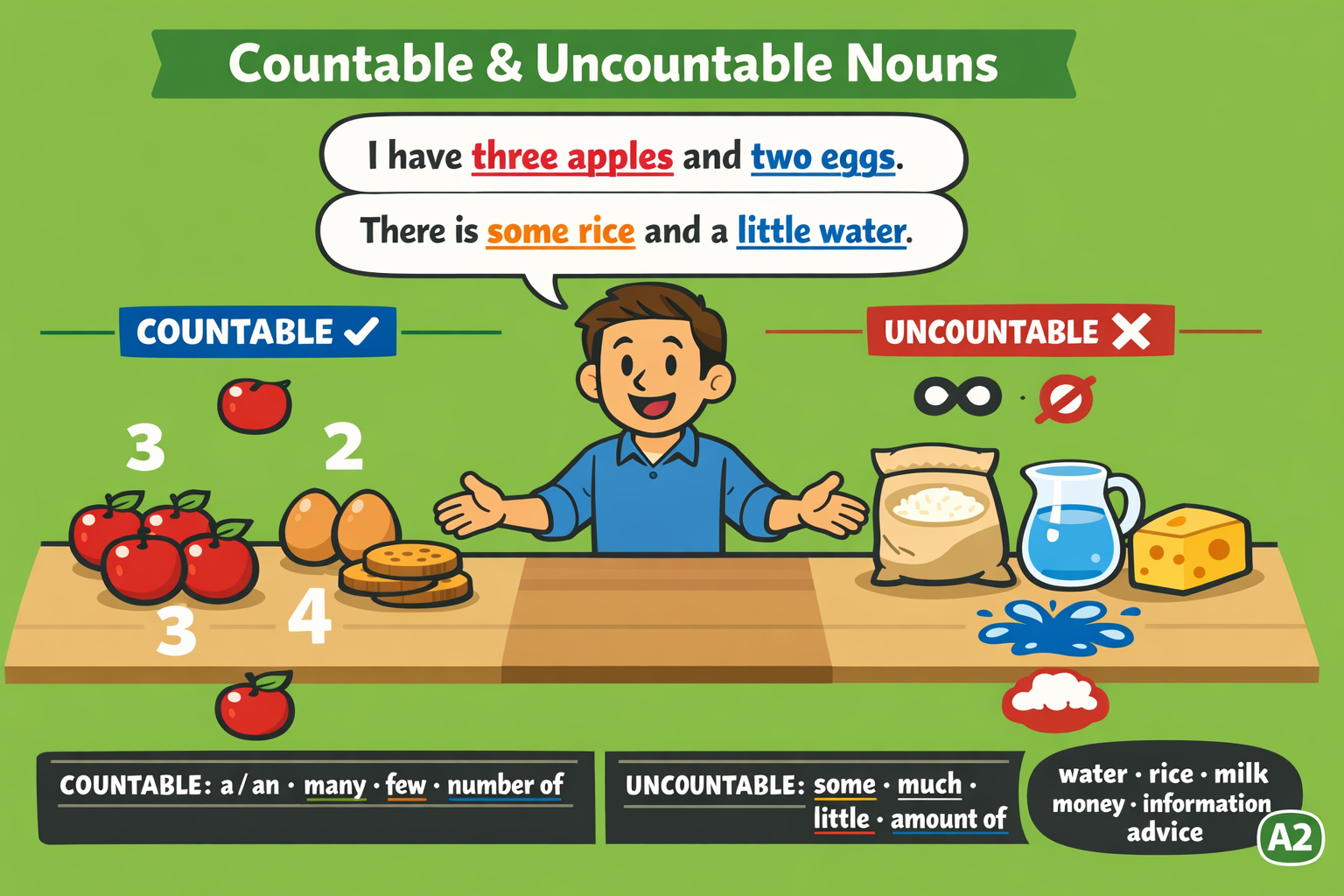
Countable nouns have a plural form and can be used with numbers: one apple, two apples. Uncountable nouns have no plural form and cannot be used with numbers: you cannot say one rice or two rices. The countable and uncountable nouns page explains this fully with common examples and lists.
Related topics
- Countable and uncountable nouns — every quantifier decision depends on this distinction. Review it first if you are not sure which nouns are countable.
- There is / there are — quantifiers appear very often with there is and there are: There are a few eggs. There isn't any milk.
- Determiners and quantifiers — the hub page covering all determiner types across levels, including articles, demonstratives, and advanced quantifiers.
Comments