
Comparative and Superlative Adjectives— A2 Grammar Exercises
Published March 14, 2026
Exercise 1 — Multiple Choice
This book is ____ than that one.
She is the ____ student in the class.
This puzzle is ____ than the last one.
He is the ____ player on the team.
This road is ____ than the one we took yesterday.
She is the ____ runner in the competition.
This task is ____ than the previous one.
He is the ____ chef in the restaurant.
This movie is ____ than the last one I saw.
She is the ____ dancer in the group.
Comparative and superlative adjectives let you compare and rank things. You use them when you want to say that London is cheaper than Paris, or that Tokyo is the most expensive city in Japan. The comparative compares two things; the superlative ranks one thing above all others in a group.
Form
How you build the comparative and superlative depends on the length of the adjective.
Short adjectives (one syllable)
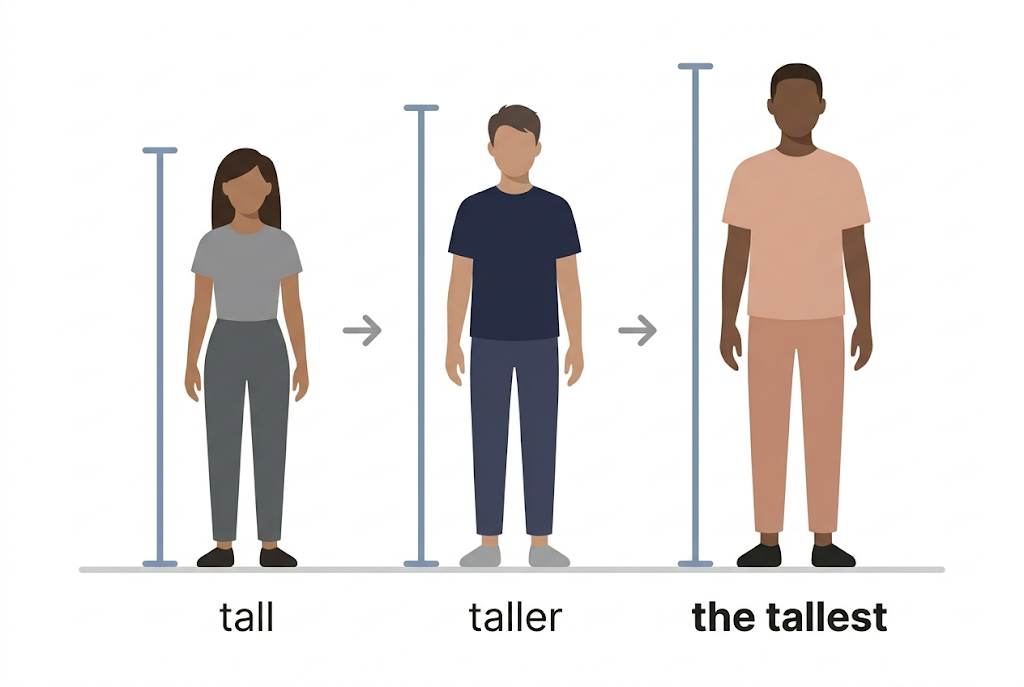
Add -er for the comparative and -est for the superlative.
| Adjective | Comparative | Superlative |
|---|---|---|
| tall | taller than | the tallest |
| fast | faster than | the fastest |
| cheap | cheaper than | the cheapest |
Two-syllable and longer adjectives
Use more for the comparative and the most for the superlative. The adjective does not change. This applies to all adjectives of three or more syllables, and to most two-syllable adjectives — with two groups worth knowing. Two-syllable adjectives ending in -y (such as happy, easy, angry, heavy) follow the short adjective rule instead and use -ier / -iest. A smaller group of two-syllable adjectives — clever, simple, narrow, quiet — can take either form: both cleverer and more clever are correct. At A2, it is safe to use more + adjective with any two-syllable adjective that does not end in -y.
| Adjective | Comparative | Superlative |
|---|---|---|
| expensive | more expensive than | the most expensive |
| comfortable | more comfortable than | the most comfortable |
| interesting | more interesting than | the most interesting |
Spelling rules for short adjectives
| Rule | Example | Comparative | Superlative |
|---|---|---|---|
| Ends in -e → add -r / -st | nice | nicer | the nicest |
| Ends in consonant + -y → change to -ier / -iest | happy | happier | the happiest |
| One vowel letter before the final consonant → double the consonant (e.g. b-i-g) | big | bigger | the biggest |
Irregular adjectives
These do not follow any rule. You need to learn them.
| Adjective | Comparative | Superlative |
|---|---|---|
| good | better than | the best |
| bad | worse than | the worst |
| far | further than | the furthest |
Further vs farther: both are comparative forms of far. Further is standard in British English for both distance and abstract use (further research). At A2, use further — it is always correct. See FAQ 5 below for the full distinction.
Using comparatives
Use a comparative adjective to say that one thing has more of a quality than another. Always use than after the comparative form.
- The bus is cheaper than the train.
- Sara speaks English better than her brother.
- This hotel is more comfortable than the last one.
- It is colder than yesterday.
- The new phone is more expensive than I expected.
- This exam is harder than the first one.
Using superlatives
Use a superlative adjective to rank one person or thing above all others in a group. Always use the before the superlative. You often follow it with in (for places) or of (for a group).
- That is the worst film I have ever seen.
- Tokyo is the most expensive city in Japan.
- Ahmed is the best student in the class.
- This is the easiest question on the test.
- She is the most organised person in the office.
- It was the longest journey of my life.
The word the is part of the superlative structure — you cannot leave it out. This is different from the general rules for articles, so it is worth noticing.
Negative comparisons: not as … as
To say that two things are equal, or that one has less of a quality than another, use as … as and not as … as. The adjective does not change — it stays in its base form.
- London is not as cheap as Madrid. — Madrid is cheaper.
- This exercise is not as difficult as the last one.
- My bag is as heavy as yours. — they are equal.
- The sequel is not as good as the original film.
Common mistakes
| Wrong | Correct | Why |
|---|---|---|
| more taller / the most tallest | taller / the tallest | Short adjectives use -er or -est only. Never add more or most as well. |
| She is taller I am. | She is taller than I am. | Than is required after every comparative form. |
| He is best student. | He is the best student. | Superlatives always need the. |
| This is more good than that. | This is better than that. | Good is irregular — its comparative is better, not more good. |
| It is not as cheap than Madrid. | It is not as cheap as Madrid. | The as … as structure uses as on both sides, never than. |
Quick summary
- Short adjectives (one syllable): -er than (comparative) and the -est (superlative).
- Long adjectives (three+ syllables): more … than (comparative) and the most … (superlative).
- Always use than after a comparative. Always use the before a superlative.
- For equal or lesser comparisons, use as … as or not as … as.
- Learn the irregulars: good → better → the best · bad → worse → the worst · far → further → the furthest.
Frequently asked questions
When do I use -er and when do I use more?
Use -er with one-syllable adjectives (tall → taller) and with two-syllable adjectives ending in -y (happy → happier). Use more with adjectives of three or more syllables (more expensive). For other two-syllable adjectives like clever or simple, both forms are correct.
Is it more clever or cleverer?
Both are correct in standard English. Cleverer is more common in British English; more clever is widely accepted everywhere. Either form is fine — choose one and be consistent.
Do I always need than after a comparative adjective?
Yes — always include than when you name what you are comparing to. In informal spoken English, speakers sometimes drop it when both things are obvious from context ("This one is better"), but at A2, treat than as required. Writing She is taller I am is a clear error; She is taller than I am is always correct.
Why does the superlative always use the?
The superlative identifies a single, specific item from a group — the tallest, the most expensive — and that kind of specific reference requires the. It works the same way as when you say the president or the capital: there is only one, so you use the.
What is the difference between further and farther?
Both are comparative forms of far. Further is the standard form in British English and works for both distance and abstract meanings (further research). Farther is more common in American English and is used mainly for physical distance. At A2, use further and you will always be correct.
How do I say two things are equal in English?
Use as … as: This bag is as heavy as yours. To say one thing has less of a quality, use not as … as: London is not as cheap as Madrid. The adjective between the two as words stays in its base form — no -er or more.
Related topics
- Adverbs of manner vs adjectives — understand the difference between quick and quickly before you compare actions.
- Quantifiers: much, many, a lot of — another way to express degree and quantity in English.
- Comparative and superlative adjectives and adverbs (B1) — the next level covers adverbs, double comparatives (getting better and better), and more complex structures.
Comments