They have been learning French ______ three hours now.
3
She has worked at that company ______ ten years.
4
We haven’t seen him ______ he moved to London.
5
I have been waiting to hear from you ______ ages.
6
My parents have owned this house ______ I was a child.
7
He’s been studying music ______ the start of the year.
8
I have wanted to visit Japan ______ a long time.
9
You haven’t stopped talking about that book ______ you finished it.
10
She has been running her own business ______ nearly a decade.
11
We’ve grown a lot ______ we started this new training program.
12
He hasn’t upgraded his computer ______ five years.
13
They have been saving money ______ the beginning of the summer.
14
I haven’t heard any complaints from them ______ quite some time.
15
She’s been feeling better ______ she changed her diet.
16
We have only met twice ______ we became neighbors.
17
He’s been working day and night ______ his contract was extended.
18
I haven’t visited my hometown ______ last summer.
19
She’s been reading that novel ______ a couple of weeks.
20
They have grown significantly ______ they took over the small company.
Share
She has lived in Paris for ten years. She has
lived in Paris since 2014. Both sentences use
the present perfect and both
describe the same situation — but for and since work in
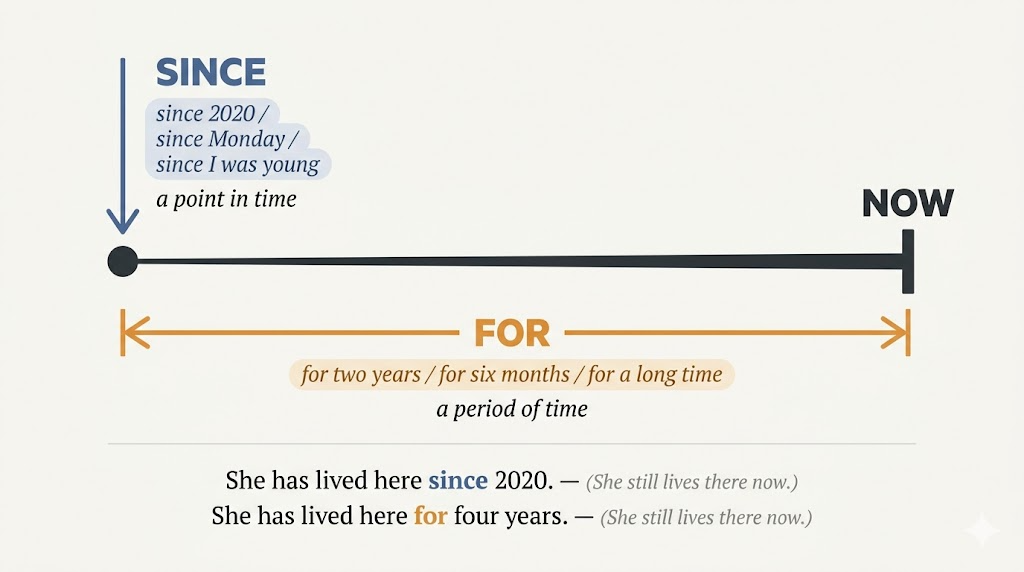
completely different ways. For tells you how long. Since
tells you when it started.
The Core Difference
For
+a period of time — how long something has lasted
Since
+a point in time — when something started
Use for with any expression that measures a duration — a number of minutes, hours, days, weeks, months, or
years. You are answering the question How long?
I have worked here for six months.
They have been married for twenty years.
We have known each other for a long time.
He has had that car for three years.
Since — a Point in Time
Use since with a specific moment — a clock time, a date, a year, a
day, or a phrase that names when something started. You are answering the
question From when?
I have worked here since March.
They have been married since 2003.
We have known each other since school.
He has had that car since last year.
A quick test: can you put a number in front of the word? for three years ✓ — use for. since three years ✗ — that's a date, use since 2021 or
change to for three years.
Tense: Present Perfect
In most cases, for and since appear with the present perfect because they describe a situation that started in the
past and continues now. The present perfect connects the past starting point
to the present moment.
She has studied English for two years. (She still studies it now.)
She has studied English since 2022. (She still studies it now.)
For can also be used with other tenses when the situation does not
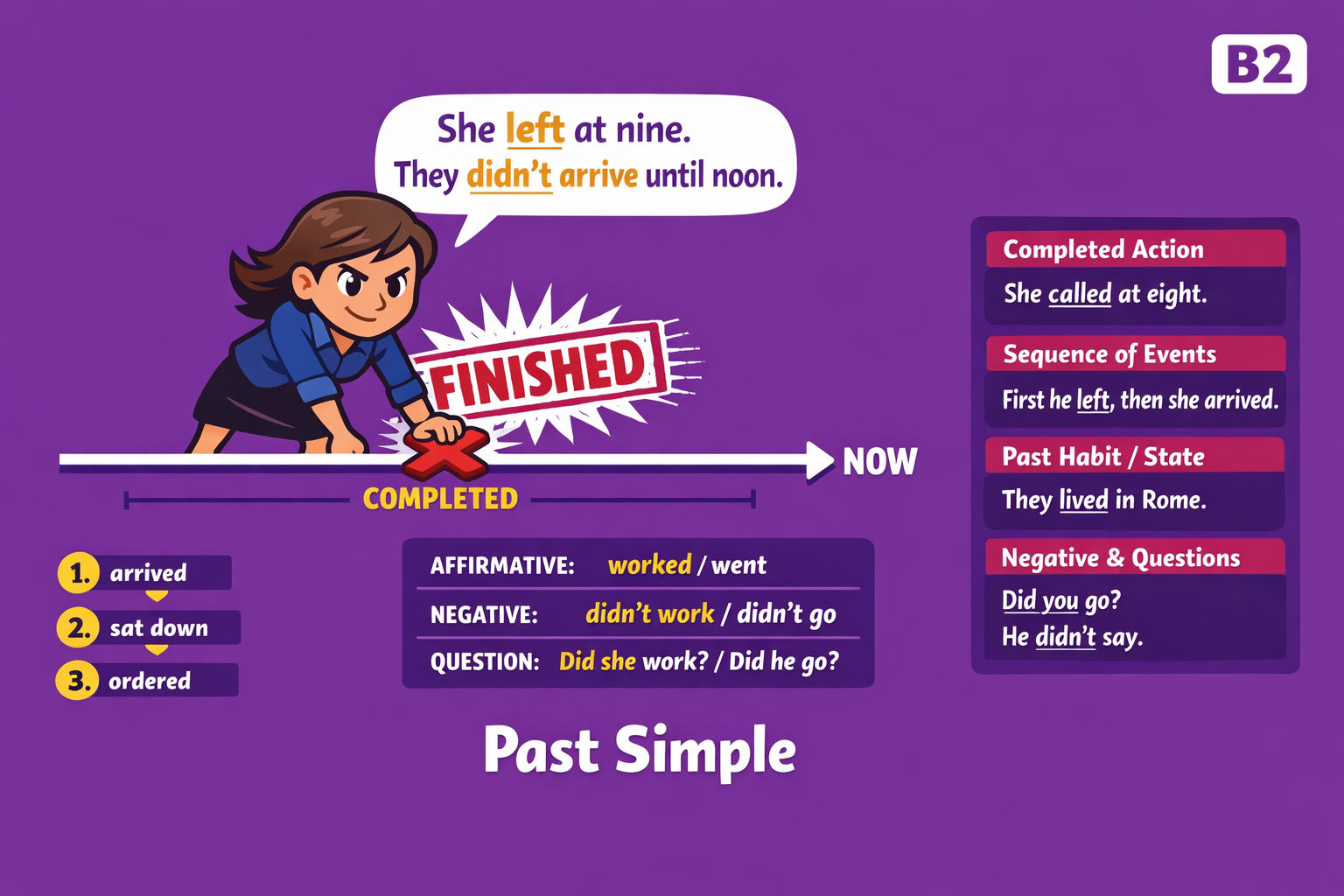
continue to the present. I worked there for five years uses the past simple — the job is finished. Since, however, almost
always appears with the present perfect at this level.
Common Mistakes
Wrong
Correct
Why
I have lived here since five years.
I have lived here for five years.
Five years is a duration → for
She has worked here for 2019.
She has worked here since 2019.
2019 is a point in time → since
He has been sick since three days.
He has been sick for three days.
Three days is a duration → for
I know her since a long time.
I have known her for a long time.
Needs present perfect + duration → for
We are friends since we were children.
We have been friends since we were children.
Situation continues now → present perfect
They have waited since two hours.
They have waited for two hours.
Two hours is a duration → for
The most common error is since + duration —
especially since three years and since a long time. These
are direct translations from many European languages. In English, a duration
always takes for.
Summary
Use for + a period of time: for two hours, for
ten years, for a long time.
Use since + a point in time: since Monday,
since 2020, since I was young.
Both words usually appear with the present perfect
when the situation continues now.
A quick test: if you can put a number in front, use for. If
you can put a year or date, use since.
Frequently Asked Questions
What is the difference between "for" and "since" in English?
For is used with a period of time to say how long
something has lasted: for three years, for a week. Since is used
with a point in time to say when something started: since 2020, since Monday. In I have worked here
for six months, for tells you the length.
In I have worked here since April, since
tells you the starting point.
Do I use "for" or "since" with a year?
Use since with a year because a year is a point in
time, not a duration: I have lived here since 2018. If you want to express
the length of time, calculate it and use for: I have lived here for six years. The mistake to
avoid is since six years — six years is a duration, so it always takes for.
Is "since a long time" correct in English?
No — the correct form is for a long time. A long time is a duration,
not a point in time, so it takes for. Since a long time is a very common error, especially
among speakers of French, Spanish, and Italian, where the
equivalent phrase uses the word for since. In
English, always use for with durations.
What tense do I use with "for" and "since"?
When the situation continues to the present moment, use the
present perfect: I have lived here for two years / since 2022. When
the situation is finished, use the past simple with for only: I worked there for five years. You cannot use since with the past simple to describe a finished
situation.
Can I use "for" and "since" with the present simple?
Not when you are describing how long a situation has been
going on. I know her since three years and I am here for two days are both incorrect in this
context. Use the present perfect: I have known her for three years. The present simple
describes habits and facts, not duration from a past
starting point.
How do I know when to use "for" or "since"?
Ask yourself: is it a duration or a starting point? If you
can measure it with a number (three hours, five years, a
long time), use for.
If it is a specific moment on the calendar or clock (Tuesday, 2019, last summer, nine o'clock), use since. Another quick test: if the word ago
would fit, it is a duration — use for.
Related Topics
Present Perfect — for
and since appear most often with the present perfect; this
topic covers the full form and all uses.
Past Simple — for can also appear with the past simple when a situation is
finished; understanding both tenses clarifies when each applies.
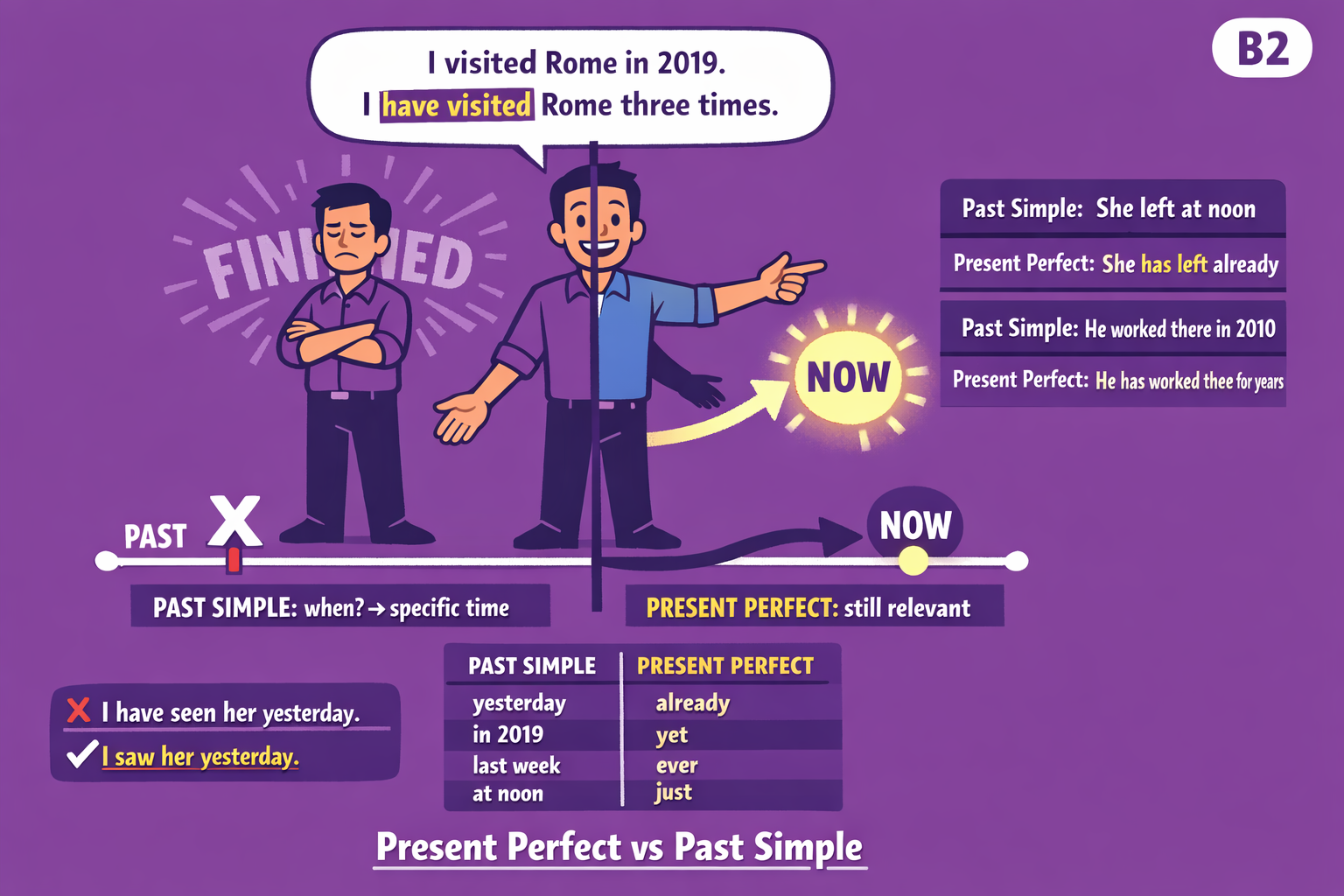
Present Perfect vs Past Simple — the tense choice directly affects
whether for and since are possible; this comparison
resolves the most common confusion at A2 level.

Comments