
Present Perfect vs Past Simple— B2 Grammar Exercises
Published March 14, 2026
Exercise 1 — Multiple Choice
I ______ Jenny since high school, but we only reconnected last year.
He ______ a text message to his boss yesterday morning.
We ______ three museums during our trip to Rome last month.
I ______ to finish my report, so I can finally take a break.
They ______ that movie on TV last night.
She ______ in four different countries since she graduated from college.
I ______ that book last week, and I really enjoyed it.
He ______ his passport, so he can’t board the plane now.
We ______ a decision about our holiday yet.
Jessica ______ her driving test on Friday, and she was so excited.
I ______ from my cousin in Australia recently, so I'm a bit worried.
He ______ at that company for two years before he moved abroad.
They ______ to the summit of Mount Fuji last summer.
Marina ______ in Spain last month, but she already wants to go back.
I ______ this type of cuisine before, so it’s a new experience.
He ______ the results of the exam yet, so he's still nervous.
We ______ two concerts this year, and both were fantastic.
Susan ______ a marathon last week, and she’s already training for the next one.
They ______ to an agreement about their contract issues a few days ago.
I ______ a new language for six months, and I can already hold a conversation.
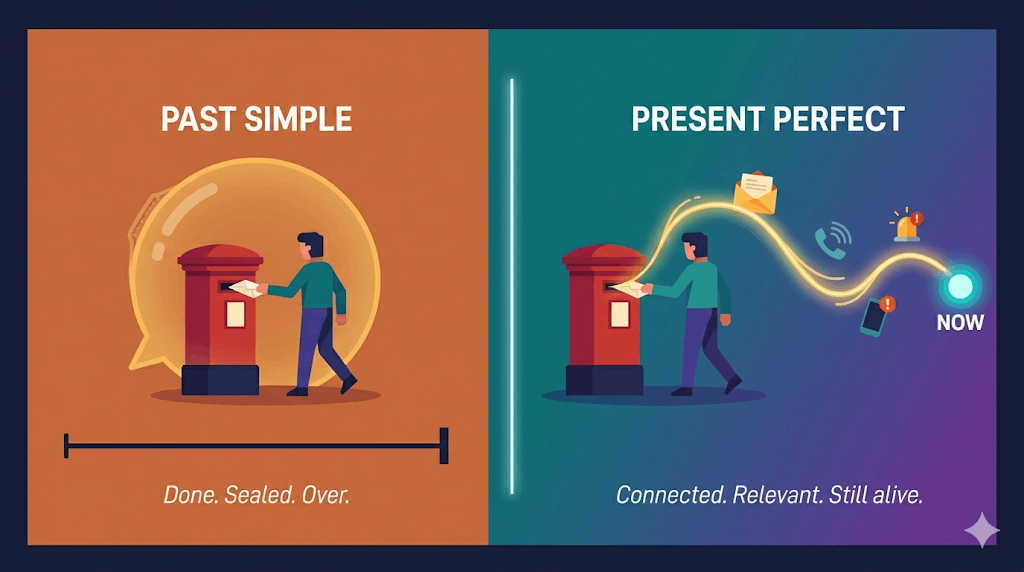
"The team won the contract." and "The team has won the contract." Both are grammatically correct. Both describe the same event. But they frame it differently, and that framing changes what the sentence communicates. The first reports a completed event. The second connects it to the present moment: the contract is ours now, and that matters. At B2 level, the grammar is rarely wrong; the problem is choosing which frame fits the situation.
The Core Distinction
The fundamental difference is about time perspective, not time itself.
- The past simple places an action in closed, finished time. The speaker locates the event in the past and leaves it there.
- The present perfect connects a past action to open, unfinished time — either because the time period is still ongoing, or because the result or relevance is felt now.
Viewing from the present → present perfect
Viewing from the past → past simple
This distinction runs beneath every specific rule. If you understand it, the individual rules become logical rather than arbitrary.
When to Use the Present Perfect
If you need to review the present perfect form before examining its uses, see the present perfect — B1 page.
1. Past action with a present result
The action happened in the past, but its consequence is visible or relevant now. The focus is on the current situation, not the past event itself.
- Someone has broken the window. → It's broken now — we can see it.
- She has just resigned. → She is no longer an employee — that affects us now.
- I have lost my badge. → I can't get in without it — the situation is live.
2. Life experience (indefinite past)
The specific time of the experience is unknown, irrelevant, or deliberately left unspecified. The focus is on whether something has happened at any point up to now.
- Have you ever worked abroad?
- She has never seen the sea.
- The committee has reviewed proposals like this before.
The moment you name a specific time, the past simple takes over: "She never saw the sea until 2019."
3. Unfinished period of time
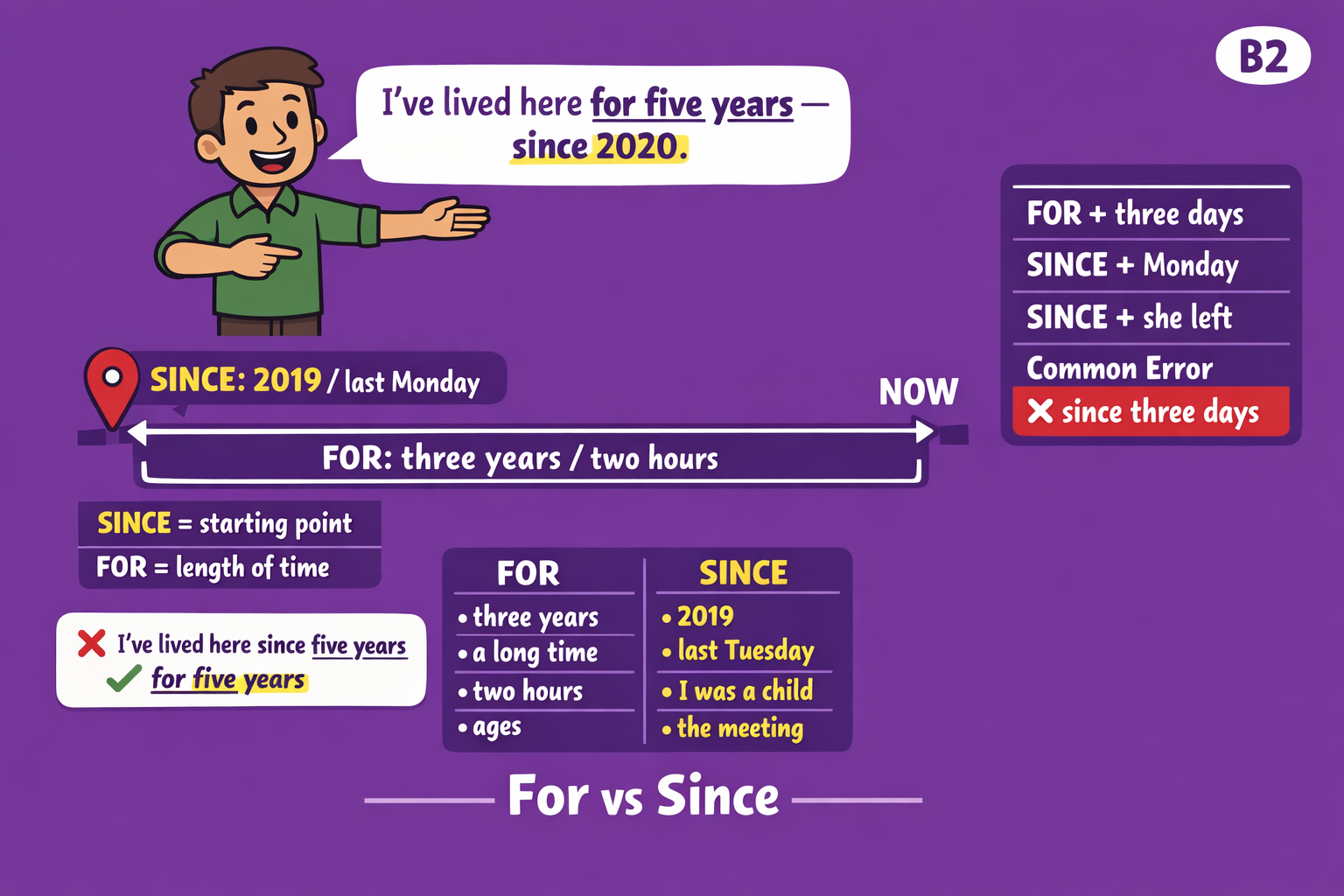
The time period that contains the action is still open — it has not ended yet. This is the use most directly linked to for and since.
- He has worked here for twelve years. → He still works here.
- They haven't updated the policy since March.
- I have lived in this city all my life.
Compare: "He worked here for twelve years." — same duration, but now he's gone. The past simple closes the period.
4. Recent events in an unfinished time frame
When the time frame is still ongoing — today, this week, this year — English typically uses the present perfect. The day, week, or year is not over.
- Sales have increased this quarter.
- I have read three reports today.
- The government has announced two new policies this month.
When to Use the Past Simple
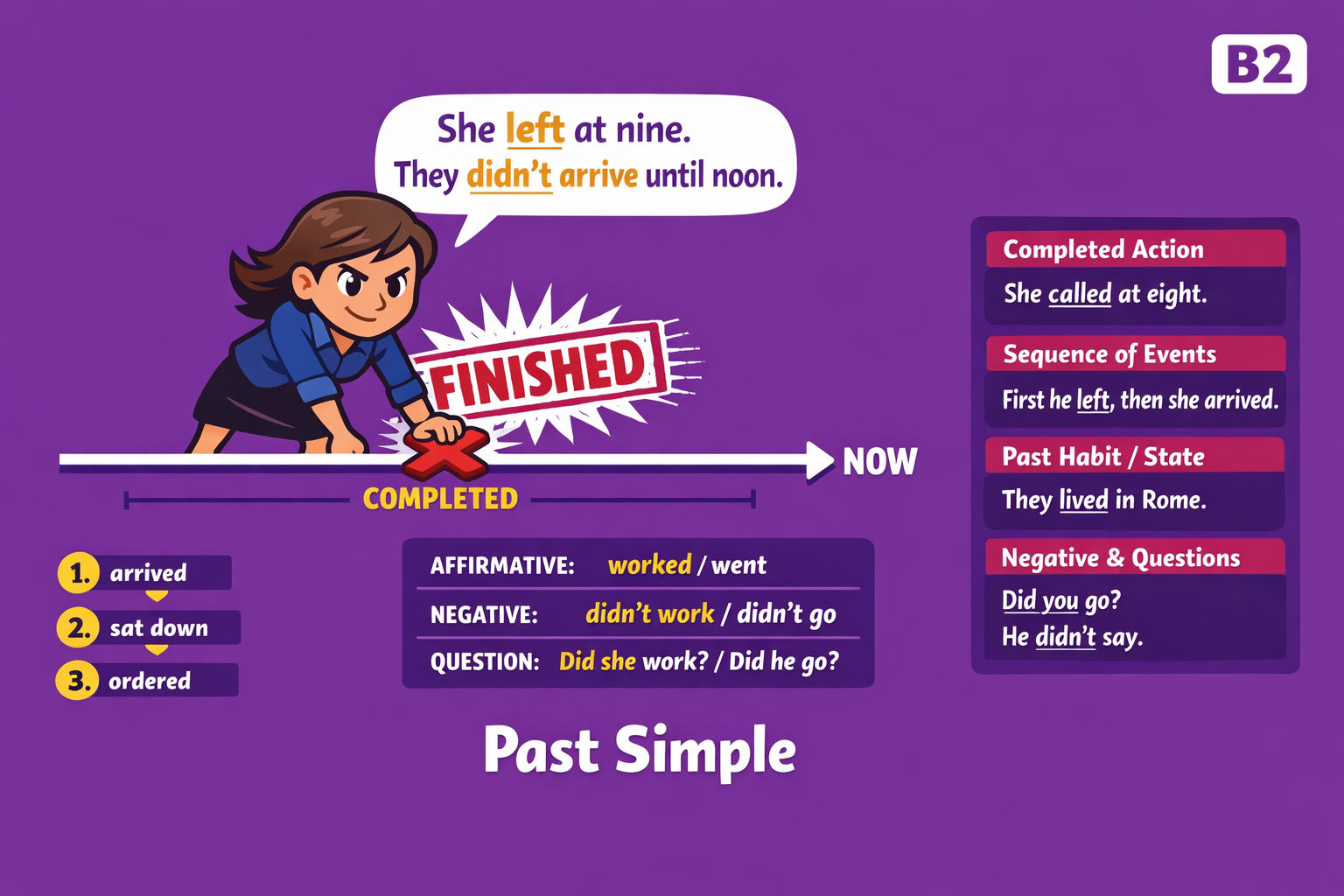
1. Completed action at a specific past time
Any stated past time reference — whether explicit or implied — anchors the action in closed time and requires the past simple. This is the most reliable trigger.
- She called at 9 a.m.
- The company was founded in 1987.
- I saw him last Tuesday.
2. Finished time period
When the time period that contained the action is over — last year, when I was a student, during the conference — the past simple is required, regardless of how recent the event is.
- She worked here for twelve years. → She no longer does.
- During the pandemic, demand fell sharply.
- When I was at university, I studied four languages.
3. Sequence of narrative events
When recounting a story or sequence in the past, the past simple carries the narrative forward. Each event is a discrete completed step. The present perfect cannot sustain a narrative chain.
- She arrived at the office, checked her messages, and called the client immediately.
- The merger was announced in January, went to regulatory review in March, and closed in August.
For the way past habits and repeated past actions interact with this, see used to and would for past habits.
Signal Words
| Present Perfect | Past Simple |
|---|---|
| just · already · yet · still (negative) | yesterday · last week / month / year |
| ever · never · so far · up to now | ago · in 2019 · at that time |
| since [point] · for [period, if ongoing] | when… · once · then · at that moment |
| this morning / week / year (if still current) | this morning / week / year (if the period is over) |
| recently · lately | for [period, if finished] |
Head-to-Head Comparison
| Present Perfect | Past Simple |
|---|---|
| She has left the company. (she's gone — affects us now) | She left the company. (reporting a past fact) |
| I have lost my keys. (I can't get in — current problem) | I lost my keys. (it happened — possibly resolved) |
| He has worked here for ten years. (still works here) | He worked here for ten years. (no longer does) |
| Have you read this report? (at any point — experience) | Did you read it last night? (specific finished time) |
| Sales have risen this year. (year still ongoing) | Sales rose last year. (year finished) |
| The CEO has announced a restructure. (news, relevance now) | The CEO announced the restructure on Monday. (specific time named) |
Common Mistakes
| Wrong | Correct | Why |
|---|---|---|
| I have seen him yesterday. | I saw him yesterday. | Yesterday is a closed, specific past time. It forces the past simple. |
| I didn't speak to her since March. | I haven't spoken to her since March. | Since marks an unfinished period extending to now. Use the present perfect. |
| She has worked here when she was young. | She worked here when she was young. | When she was young is a finished past time frame. Past simple required. |
| First I have arrived, then I have called the office. | First I arrived, then I called the office. | Sequential narrative uses the past simple throughout. The present perfect cannot chain events. |
| Did you ever try this? (formal British context) | Have you ever tried this? | Life experience questions use the present perfect in standard British and international English. |
| Look — someone ate my lunch. | Look — someone has eaten my lunch. | The evidence is in front of you now. Present consequence → present perfect. |
| I lived here for 20 years. (meaning: still do) | I have lived here for 20 years. | The past simple implies the period is over. If you still live there, use the present perfect. |
Quick Summary
- Use the present perfect when the time is open, the result is felt now, or the experience is unspecified.
- Use the past simple when a specific time is stated, the time period is over, or you are telling a story.
- Since, ever, never, yet, already, just, and so far almost always signal the present perfect.
- Yesterday, ago, last…, in [year], and when… almost always signal the past simple.
- If the action is still ongoing — "I've worked here for six years" (still here) — use the present perfect. If it is finished — "I worked there for six years" (left) — use the past simple.
- Note For actions that are recent but part of an ongoing process (reading, studying, building), the present perfect continuous may be a stronger choice: "I've been reading the report all morning."
Frequently Asked Questions
What is the main difference between present perfect and past simple?
The past simple places an action in finished, closed time — often with a stated time reference. The present perfect connects a past action to the present moment, either because the result is still relevant, the time period is still open, or the experience is unspecified. The question to ask yourself is: am I reporting a past event, or describing its present relevance?
Can I use "yesterday" with the present perfect?
No. Yesterday names a specific, finished past time, which forces the past simple: "I saw him yesterday" — not "I have seen him yesterday." Any specific past time reference (last week, in 2020, at 3 p.m.) requires the past simple.
When do I use "since" with present perfect vs past simple?
Since used to mark a starting point of a period that extends to now takes the present perfect: "I haven't eaten since this morning." The past simple with since is a common learner error. For a full treatment of for and since, see the for vs since page.
Why do news headlines use the present perfect?
Headlines treat recent events as still relevant to the reader right now — the announcement, discovery, or decision has just entered public awareness. As soon as an article gives a specific time ("The company announced on Tuesday that…"), the past simple takes over.
Is it ever correct to say "Did you ever try…?"
In American English, yes — the past simple is commonly used for life experience questions where British English uses the present perfect. In formal international contexts and British English, "Have you ever tried…?" is the standard form. Neither is wrong; the register and variety determine the choice.
How do I know whether to use present perfect or present perfect continuous?
Use the present perfect ("I've written the report") when the action is complete and the result matters. Use the present perfect continuous ("I've been writing the report") when the focus is on the ongoing activity or how long it has been happening, and the action may not be finished. Both connect a past action to the present — the distinction is completeness vs duration.
Related Topics
- Present perfect B1 — the form and core uses, before the contrast with past simple.
- For vs since B2 — essential for getting unfinished time expressions right.
- Present perfect continuous B1 — the third tense in this family, focusing on duration and ongoing activity.
- Used to and would for past habits B1 — how to express repeated past actions that have now stopped.

Comments