
Articles: A, An, The— A1 Grammar Exercises
Published March 14, 2026
Exercise 1 — Multiple Choice
I saw ____ elephant at the zoo.
She wants to be ____ artist when she grows up.
Can you pass me ____ salt, please?
I need ____ book that you borrowed.
There is ____ apple on the table.
I have ____ idea for the project.
We saw ____ movie last night.
Do you have ____ umbrella I can borrow?
She is ____ best student in the class.
I want to eat ____ orange.
You want a coffee. The waiter brings it. You say, "The coffee is cold." Not "A coffee is cold." That one small word — a or the — changes the whole meaning. Articles tell the listener which thing you mean.
A or An?
Use an before a vowel sound. Use a before a consonant sound. The spelling matters less than the sound.
| Vowel sound → an | Consonant sound → a |
|---|---|
| an apple | a banana |
| an umbrella | a car |
| an hour (silent h) | a university (yoo sound) |
| an old man | a new book |
When to Use A / An
One thing — not a specific one
Use a/an when you mean one of many. You are not saying which one.
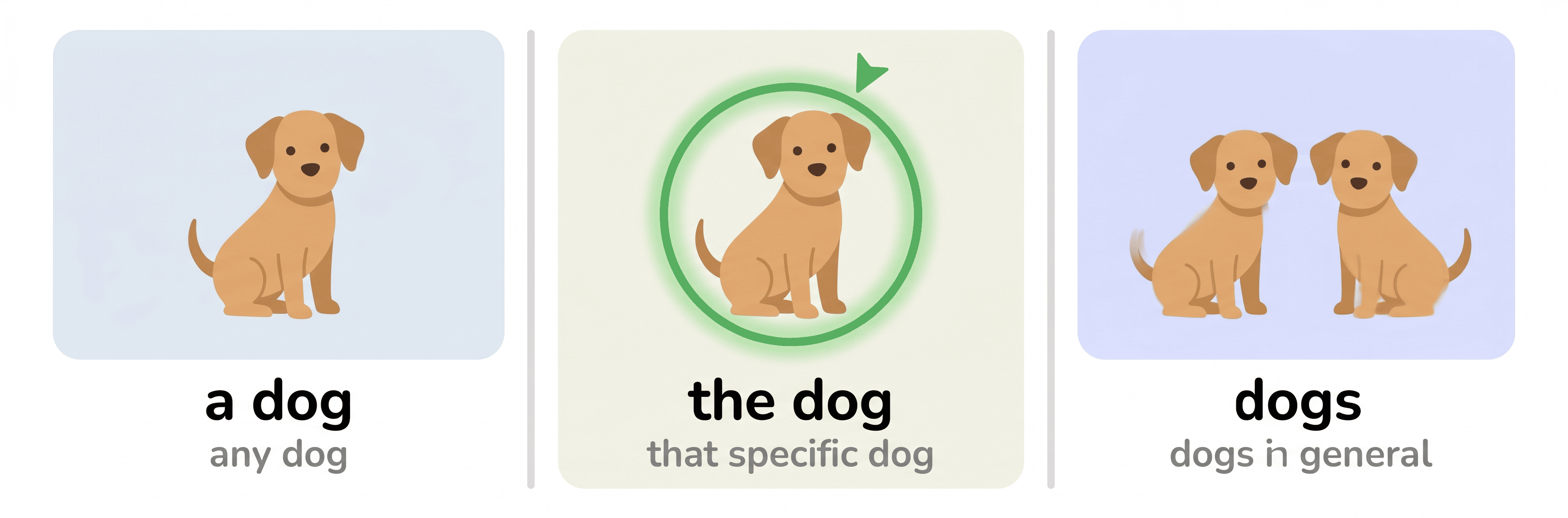
I saw a dog in the park. (Some dog. Any dog.)
She has an umbrella. (One umbrella. Not a specific one.)
First mention
Use a/an the first time you talk about something. After that, use the.
I ordered a coffee. The coffee was cold. (First: a. Second: the — now we know which coffee.)
Jobs and roles
Use a/an to say what someone's job is. See verb to be for the full pattern.
My mother is a doctor.
He is an engineer.
When to Use The
Both speaker and listener know which one
Use the when there is only one thing you can mean. You already know the coffee — it's the one in front of you. Same rule everywhere.
Please close the door. (There is one door in this room.)
The sun is hot today. (There is only one sun.)
Mentioned before
Use the after the first mention. You ordered a coffee. Now it's the coffee — you both know which one.
I have a cat. The cat sleeps all day.
She ordered a pizza. The pizza was delicious.
Unique things
Use the with things that exist only once.
The moon is full tonight.
He is the president of the company.
When to Use No Article
Do not use a/an or the when you talk about things in general. This applies to plural nouns and uncountable nouns (things you cannot count, like water, music, information).
Dogs are friendly. (All dogs in general.)
I like coffee. (Coffee in general — not one specific cup.)
Children need sleep. (All children.)
For more on countable and uncountable nouns, see countable and uncountable nouns.
Meals
No article with the names of meals.
We have breakfast at 7.
What did you eat for lunch?
Institutions used for their purpose
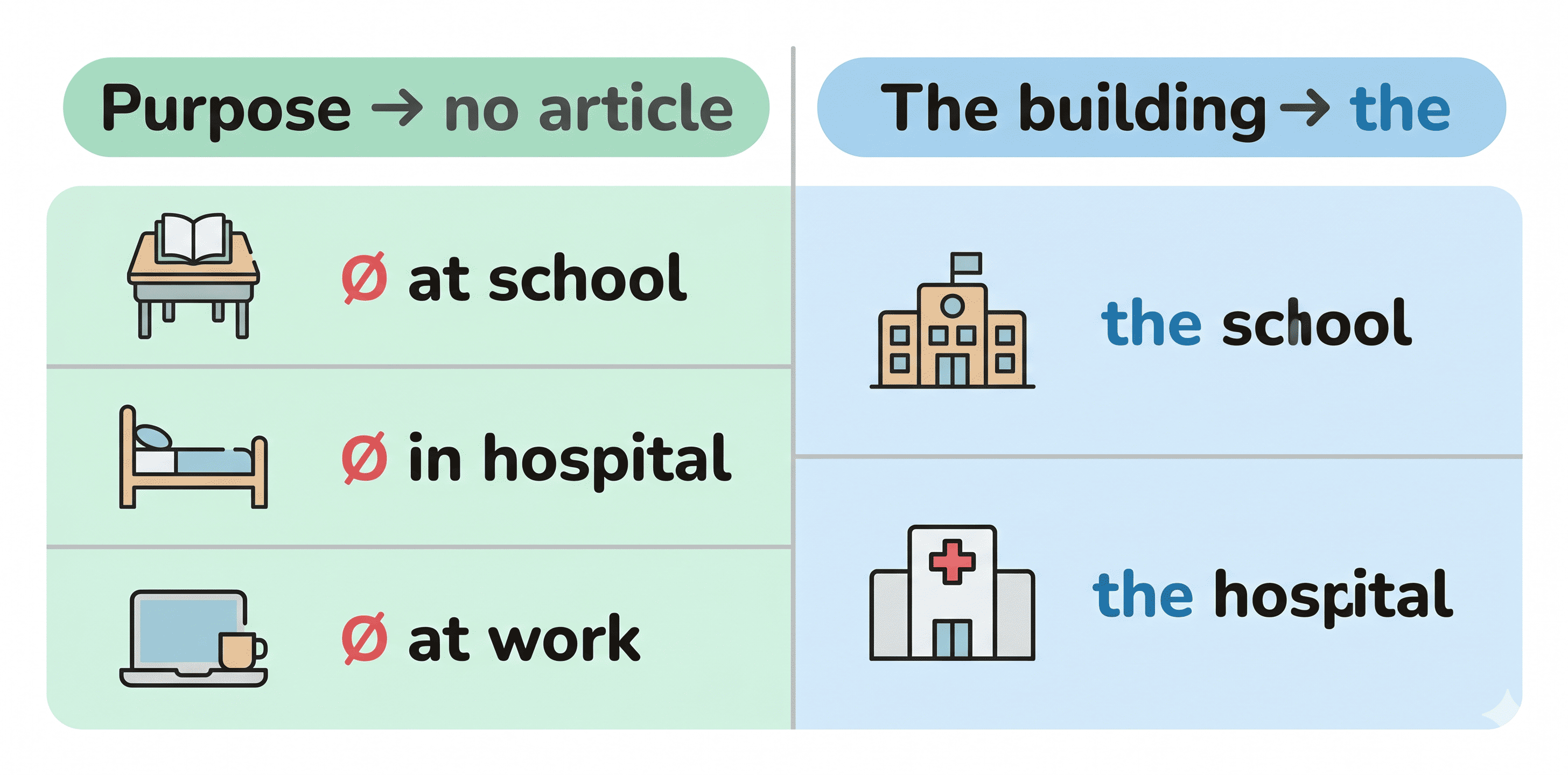
Some nouns — school, hospital, prison — take no article when you refer to why someone is there, not the building itself.
| Purpose (no article) | The building (use the) |
|---|---|
| She is at school. (studying) | He drove past the school. (the building) |
| My father is in hospital. (as a patient) | I walked to the hospital. (the building) |
The same idea applies to work: She goes to work by bus — no article, because you mean the activity, not a specific building.
Common Mistakes
| Incorrect | Correct | Why |
|---|---|---|
| I am an student. | I am a student. | Student starts with a consonant sound — use a, not an. |
| She is engineer. | She is an engineer. | Jobs need a/an. |
| I like the music. (meaning music in general) | I like music. | General meaning — no article. |
| Close a door, please. | Close the door, please. | Both people know which door. |
| I go to the school every day. | I go to school every day. | You go to study — purpose, not the building. No article. |
| I want an information. | I want some information. | Information is uncountable — no a/an. |
Quick Summary
- Use a/an for one thing (not a specific one), for jobs, and for the first mention.
- Use an before a vowel sound: an apple, an hour.
- Use the when both speaker and listener know which thing is meant.
- Use the for unique things: the sun, the moon.
- Use no article for general statements: plural nouns (dogs, books) and uncountable nouns (music, water).
- Use no article with meals (breakfast, lunch) and with institutions used for their purpose (at school, in hospital).
- Watch out: don't use a/an with uncountable nouns — not an information, but some information.
Frequently Asked Questions
When do you use "a" vs "the" in English?
Use a when you mean one of many things and you are not saying which one. Use the when both you and the listener know exactly which thing you mean. "I saw a dog" — any dog. "I saw the dog" — a specific dog you both know about.
Why is it "an hour" but "a university"?
The rule is about sound, not spelling. Hour begins with a silent h, so the first sound is a vowel: an hour. University begins with a y sound (a consonant sound), so use a university. Always listen to the first sound, not the first letter.
Do you say "a" or "the" before a job title?
Use a/an when you say what someone's job is: She is a teacher. Use the only when you refer to a specific, unique role: She is the head teacher of this school.
When do you use no article in English?
Use no article when you talk about something in general — with plural nouns (Dogs are friendly), uncountable nouns (I like music), meals (We have dinner at 7), and institutions used for their purpose (She is at school).
What is the difference between "I like music" and "I like the music"?
I like music means music in general — all music, as a concept. I like the music means a specific piece of music — for example, the song playing right now. No article = general. The = specific.
Can you use "a" with uncountable nouns?
No — uncountable nouns like water, advice, and information never take a/an. Use some instead: some water, some advice, some information. A/an is only for singular countable nouns — things you can count one by one.
Related Topics
- Singular and plural nouns — knowing whether a noun is singular or plural is the first step to choosing the right article.
- Quantifiers: some, any, a lot of — the next step after articles. Some and any often replace a/an with uncountable nouns and plurals.
- Verb to be: am, is, are — articles appear constantly in to be sentences: She is a teacher. It is the best hotel.
- Countable and uncountable nouns — the zero-article rule only makes full sense once you know which nouns are uncountable.
Comments