
Defining Relative Clauses— B1 Grammar Exercises
Published March 14, 2026
Exercise 1 — Multiple Choice
The book ____ I borrowed from you is fascinating.
The teacher ____ helped me with my homework is very kind.
The car ____ I bought last year is already having problems.
The movie ____ we watched last night was thrilling.
The students ____ passed the exam were very happy.
The laptop ____ I use for work is very fast.
The artist ____ painted this mural is very talented.
The book ____ you recommended was excellent.
The teacher ____ I admire the most is retiring.
The phone ____ I lost was brand new.
A defining relative clause identifies exactly which person, thing, or place you mean. You say the woman and someone asks: which woman? You answer: the woman who works in the café. The highlighted part is the defining relative clause — it removes all ambiguity. Without it, the sentence is unclear. With it, there is no confusion.
The four relative pronouns
The relative pronoun you use depends on what the clause is describing.
| Pronoun | Use for | Example |
|---|---|---|
| who | People | The teacher who helped me was very kind. |
| which | Things and animals | The bag which is on the chair is mine. |
| that | People or things | The film that we watched was boring. |
| where | Places | The café where I study is very quiet. |
Structure
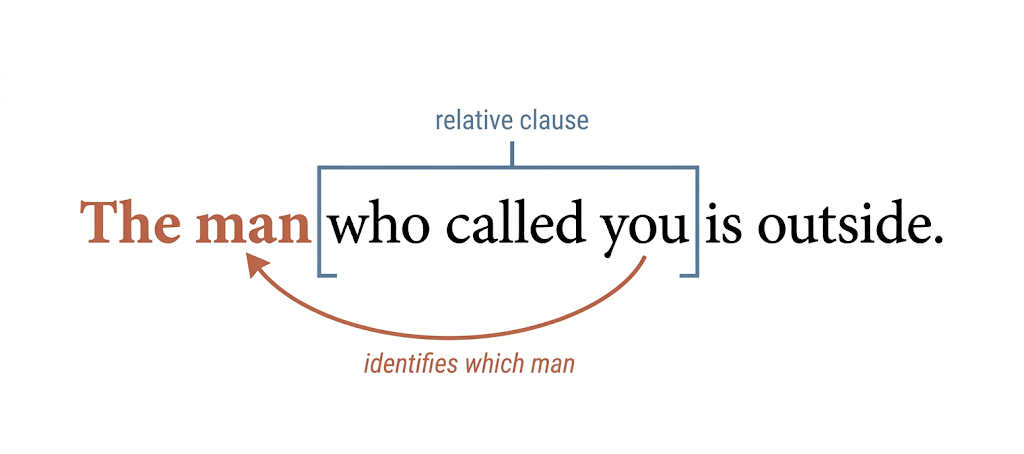
The relative clause usually comes directly after the noun it describes. Avoid placing it far away from its noun, especially across a verb — this can make the sentence confusing or ungrammatical.
The man who called you is outside. — clause follows man directly.
The man is outside who called you. — the clause has moved away from its noun.
Who — for people
Use who when the noun is a person.
- The doctor who treated me was very experienced.
- Do you know the boy who lives next door?
- I have a friend who speaks four languages.
- The woman who called this morning left a message.
Which — for things and animals
Use which when the noun is a thing or an animal.
- The phone which I bought last week is already broken.
- That's the dog which bit the postman.
- The report which she wrote was excellent.
- The shop which opened last month sells second-hand books.
That — for people or things
That can replace both who and which. In everyday speech and informal writing, that is very common.
- The woman that served us was friendly. (= who served us)
- The car that broke down is at the garage. (= which broke down)
- Is he the man that you met at the conference? (= who you met)
Where — for places
Use where when the noun is a place and the verb in the clause does not take a direct object — you live in a city, you stay in a hotel. When the place is the direct object of the verb (you visit a city, you love a city), use which or that instead. This distinction is explained fully in the callout below the common mistakes table.
- That's the school where I studied as a child.
- I want to live in a city where the weather is warm.
- The hotel where we stayed was very expensive.
- This is the room where the meeting takes place.
Leaving out the relative pronoun
You can leave out who, which, or that when it is the object of the relative clause — that is, when the clause already has its own subject.
- The film that we watched was boring. → The film we watched was boring. ✓
- The bag which I bought is too small. → The bag I bought is too small. ✓
You cannot leave out the pronoun when it is the subject of the clause — that is, when there is no other subject in the clause:
The man called you is outside. — who is the subject; it cannot be removed.
The man who called you is outside. ✓
The shop sells books closed last year. — which is the subject; it cannot be removed.
The shop which sells books closed last year. ✓
Common mistakes
| Wrong | Correct | Why |
|---|---|---|
| The woman which helped me was kind. | The woman who helped me was kind. | Use who for people, not which. |
| The phone who I bought is broken. | The phone which I bought is broken. | Use which or that for things, not who. |
| The city where I visited was beautiful. | The city which I visited was beautiful. | Where means in which. You visit a city, not in a city. Use which or that here. |
| The hotel that we stayed was very nice. | The hotel where we stayed was very nice. | Use where when the place is not the direct object of the verb — you stay in the hotel, not the hotel. Use which or that when the place is the direct object. |
| She is the teacher. She helped me. | She is the teacher who helped me. | Two short sentences describing the same noun can be joined with a relative clause. |
Quick summary
- A defining relative clause tells you which person, thing, or place. It comes directly after the noun.
- Use who for people, which for things, where for places.
- That can replace who or which in most situations.
- You can leave out who / which / that when it is the object of the clause — but not when it is the subject.
- Never use which for people or who for things.
Frequently asked questions
What is a defining relative clause?
A defining relative clause is a part of a sentence that identifies exactly which person, thing, or place you are talking about. It comes directly after the noun it describes and is essential to the meaning — if you remove it, the sentence becomes unclear or loses its specific meaning. For example, in The woman who called is waiting, the clause who called tells you which woman. Without it, you would just say The woman is waiting — and no one knows which woman you mean.
Can I use that instead of who?
Yes, in most cases you can. That works for both people and things in defining relative clauses. The man that called and the man who called are both correct. In everyday speech, that is very common. In formal writing, who is preferred for people and which is preferred for things.
When can I leave out the relative pronoun?
You can leave out who, which, or that only when it is the object of the relative clause — that is, when the clause has its own subject. The film we watched (= the film that we watched) is correct because we is the subject of the clause. You cannot leave out the pronoun when it is the subject of the clause: The man who called cannot become The man called without changing the meaning entirely.
What is the difference between where and which for places?
Use where when the place is not the direct object of the verb — you live in a city, stay in a hotel, work in an office. Use which or that when the place is the direct object of the verb — you visit a city, love a city, see a place. So: the city where I live ✓ but the city which I visited ✓ (not the city where I visited).
What is the difference between who and which?
Who is for people only. Which is for things and animals. The most common mistake is using which for a person or who for a thing. If you are not sure whether to use who or which, ask yourself: is the noun a person? If yes, use who. If no, use which. Or use that, which works for both.
What is the difference between a defining and a non-defining relative clause?
A defining relative clause identifies which specific person, thing, or place you mean — it is essential to the sentence. A non-defining relative clause adds extra information about a noun that is already clearly identified — it is not essential and is separated by commas. Compare: The student who passed is celebrating (defining — tells you which student) vs Maria, who passed, is celebrating (non-defining — Maria is already identified; the clause just adds information). Non-defining relative clauses are covered at B1 level.
Related topics
- Defining relative clauses (B1) — the next level adds whose, whom, and object-position omission in more complex sentences.
- Advanced relative clauses (C1) — reduced relative clauses, whereby, and structures used in formal writing.
- Possessive pronouns — when you need to show that something belongs to the person in the relative clause, you will need whose at B1 level. Review possessive pronouns first.
Comments