
First Conditional— B1 Grammar Exercises
Published March 14, 2026
Exercise 1 — Multiple Choice
If it rains, I will ____ my umbrella.
If it rains, we will ____ inside.
If it rains, she will ____ a taxi.
If it rains, they will ____ the game.
If it rains, I will ____ my plans.
If it rains, he will ____ home early.
If it rains, we will ____ a movie.
If it rains, she will ____ her friends.
If it rains, I will ____ my homework.
If it rains, they will ____ the picnic.
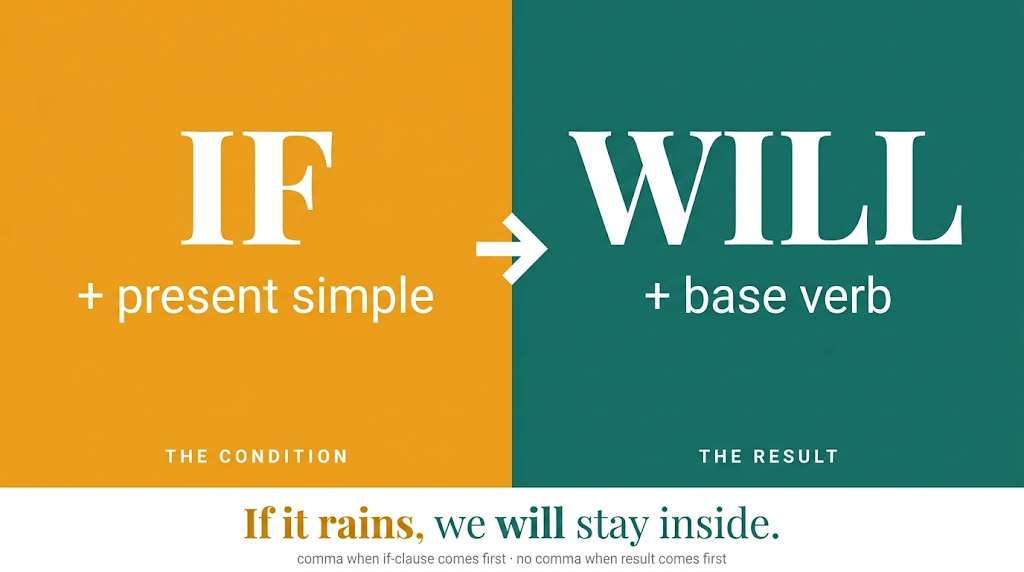
The first conditional expresses a real, possible situation in the future and its likely result. If the condition happens, the result will follow. If it rains, we will stay inside. The rain is possible. Staying inside is the result if it happens.
Form
The first conditional has two parts: the if-clause (the condition) and the result clause. They can come in either order.
If + subject + present simple , subject + will + base infinitive
Subject + will + base infinitive + if + subject + present simple
| Form | If-clause | Result clause |
|---|---|---|
| Positive | If it rains | we will stay inside. |
| Negative if-clause | If she doesn't hurry | she will miss the bus. |
| Negative result | If you study | you won't fail the exam. |
| Question | If I call you | will you answer? |
Real future possibilities
The speaker believes the condition is possible — not certain, but realistic.
- If the weather is nice, we will have lunch outside.
- If he arrives on time, we will start the meeting.
- She will help you if you ask her.
- If you are hungry, I will make something to eat.
Warnings
The first conditional is very common for warnings — when the condition leads to a negative consequence.
- If you touch that, you will burn yourself.
- You will get sick if you don't wear a coat.
- If she doesn't apologise, he won't speak to her again.
- If you don't pay the bill, they will cut the electricity.
Promises and offers
The first conditional is also used to make promises or offers that depend on a condition.
- If you help me now, I will help you later.
- I will carry your bag if it's too heavy.
- If you come to the party, it will be much more fun.
Other modals in the result clause
Will is the most common modal in the result clause, but can and might also work and change the meaning slightly. These are all covered on the modal verbs page.
| Modal | Meaning | Example |
|---|---|---|
| will | Certain result | If you study, you will pass. |
| can | Possibility or permission | If you finish early, you can leave. |
| might | Less certain result | If we hurry, we might catch the train. |
Signal words
| Signal word | Meaning | Example |
|---|---|---|
| if | Introduces the condition | If I see her, I will tell her. |
| unless | = if … not | Unless you hurry, we will be late. |
| when | Certain future event | When she arrives, we will eat. |
Common mistakes
| Wrong | Correct | Why |
|---|---|---|
| If it will rain, we will stay inside. | If it rains, we will stay inside. | The if-clause uses present simple, not will. Never use will after if. |
| If you don't hurry, you miss the bus. | If you don't hurry, you will miss the bus. | The result clause needs will to show a future consequence. |
| Unless you don't come, I will go alone. | Unless you come, I will go alone. | Unless already means if … not. Adding don't reverses the meaning. |
| If it rains, we stayed inside. | If it rains, we will stay inside. | The result clause is future, so it needs will — not past simple. |
| If, I see him I will tell you. | If I see him, I will tell you. | No comma after if. The comma goes after the whole if-clause. |
First conditional vs second conditional
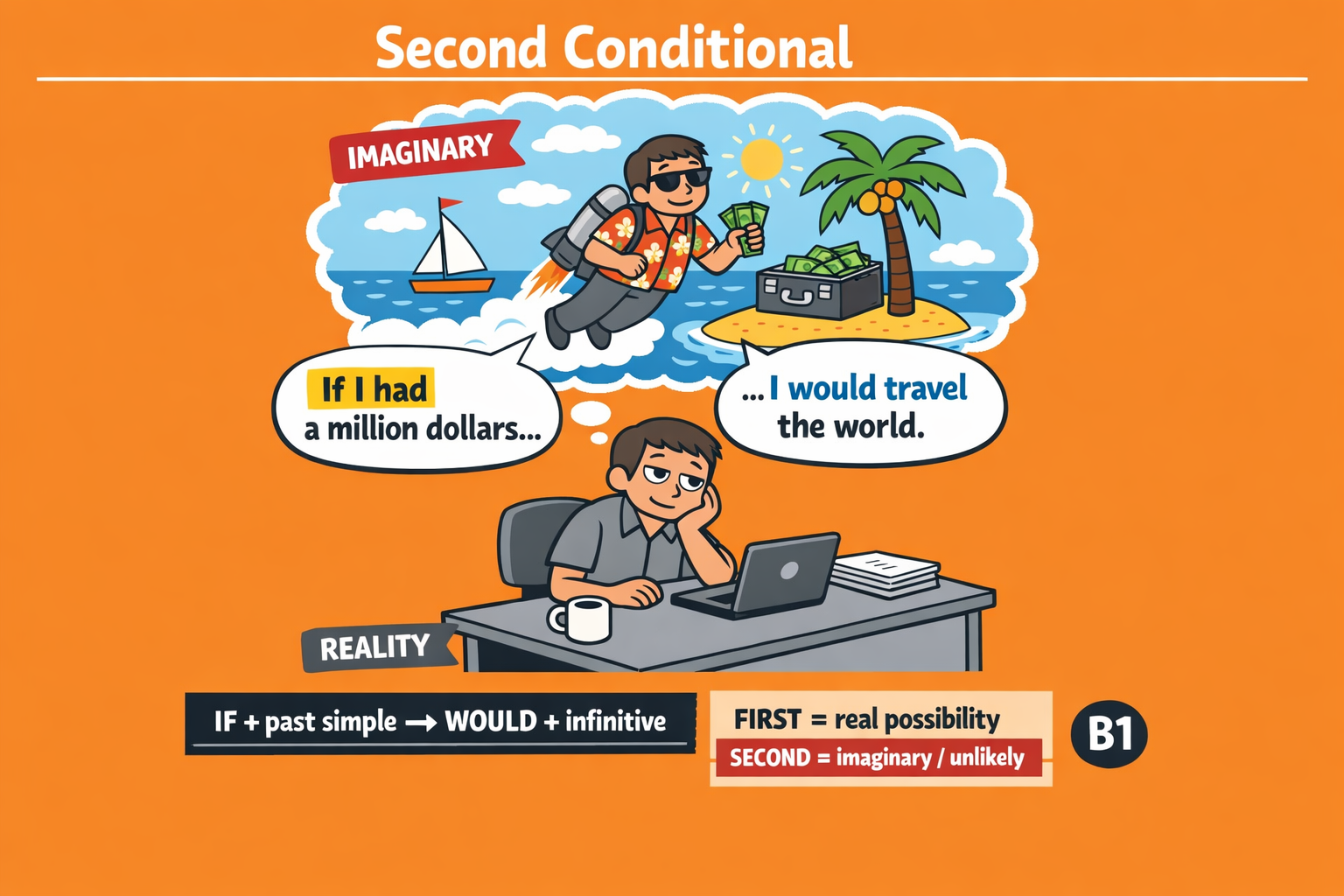
The first conditional is for real, possible situations. The second conditional is for imaginary or unlikely situations. The difference is about how real the speaker thinks the condition is — not just grammar.
| First conditional | Second conditional | |
|---|---|---|
| Situation | Possible, realistic | Imaginary, unlikely |
| If-clause | present simple | past simple |
| Result clause | will + base verb | would + base verb |
| Example |
If I see her, I will tell her.
(I might see her.) |
If I saw her, I would tell her.
(I probably won't see her.) |
Quick summary
- The first conditional is for real, possible future situations and their likely result.
- If-clause: present simple. Result clause: will + base verb.
- Never use will after if in the condition clause.
- Comma after the if-clause when it comes first. No comma when the result clause comes first.
- Unless = if … not. Never add a second negative after it.
- When replaces if when the future event is certain, not just possible.
Frequently asked questions
What is the first conditional?
The first conditional is a sentence structure used to talk about a real, possible future situation and what will happen as a result. It has two parts: an if-clause in the present simple and a result clause with will + base verb. For example: If it rains, we will cancel the trip. The rain is possible; cancelling is the result if it happens. You can review all conditional types on the conditionals page.
Why do we use present simple after if?
In English, the verb after if in a conditional sentence does not use will, even though the meaning is future. This is a fixed rule. The present simple in the if-clause represents a future condition, not a present fact. So you say If it rains, not If it will rain. The will belongs in the result clause only.
Can the result clause come before the if-clause?
Yes. Both orders are correct and mean the same thing. If you study, you will pass = You will pass if you study. The only difference is punctuation: when the if-clause comes first, put a comma after it. When the result clause comes first, no comma is needed.
What is the difference between if and when?
If introduces a condition that may or may not happen — the speaker is not certain. When is used for a future event the speaker is certain will happen. If she calls, I will answer (she might not call) versus When she calls, I will answer (she will definitely call). Both use the present simple in their clause and will in the result clause.
What does unless mean?
Unless means if … not. Unless you hurry, we will be late = If you don't hurry, we will be late. Because unless already contains the negation, never add not or don't after it. Unless you don't hurry is wrong. Unless you hurry is correct.
What is the difference between the first and second conditional?
The first conditional is for real and possible situations: If it rains, I will take an umbrella. The second conditional is for imaginary or very unlikely situations: If I were rich, I would travel the world. The grammar changes too: first conditional uses present simple + will; second conditional uses past simple + would.
Related topics
- First conditional (B1) — extends this structure with future time clauses using when, as soon as, before and after.
- Second conditional — for imaginary and unlikely situations: If I had more time, I would learn to paint.
- Will for predictions and offers — the result clause of a first conditional uses will. Review how will works in other future contexts.
Comments