
Advanced passive structures— B2 Grammar Exercises
Published March 25, 2026
Exercise 1 — Gap Fill Select
The new policy by the government last week.
By next year, the project completed by the team.
The documents before the meeting starts.
The report by the experts at the moment.
The invitations when I arrived.
The new software to all employees by the end of the month.
The emails by the assistant before the manager arrived.
The contract by the legal team before signing.
The presentations at the conference every year.
The feedback carefully before making any decisions.
What makes a passive structure "advanced"?
You already know the basic passive: subject + be + past participle. At B2 level, English uses several other passive patterns that feel more natural to native speakers — especially in formal writing, journalism, and academic English. This page covers five of those patterns.
Each section explains the structure, shows you when to use it, and gives realistic examples. A common mistakes table and FAQ are at the end.
1. Passive with reporting verbs
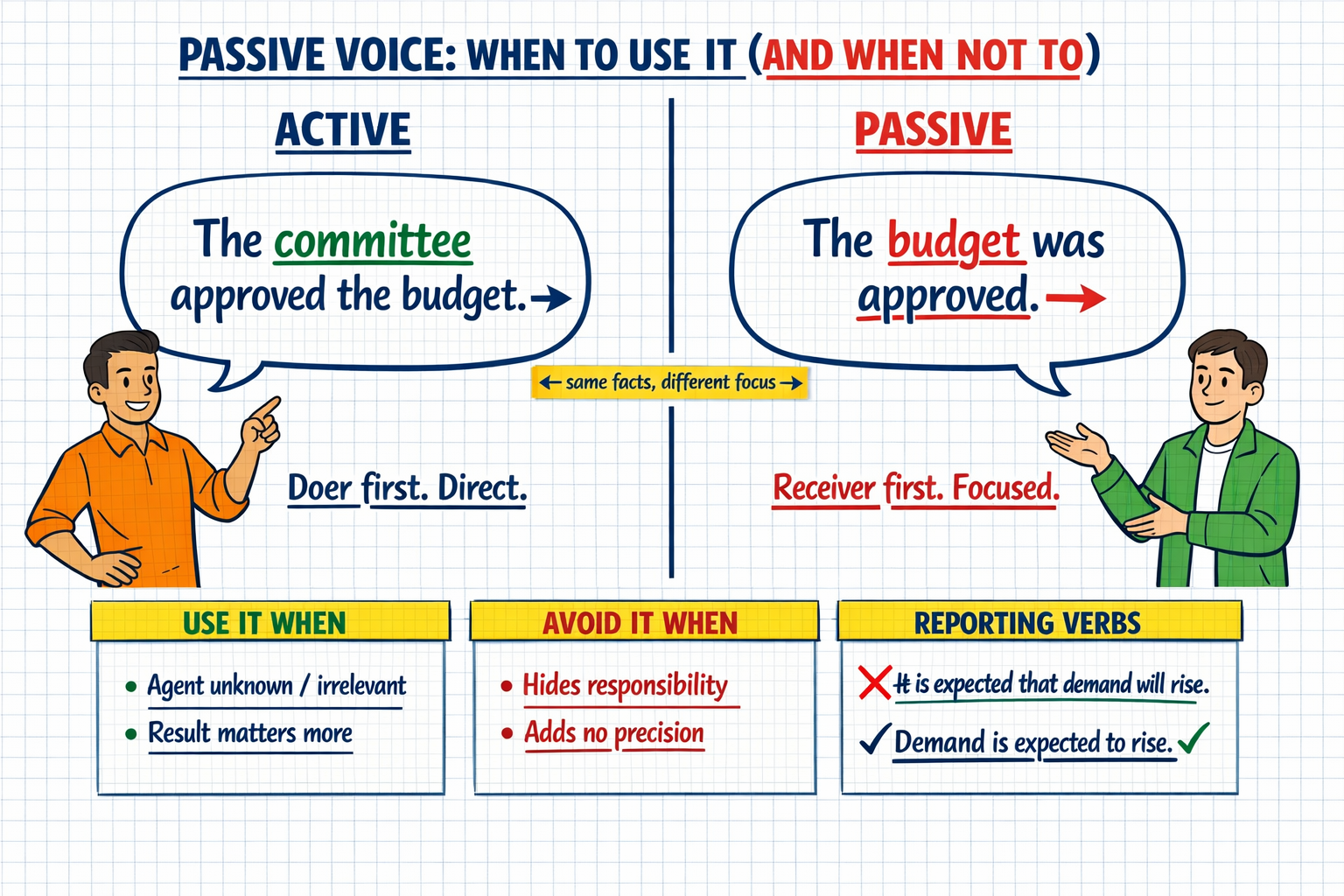
This pattern is everywhere in news articles, academic writing, and formal reports. It lets you report what people believe, say, or claim without naming a specific source.
There are two forms. Both mean the same thing.
Form A — impersonal "it" structure
| Reporting verb | Example (Form A) |
|---|---|
| say | It is said that coffee increases focus. |
| believe | It was believed that the earth was flat. |
| report | It has been reported that prices will rise. |
| think | It is thought that the fire was accidental. |
| claim | It is claimed that the drug has no side effects. |
| know | It is known that stress affects sleep quality. |
Form B — personal passive structure
Take the subject of the that-clause and move it to the front. Use this form when the subject is a person and the context is formal or journalistic — Form B sounds more natural in those registers.
| Form A | Form B (preferred in formal/journalistic English) |
|---|---|
| It is said that she earns over a million a year. | She is said to earn over a million a year. |
| It is believed that the suspect fled the country. | The suspect is believed to have fled the country. |
| It was reported that two people were injured. | Two people were reported to have been injured. |
| It is thought that the building dates back to 1780. | The building is thought to date back to 1780. |
When the reported action happened before the reporting, use to have + past participle.
When the reported action is happening at the same time, use to be + -ing or the plain infinitive.
The suspect is believed to have fled the country. (fled = earlier than now)
She is reported to be living abroad. (living = happening now)
Some reporting verbs cannot be used in the personal passive (Form B). These include suggest, argue, and announce.
✅ It has been suggested that the policy should change.
❌ The policy has been suggested to change. — this does not work in English.
A safe rule: if you are unsure, use Form A. It always works.
2. Passive infinitive structures
Passive infinitives appear after modal verbs, adjectives, and certain verbs. The form is always to be + past participle. Use the perfect version when the action was already completed.
to have been + past participle (perfect — action already complete)
not to be + past participle (negative form)
| Context | Example |
|---|---|
| After a modal verb | The report needs to be submitted by Friday. |
| After want, expect, hope | The director wants the script to be rewritten. |
| After adjectives like happy, proud, lucky | She was happy to be chosen for the role. |
| Perfect passive infinitive (past action) | He claims to have been wrongly dismissed. |
| Perfect passive infinitive (past action) | The funds appear to have been transferred overnight. |
| Negative passive infinitive | The witness asked not to be identified in the report. |
| Negative perfect passive infinitive | She was upset not to have been notified about the change. |
3. Passive with modal verbs
You can combine any modal verb with a passive infinitive. The structure changes depending on whether you are talking about the present/future or the past.
Past: modal + have been + past participle
| Modal | Present/future passive | Past passive |
|---|---|---|
| must | Passports must be checked at the border. | The data must have been deleted by accident. |
| should | The contract should be signed today. | He should have been told earlier. |
| could | The deadline could be extended. | The mistake could have been avoided. |
| might | Your application might be rejected. | The file might have been corrupted. |
| will | The results will be announced on Monday. | — |
4. The causative: have/get something done
Use this structure when you arrange for someone else to do something for you. You are not doing the action yourself — you organise it or pay for it.
get + object + past participle (more informal — same meaning)
| Tense | Have causative | Get causative |
|---|---|---|
| Present simple | She has her nails done every Friday. | She gets her nails done every Friday. |
| Past simple | We had the roof repaired last month. | We got the roof repaired last month. |
| Present perfect | Have you had your eyes tested recently? | Have you got your eyes tested recently? |
| Future (will) | I'll have the documents translated. | I'll get the documents translated. |
| Negative | I didn't have the roof repaired — I did it myself. | I didn't get the roof repaired — I did it myself. |
1. You arranged it: I had my bike fixed. (I paid a mechanic.)
2. Something happened to you — often negative: She had her bag stolen. (She didn't choose this — it happened to her.)
Context makes the meaning clear in most cases.
5. Double object passives
Some verbs — like give, send, show, offer, tell, teach, pay, lend — take two objects in the active: an indirect object (the person) and a direct object (the thing). Either object can become the subject of a passive sentence.
Passive (person as subject): She was given a promotion. ← more natural
Passive (thing as subject): A promotion was given to her.
The first form — person as subject — is far more common in everyday English.
| Active | Passive (person as subject) |
|---|---|
| They sent me the contract. | I was sent the contract. |
| The bank lent them the money. | They were lent the money by the bank. |
| Nobody told us about the meeting. | We were not told about the meeting. |
| The company offered her a new contract. | She was offered a new contract. |
| They showed him the evidence. | He was shown the evidence. |

Common mistakes
| ❌ Incorrect | ✅ Correct | Why |
|---|---|---|
| She is said that she is leaving. | She is said to be leaving. | Form B uses a to-infinitive, not a that-clause. The that-clause belongs only to Form A: It is said that she is leaving. |
| The suspect is believed to fled the country. | The suspect is believed to have fled the country. | The action (fleeing) happened before the reporting — use the perfect infinitive to have fled, not the bare past participle. |
| I repaired my car last week. (meaning: a mechanic did it) | I had my car repaired last week. | Use the causative have something done when you arranged the work but did not do it yourself. |
| She was given to a promotion. | She was given a promotion. | In the double object passive with a person as subject, the direct object follows directly — no preposition is needed. |
| The mistake could have avoid. | The mistake could have been avoided. | Past modal passives require the full structure: modal + have been + past participle. Have avoid is neither passive nor complete. |
Frequently asked questions
What is the difference between "it is said that" and "she is said to be"?
Both structures report the same information — the only difference is which word comes first. It is said that she is leaving uses an impersonal subject (Form A); She is said to be leaving puts the person first (Form B). Form B is more common in formal writing and journalism when the subject is a person. Form A works in all contexts and is always safe to use.
When do I use "to have been done" instead of "to be done"?
Use to have been done (the perfect passive infinitive) when the action was completed before the moment of reporting. Use to be done when the action is happening at the same time or in the future. Compare: She is believed to be hiding in the city (hiding = now) vs She is believed to have hidden the evidence (hiding happened earlier).
Is "get something done" more informal than "have something done"?
Yes, slightly. Get something done sounds more informal and spoken; have something done is neutral and works in both formal and informal contexts. In writing — emails, reports, academic tasks — have something done is the safer choice. In conversation, both are natural and widely used.
Can all reporting verbs be used in the personal passive (Form B)?
No. Verbs like suggest, argue, and announce cannot be used in Form B. You cannot say The policy is suggested to change — this is not standard English. For these verbs, always use Form A: It has been suggested that the policy should change. The safe verbs for Form B are: say, believe, think, report, know, claim, consider, expect, understand.
What is the difference between "she had her bag stolen" and "she had her bag cleaned"?
The structure is the same, but the meaning depends on context. She had her bag cleaned means she arranged for someone to clean it (intentional). She had her bag stolen means the theft happened to her — she did not arrange it (unintentional, usually negative). This double meaning is unique to have something done and is worth knowing at B2 level.
Do I need to mention the agent (the person doing the action) in an advanced passive?
Only mention the agent with by when it adds useful information. In most advanced passive structures — especially reporting verbs and causatives — the agent is unknown, obvious, or unimportant. The contract was signed by the director includes the agent because it matters; It is believed that prices will rise has no named agent because the source is general. When in doubt, leave the agent out.
Quick reference: all five structures
| Structure | Form | Typical use | Register |
|---|---|---|---|
| Reporting verb — Form A | It is said that... | News, academic writing | Formal |
| Reporting verb — Form B | He is said to be... | News, journalism | Formal |
| Passive infinitive | to be done / to have been done | After modals, adjectives, certain verbs | Neutral |
| Modal + passive | must be done / could have been done | Obligation, possibility, advice | Neutral |
| Causative — have | have something done | Arranging services; negative events | Neutral |
| Causative — get | get something done | Same as above | Informal |
| Double object passive | She was given a promotion. | Verbs with two objects: give, send, offer, tell... | Neutral |
Comments