
Inversion with negative adverbials— B2 Grammar Exercises
Published March 25, 2026
Exercise 1 — Gap Fill Select
Never I seen such a beautiful sunset.
Rarely she make mistakes in her presentations.
Seldom we get the chance to relax during the week.
Never before I felt so proud of my work.
Not only he complete the project on time, but he also exceeded expectations.
Under no circumstances you open the door without knocking.
Hardly the meeting start when the fire alarm rang.
Not until the results did we realize the importance of the experiment.
No sooner the plane landed than it started raining.
Not in my life I experienced such kindness.
A political speech opens: Never have we faced a challenge of this scale. A novel begins: Rarely had the village seen so much rain. A contract states: Under no circumstances shall the deposit be refunded. All three sentences start with a negative or restrictive adverbial, and all three flip the normal word order - the auxiliary verb jumps in front of the subject. That is inversion with negative adverbials.
The structure carries the same propositional meaning as a normal sentence, but the effect is different: more formal, more emphatic, often more literary. You'll meet it in essays, news writing, fiction, formal speeches, and the higher bands of exam writing tasks.
How the structure works
When a negative or restrictive expression moves to the front of the sentence, the subject and auxiliary verb swap places - exactly the same word order used in questions. The meaning does not change; the emphasis and register do.
If the original sentence already has an auxiliary, keep it and move it in front of the subject:
| Normal order | Inverted |
|---|---|
| She has never seen such chaos. | Never has she seen such chaos. |
| The minister would under no circumstances resign. | Under no circumstances would the minister resign. |
If the original has no auxiliary - a present simple or past simple sentence - add do, does, or did, and put the main verb in the base form:
| Normal order | Inverted |
|---|---|
| He rarely complains. | Rarely does he complain. |
| The committee seldom met in person. | Seldom did the committee meet in person. |
- Identify the trigger: rarely.
- Check for an auxiliary - there isn't one (it's present simple).
- Insert do, does, or did to match the person and tense: does.
- Put the auxiliary before the subject: does he.
- Return the main verb to its base form: complain.
Triggers that cause inversion
Every expression in this list carries a negative or restrictive meaning. That meaning is what licenses the inversion.
Negative adverbs of frequency
never, rarely, seldom, hardly ever.
- Never have I tasted better coffee than this.
- Seldom does the manager attend these meetings.
- Rarely had the country experienced such political turmoil.
- Hardly ever does the president comment on personal matters.
- Never before has the firm faced such fierce competition.
- Seldom is a decision of this magnitude made without consultation.
"No" expressions
at no time, on no account, under no circumstances, in no way, nowhere, at no point.
- Under no circumstances should you open this door.
- At no time did the witness change her story.
- On no account must the data be shared with third parties.
- In no way does this report imply criminal conduct.
- Nowhere in the contract does it mention overtime pay.
- At no point during the negotiations did either side raise this issue.
Restrictive expressions with only and not until
only then, only later, only after, only when, only by, only if, not until.
- Only by working overtime did the team finish on time.
- Not until midnight did the storm pass.
- Only after months of training did she feel ready for the marathon.
- Only then did the audience realise what the speaker meant.
- Not until the audit was complete could the budget be approved.
- Only when the last guest had left did the host sit down.
- Only when she finished her speech did the audience react.
- Only when did she finish her speech the audience reacted.
Not only … but also
The inversion follows not only, not but also. The second clause uses normal word order.
- Not only did the film win awards, but it also broke box-office records.
- Not only is the apartment too small, but it is also too expensive.
- Not only does the new policy reduce costs, but it also improves morale.
- Not only have prices risen sharply, but supply has also become unreliable.
- Not only was she a brilliant scientist, but she was also a gifted teacher.
- Not only do these proposals lack detail, but they also contradict earlier statements.
Sequence: no sooner … than, hardly/scarcely … when
These describe one event happening immediately after another. The first verb takes the past perfect (had + past participle); the second takes the past simple.
- No sooner had he opened the door than the alarm went off.
- Hardly had we sat down when the phone rang.
- Scarcely had the meeting begun when the fire alarm sounded.
- No sooner had the announcement been made than journalists began calling.
Little + mental verbs
A fixed dramatic pattern, used with think, know, realise, suspect, dream, imagine. It signals that the subject was unaware of something important.
- Little did I know that the journey would change my life.
- Little did she suspect what was waiting for her at home.
- Little did the team realise how close they were to a breakthrough.
- Little did anyone imagine that the small startup would dominate the industry within a decade.
Register: when to use it, when not to
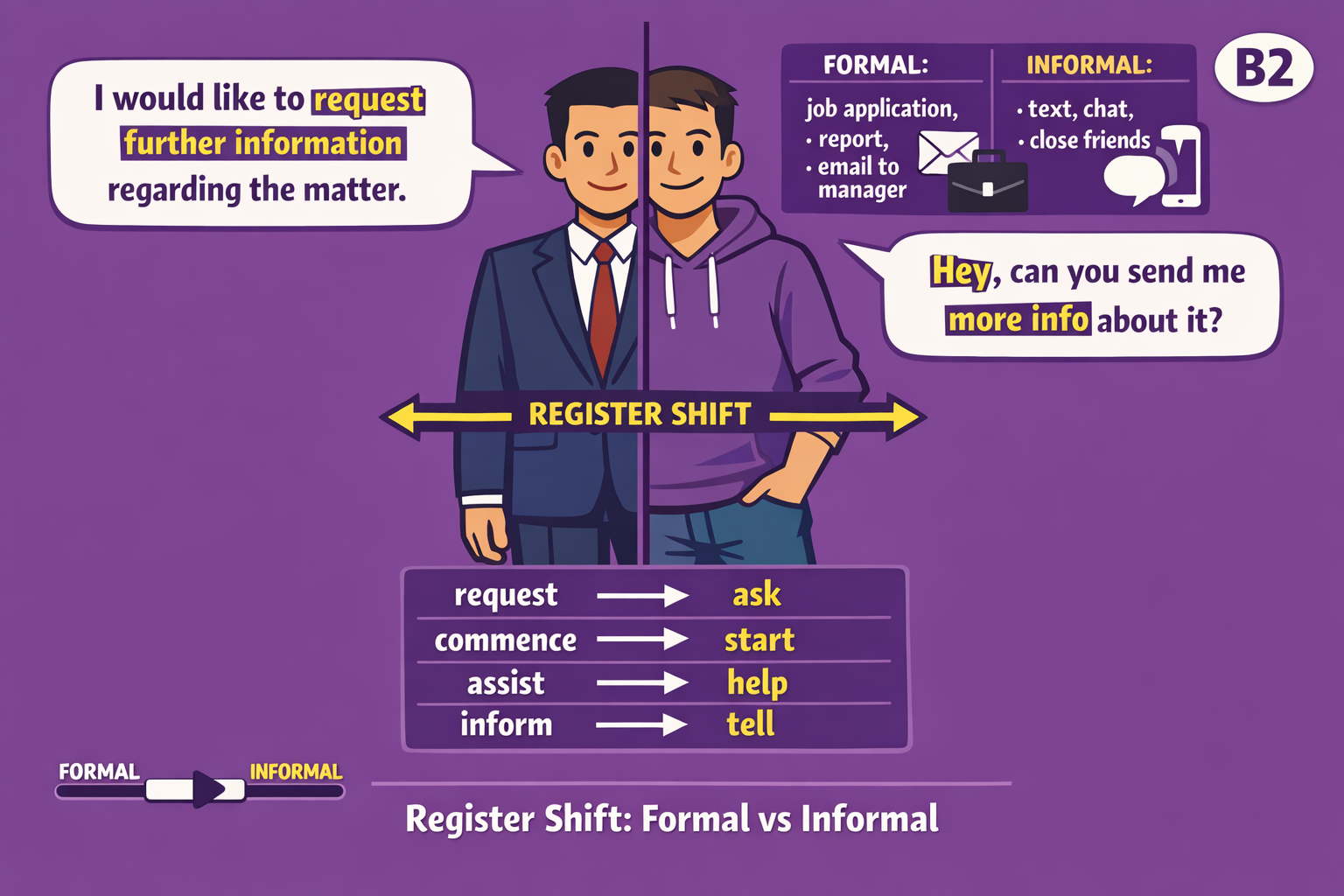
Inversion belongs to formal, written, or deliberately emphatic English. Tip You wouldn't say Rarely does he complain in casual conversation - you'd say He hardly ever complains. Save inversion for essays, news writing, formal speeches, fiction, and the higher bands of exam writing. For the broader picture of when each register fits, see formal and informal English.
Common mistakes
| Wrong | Right | Why |
|---|---|---|
| Never I have seen this before. | Never have I seen this before. | After a fronted negative, the auxiliary moves in front of the subject - like in a question. |
| Only when the rain stopped we left. | Only when the rain stopped did we leave. | The inversion goes in the main clause, not the subordinate one. |
| Not only he sings, but also he dances. | Not only does he sing, but he also dances. | The trigger is not only; but also takes normal word order. |
| No sooner I arrived than the meeting started. | No sooner had I arrived than the meeting started. | No sooner takes the past perfect for the earlier event. |
| Often does she travel for work. | She often travels for work. | Often is positive - it doesn't trigger inversion. The pattern only works with negative or restrictive adverbials. |
Inverted vs normal word order
The two structures carry the same propositional meaning. The difference is tone and emphasis.
| Inverted (formal, emphatic) | Normal order (neutral) |
|---|---|
| Never have I felt so welcome. | I have never felt so welcome. |
| Under no circumstances should employees share passwords. | Employees should not share passwords under any circumstances. |
| Only after the meeting did the truth emerge. | The truth only emerged after the meeting. |
| Not only is the design elegant, but it is also practical. | The design is both elegant and practical. |
Use the inverted version when you want to draw attention to the negative or restrictive idea, or when the surrounding text is formal. Use normal order in conversation, informal writing, and any context where the inverted form would sound stiff or theatrical.
Try it yourself
- The student had never written such a brilliant essay.
- We will under no circumstances accept late submissions.
- He realised the danger only when it was too late.
- The committee not only rejected the proposal but also criticised its author.
- As soon as the door closed, the discussion began. (Use no sooner.)
Quick summary
- Move the negative adverbial to the front, then put the auxiliary before the subject.
- If there's no auxiliary, add do, does, or did and use the base verb.
- The trigger must be negative or restrictive - positive adverbs like often or always don't work.
- With only when, only after, and not until, the inversion goes in the main clause.
- Use this structure for formal, written, or deliberately emphatic English - not casual speech.
Frequently asked questions
Why do we say "never have I" instead of "I have never"?
Never have I moves the negative adverb to the front of the sentence, and that fronting triggers inversion - the auxiliary jumps before the subject. Both versions mean the same thing, but the inverted form is more formal and emphatic; I have never is the neutral, everyday version. Use the inversion in essays, formal speeches, or dramatic writing.
What's the difference between "no sooner" and "hardly"?
Both describe one event happening immediately after another, and both trigger inversion in formal English. The difference is in the connector that follows: no sooner pairs with than (No sooner had I arrived than the meeting started), while hardly and scarcely pair with when (Hardly had I arrived when the meeting started). Mixing them up - no sooner … when - is a common error.
Does "not only" always trigger inversion?
Not only triggers inversion only when it stands at the beginning of a sentence or clause. If it appears in the middle (She is not only intelligent but also kind), there's no inversion and the sentence keeps normal word order. The trigger is fronting plus negative meaning, not the phrase by itself.
Can you use inversion in spoken English?
Inversion with negative adverbials is rare in casual conversation and can sound theatrical or pretentious in everyday speech. It belongs to formal speeches, presentations, news reports, and any context where written-style English fits. In ordinary talk, the natural choice is normal word order: I've never seen anything like it, not Never have I seen anything like it.
Why is it "little did I know" and not "little I knew"?
Little in this dramatic sense - meaning "not at all" - is a negative adverbial, and like all negative adverbials, it triggers inversion when fronted. The pattern is fixed: Little + auxiliary + subject + main verb. Little I knew is ungrammatical because the negative meaning of little requires the syntactic flip; I knew little works in normal order, but loses the dramatic effect.
Do positive adverbs like "often" trigger inversion?
No - only adverbials with negative or restrictive meaning cause inversion. Often, always, sometimes, and usually are positive frequency adverbs, and they keep normal word order: She often travels for work, not Often does she travel for work. The grammatical trigger is negative or restrictive meaning, not just being a fronted adverbial.
Related topics
- Formal and informal English - when an inverted structure fits the register and when it doesn't.
- Mixed conditionals - conditional sentences also allow a related kind of inversion (Had I known…, Were she to accept…).
- Inversion: all types (C1) - the next step up, covering conditional, comparative, and emphatic inversion in depth.
- Fronting and focus structures (C1) - fronting moves a phrase to the front; inversion adds the word-order change on top of that.

Comments