
Present Simple vs Present Continuous— A1 Grammar Exercises
Published March 14, 2026
Exercise 1 — Multiple Choice
He ______ tennis every Sunday.
Look! She ______ right now.
They usually ______ to school by bus.
At the moment, I ______ dinner.
We ______ coffee every morning.
She ______ in London now.
John ______ to the gym on Fridays.
Right now, they ______ TV in the living room.
My brother ______ his car every weekend.
I can't talk now. I ______ dinner at the moment.
Anna works in a hospital. Right now she is working in the emergency room. Both sentences use the present tense — but they say different things. The first describes her job. The second describes this moment. That difference is the key to this topic.
Form
Present Simple
Add -s or -es after the verb for he, she, it. All other subjects use the base form. For negatives and questions, use do or does. For the verb to be, see am, is, are.
| I / You / We / They | He / She / It | |
|---|---|---|
| Positive | I work every day. | She works every day. |
| Negative | They don't work on Sunday. | He doesn't work on Sunday. |
| Question | Do you work here? | Does she work here? |
Present Continuous
Use am / is / are + the -ing form of the verb. For a full guide to this tense on its own, see present continuous.
| Example | |
|---|---|
| Positive | I am working right now. |
| Negative | She isn't working today. |
| Question | Are they working now? |
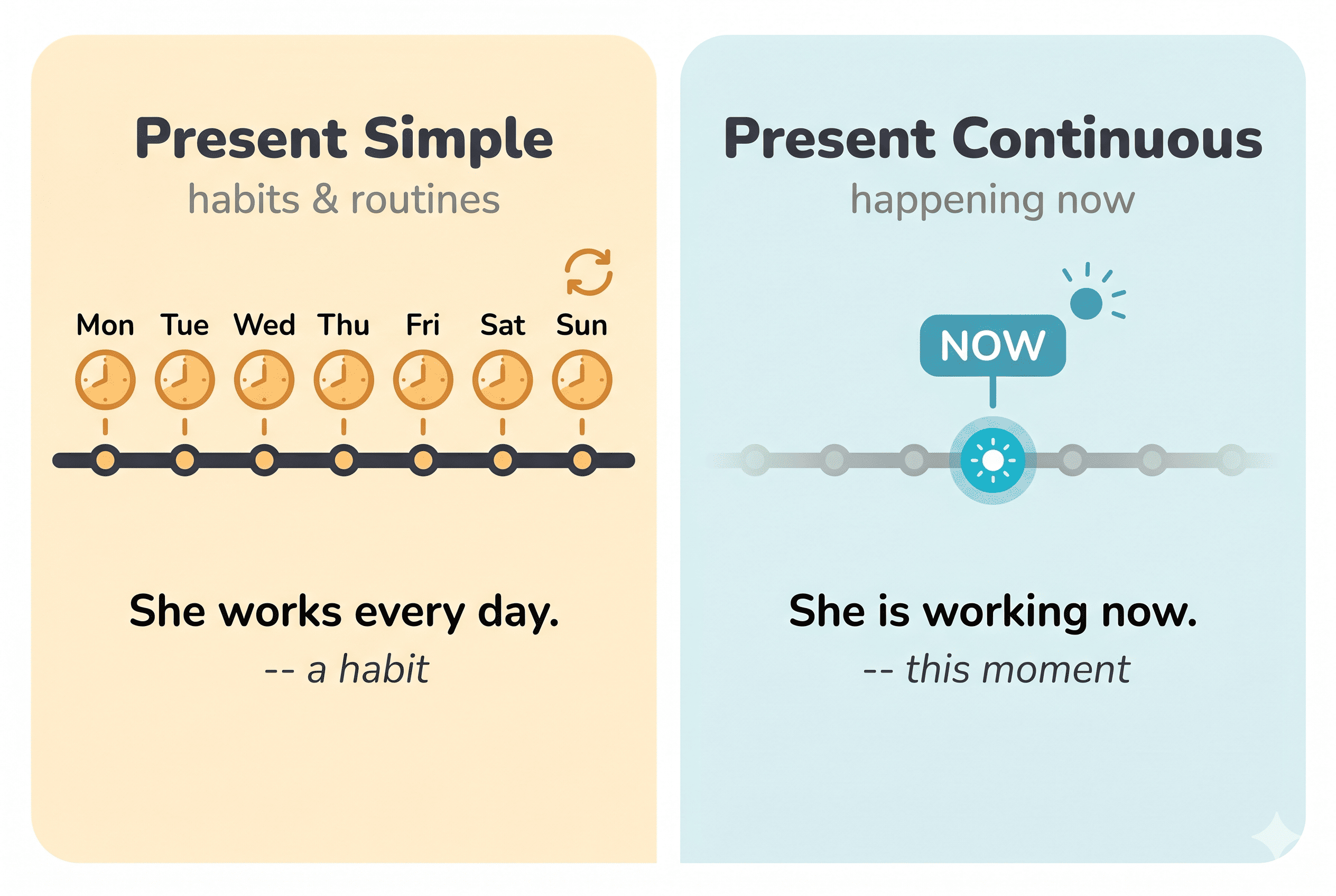
When to Use Each
Present Simple: habits and routines
Use the present simple for things that happen regularly — every day, every week, always.
- Marco gets up at 7 every morning.
- We don't eat meat.
Present Simple: facts and general truths
Use it for things that are always true.
- Water boils at 100°C.
- The sun rises in the east.
Present Continuous: actions happening now
Use the present continuous for what is happening at this exact moment.
- She is talking on the phone right now.
- They are having dinner at the moment.
Present Continuous: temporary situations
Use it for things that are happening around now but will not last forever.
- I am staying at my sister's house this week.
- He is studying English this year.
- She usually works in the office, but this week she is working from home.
Signal Words
Certain words tell you which tense to use. Signal words are not a rule — they are a clue. Always check the meaning too.
| Present Simple | Present Continuous |
|---|---|
| always | now |
| usually | right now |
| often | at the moment |
| sometimes | today (also used with simple) |
| never | this week / month |
| every day / week | currently |
Stative Verbs: No Continuous Form
Some verbs describe a state — not an action. You cannot use them in the continuous form. The most common ones at A1 are: like, love, hate, want, need, know, understand, have (for possession), and hear, see, smell.
I am liking this film. → I like this film.
She is wanting a coffee. → She wants a coffee.
He is knowing the answer. → He knows the answer.
Common Mistakes
| Incorrect | Correct | Why |
|---|---|---|
| I am working every day. | I work every day. | A routine — use present simple, not continuous. |
| She works right now. | She is working right now. | Right now signals this moment — use present continuous. |
| He is knowing the answer. | He knows the answer. | Know is a stative verb — no continuous form. |
| Water is boiling at 100°C. | Water boils at 100°C. | A general fact — use present simple. |
| I am staying here every summer. | I stay here every summer. | A repeated habit — use present simple. |
| Does she working today? | Is she working today? | Present continuous questions use is/are, not do/does. |
Side-by-Side Comparison
| Present Simple | Present Continuous |
|---|---|
| Habits and routines | Actions happening now |
| General facts and truths | Temporary situations |
| Signal words: always, every day, never | Signal words: now, at the moment, this week |
| Form: work / works | Form: am/is/are working |
| Question: Do/Does + base verb? | Question: Am/Is/Are + -ing? |
| She works in a hospital. | She is working right now. |
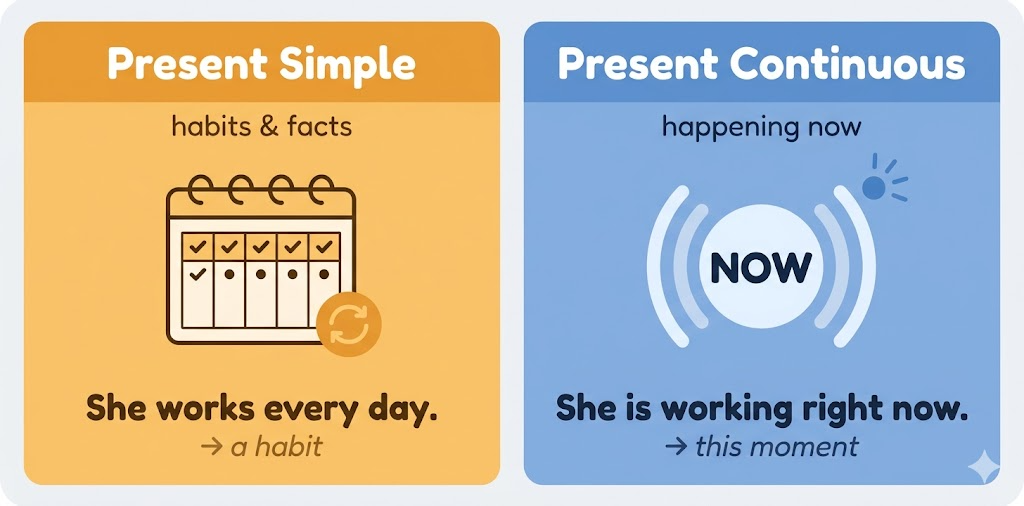
Quick Summary
- Use present simple for habits (I work every day) and facts (water boils at 100°C).
- Use present continuous for actions happening now (she is working) and temporary situations (I am staying here this week).
- Signal words help: always / never / every day → simple. now / at the moment / today → continuous.
- In most cases, stative verbs (like, love, know, want, need) do not use the continuous form. Have is the main exception — see the note above.
- Questions are different: Do you work? (simple) vs Are you working? (continuous).
Frequently Asked Questions
What is the difference between present simple and present continuous?
Present simple describes habits, routines, and facts — things that are generally true. Present continuous describes what is happening right now or a temporary situation around the present time. "She works in a hospital" (her job, always true) vs "She is working right now" (this exact moment).
When do I use present simple in English?
Use present simple for three main situations: repeated habits and routines (I walk to school every day), permanent facts (the sun rises in the east), and general truths (water boils at 100°C). Signal words like always, usually, never, and every day are strong clues.
When do I use present continuous in English?
Use present continuous when something is happening at this moment (I am eating lunch right now) or when a situation is temporary and around the present time (she is staying with her parents this month). Signal words like now, at the moment, and this week are strong clues.
What are stative verbs and why can't I use them in continuous?
Stative verbs describe a state or condition — not an action — so there is no ongoing process to describe. Verbs like know, like, love, want, and need fall into this category. You say I know the answer, not I am knowing the answer, because knowing is not something you do — it is something you have. In most cases this rule holds firm, though some stative verbs have action meanings that do allow the continuous, as with have.
Is "today" present simple or present continuous?
Today can go with either tense — it depends on the meaning, not the word itself. "I work today" (simple) means today is a workday, a scheduled fact. "I am working today" (continuous) emphasises the activity in progress or a temporary arrangement. When you see today, check whether you mean a scheduled fact or an ongoing action.
How do I form questions in present simple vs present continuous?
The auxiliary verb changes completely between the two tenses. For present simple, use do or does: Do you work here? / Does she work here? For present continuous, use am, is, or are: Are you working now? / Is she working now? Never mix them: Does she working now? is always wrong.
Related Topics
- Present continuous — the form and all uses of the present continuous on its own.
- Verb to be: am, is, are — the present continuous is built on am/is/are, so this is the essential foundation.
- Have vs has — one of the most common stative verbs, with its own rules for when continuous is and isn't allowed.
- Past simple: regular verbs — once you are confident with the present tenses, past simple is the natural next step.
Comments