
The Verb To Be— A1 Grammar Exercises
Published March 14, 2026
My name is Carlos. I am 24. I am a student. I am from Mexico. These four sentences use the same verb: to be. It tells us who someone is, what they do, how they feel, and where they are. No verb in English does more work at A1 level.
To be is irregular. It does not follow the normal rules for present simple verbs. You need to learn the three forms — am, is, and are — and know which subject each one goes with. The subject pronouns I, you, he, she, it, we and they each take a specific form.
Form
| Subject | Positive | Contraction | Negative | Question |
|---|---|---|---|---|
| I | I am tired. | I'm tired. | I am not tired. | Am I late? |
| he / she / it | He is a doctor. | He's a doctor. | He is not a doctor. | Is she free? |
| you / we / they | They are friends. | They're friends. | They are not friends. | Are you ready? |
Short negatives: I'm not, he isn't / he's not, they aren't / they're not.
Short Answers
In short answers, repeat only am, is, or are. Do not add extra words.
| Question | Yes | No |
|---|---|---|
| Are you a teacher? | Yes, I am. | No, I am not. / No, I'm not. |
| Is Marco Italian? | Yes, he is. | No, he isn't. |
| Are they at home? | Yes, they are. | No, they aren't. |
What To Be Describes
Name and identity
- My name is Yuki.
- I am a student.
Nationality and origin
- She is Brazilian.
- They are from South Korea.
Jobs and roles
Use a or an before a job noun when the subject is singular.
- He is a nurse.
- We are engineers. (plural — no article needed)
Age
- Maria is 30 years old.
- How old are you?
Feelings and states
- I am hungry.
- He is very tired today.
Location
- The keys are on the table.
- She is at work.
Common Mistakes
| Incorrect | Correct | Note |
|---|---|---|
| She is 30 years. | She is 30 years old. | Age always needs years old or just the number alone: "She is 30." |
| I am doctor. | I am a doctor. | Singular job nouns need a or an before them. |
| He is not very tall. Yes, he isn't. | He is not very tall. No, he isn't. | Agree with a negative statement using no, not yes. |
| Are you tired? Yes, I'm. | Are you tired? Yes, I am. | No contraction in positive short answers. |
| They is from Japan. | They are from Japan. | Is is only for he / she / it. Use are with they. |
| Where you are from? | Where are you from? | In questions, am / is / are comes before the subject, not after it. |
Quick Summary
- Am goes with I. Is goes with he / she / it. Are goes with you / we / they.
- Contractions: I'm, he's, she's, it's, you're, we're, they're.
- The only negative of I am is I'm not — not I amn't.
- In questions, put am / is / are before the subject.
- Short answers: say Yes, I am — never Yes, I'm.
- Use to be for identity, nationality, jobs, age, feelings, and location.
Frequently Asked Questions
What is the verb to be in English?
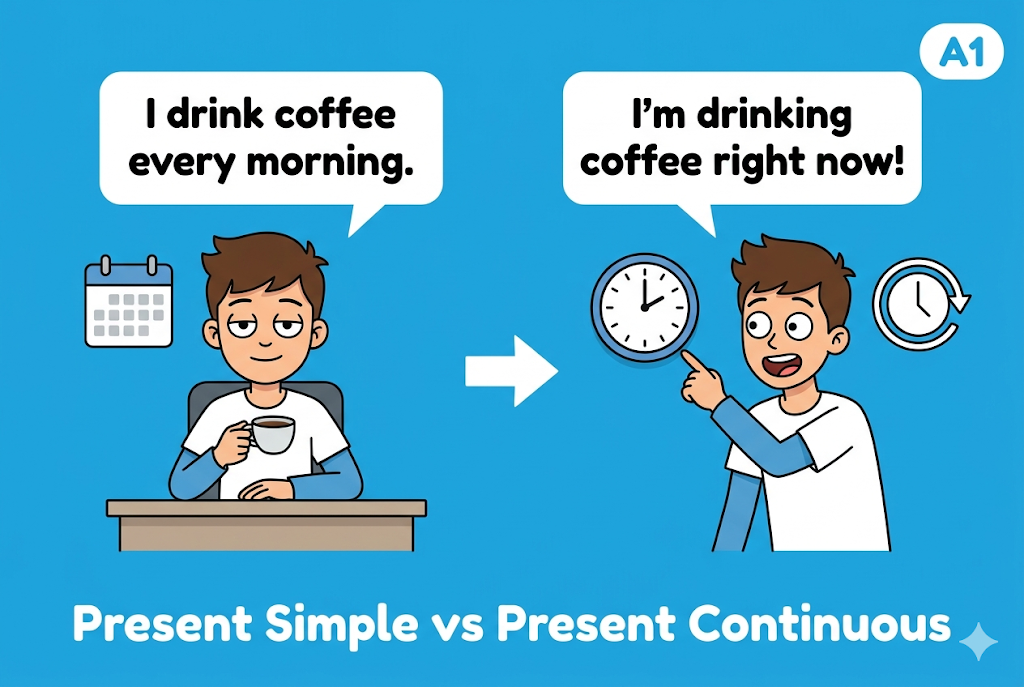
To be is the most common verb in English. In the present tense it has three forms: am (with I), is (with he / she / it), and are (with you / we / they). It describes identity, nationality, jobs, age, feelings, and location. It also acts as a helper verb in the present continuous tense.
When do you use am, is, and are?
The form depends entirely on the subject. Use am only with I: "I am ready." Use is with he, she, and it: "She is a teacher." Use are with you, we, and they: "They are from Canada." The subject and the verb must always match.
What are the contractions of to be?
The contractions combine the subject pronoun and the verb into one word: I'm, you're, he's, she's, it's, we're, they're. Contractions are used in speaking and informal writing. In formal writing, the full forms are preferred. One important rule: never use a contraction in a positive short answer. Say "Yes, he is" — not "Yes, he's."
How do you make a negative sentence with to be?
Add not after am, is, or are: "I am not late." The short forms are isn't and aren't. There is no short form amn't in standard English — the only option for I am not is I'm not.
How do you make a question with to be?
Move am, is, or are to the front of the sentence, before the subject: "She is tired" → "Is she tired?" For question-word questions, put the question word first, then am / is / are, then the subject: "Where are you from?" Never put am / is / are after the subject in a question.
What is the difference between to be and to have?
To be describes what someone or something is — identity, state, or location: "I am hungry." "She is a pilot." To have describes possession or physical characteristics: "I have a dog." "She has brown eyes." A common mix-up: in English, age uses to be ("I am 20"), not to have — unlike in Spanish, French, and some other languages.
Related Topics
- Have vs has — possession and characteristics, and how have/has differs from to be.
- Subject and object pronouns — the pronouns that go with each form of to be.
- Present continuous — where to be works as a helper verb with -ing.
Comments