
Present Continuous— A1 Grammar Exercises
Published March 14, 2026
Exercise 1 — Multiple Choice
I ____ a book right now.
She ____ her homework at the moment.
They ____ a movie now.
He ____ breakfast at this time.
We ____ to the park right now.
I ____ a song at the moment.
You ____ very well today.
The dog ____ in the garden now.
We ____ a picnic today.
She ____ her friends right now.
Look out of the window right now. What do you see? A car is moving. A dog is running. Someone is talking on the phone. All of these actions are happening at this moment. That is when you use the present continuous.
English uses the present continuous to show that an action is in progress — it has started but has not finished. The tense is built with the verb to be plus a main verb ending in -ing. You need am, is, or are — the right form depends on the subject.
Form
| Positive | Negative | Question | |
|---|---|---|---|
| I | I am eating. | I am not eating. | Am I eating? |
| he / she / it | She is sleeping. | She is not sleeping. | Is she sleeping? |
| you / we / they | They are playing. | They are not playing. | Are they playing? |
Short negatives: I'm not, she isn't, they aren't.
Spelling: Adding -ing
Most verbs: add -ing directly. eat → eating | read → reading | sleep → sleeping
Verbs ending in -e: remove the -e, then add -ing. make → making | write → writing | come → coming
Short verbs ending in one vowel + one consonant: double the consonant. run → running | sit → sitting | swim → swimming
Verbs ending in -ie: change -ie to -y, then add -ing. die → dying | lie → lying | tie → tying
When to Use the Present Continuous
Actions happening right now
The action is in progress at this exact moment. It started before now and has not finished.
- She is talking on the phone. (right now, at this second)
- I am writing an email.
Actions happening around now
The action is in progress this week, this month, or this period. It is not a permanent habit. "He studies English" is a permanent habit — he always does it. "He is studying English this year" is temporary — it is in progress now but will end.
- He is studying English this year.
- We are reading a very good book this week.
Fixed plans in the future
You can use the present continuous for a fixed plan in the future. The plan is already decided and arranged — not just an idea.
- I am meeting Sarah tomorrow. (time and place are already arranged)
- They are flying to Rome on Friday.
Signal Words
These words often appear with the present continuous:
| Signal word | Example |
|---|---|
| now | I am cooking now. |
| right now | She is sleeping right now. |
| at the moment | They are having lunch at the moment. |
| today | He is working from home today. |
| this week / month / year | Anna is taking a course this month. |
| tomorrow / next week | We are leaving tomorrow. (fixed plan) |
| Look! / Listen! | Look! The cat is climbing the tree. |
Common Mistakes
| Incorrect | Correct | Note |
|---|---|---|
| She is eat lunch now. | She is eating lunch now. | The main verb always needs -ing. |
| They eating dinner. | They are eating dinner. | Am / is / are cannot be omitted. Without it, the sentence has no verb. |
| He is swiming. | He is swimming. | Short vowel + one consonant: double the consonant before -ing. |
| She is makeing dinner. | She is making dinner. | Verbs ending in -e: remove the -e before adding -ing. |
| Is she sleeping? Yes, she is sleeping. | Is she sleeping? Yes, she is. | In short answers, repeat only the auxiliary (am / is / are) and omit everything else. |
| I am knowing the answer. | I know the answer. | Know is a state verb — it describes a mental state, not a physical action. State verbs do not use the continuous form. |
Quick Summary
- Form: am / is / are + verb-ing. Never omit am / is / are.
- Use it for actions in progress right now, around this period, or for fixed future plans.
- Spelling: drop -e before -ing; double the final consonant after a short vowel; change -ie to -y.
- Signal words: now, right now, at the moment, today, this week, tomorrow, Look!, Listen!
- State verbs (know, like, want, need, love) do not use the present continuous.
Frequently Asked Questions
What is the present continuous tense?
The present continuous is a verb form that shows an action is in progress — it has started but has not finished. It is formed with am / is / are + a main verb ending in -ing: "She is reading." It is used for actions happening right now, temporary situations in progress around this period, and fixed plans in the near future.
When do we use the present continuous?
The present continuous has three main uses. First, for actions happening at this exact moment: "I am eating lunch." Second, for temporary situations in progress this week, month, or year: "He is studying for his exams." Third, for fixed, arranged plans in the near future: "We are flying to Madrid on Saturday."
How do you form the present continuous in English?
Take the correct form of to be — am for I, is for he / she / it, are for you / we / they — and add the main verb with -ing. For negatives, add not after am / is / are. For questions, place am / is / are before the subject: "Are they coming?"
What are state verbs in English?
State verbs describe a condition or mental state rather than a physical action, so they are not normally used in the continuous form. Common examples are know, like, love, hate, want, need, understand, believe, and remember. You say "I know the answer", not "I am knowing the answer" — because knowing is a state you are in, not something you can watch happening moment by moment.
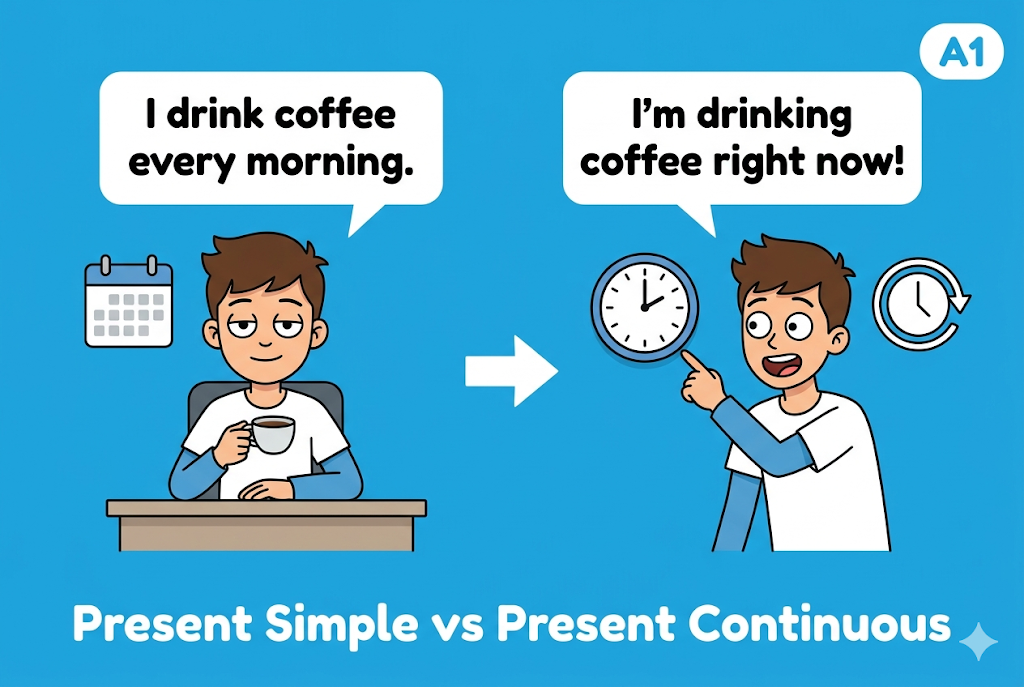
What is the difference between present simple and present continuous?
The present simple describes habits, routines, and permanent facts: "She works in a hospital." The present continuous describes actions in progress right now or situations that are temporary: "She is working on a new project this month." The key test: if the action is happening at this moment or is temporary, use the continuous. If it is always true or a regular habit, use the simple.
Why do we double the consonant in running and swimming?
The consonant is doubled to protect the short vowel sound. Run has a short u sound. Without doubling, runing looks like a long vowel — the same pattern as tune → tuning. Adding a second consonant (running) signals that the vowel stays short. The rule applies whenever a verb ends in one vowel followed by one consonant: sit → sitting, stop → stopping, swim → swimming.
Related Topics
- The verb to be — the auxiliary verb in every present continuous sentence.
- Present simple vs present continuous — when to use each one.
- Past continuous — the same -ing structure, used for actions in progress in the past.

Comments