
Participle clauses— B2 Grammar Exercises
Published March 25, 2026
Exercise 1 — Gap Fill Select
Walking down the street, she a strange noise behind her.
Having finished his homework, John to watch TV.
The man by the police was wearing a red jacket.
Excited about the trip, the children their bags quickly.
Not knowing what to say, she silent.
The documents on the table belong to the manager.
Having been warned about the storm, they their plans.
The girl in the corner is my cousin.
Feeling tired after the long journey, he straight to bed.
The books by the students were returned to the library.
A report written in haste rarely convinces anyone. Having read the contract carefully, she refused to sign. Participle clauses compress what would otherwise be a full subordinate clause into a tighter, more economical structure. They are a defining feature of formal written English — in essays, reports, and academic writing, they signal that a writer has control of the language. In spoken English, full subordinate clauses are the natural choice; participle clauses belong to the written register.
The Three Types
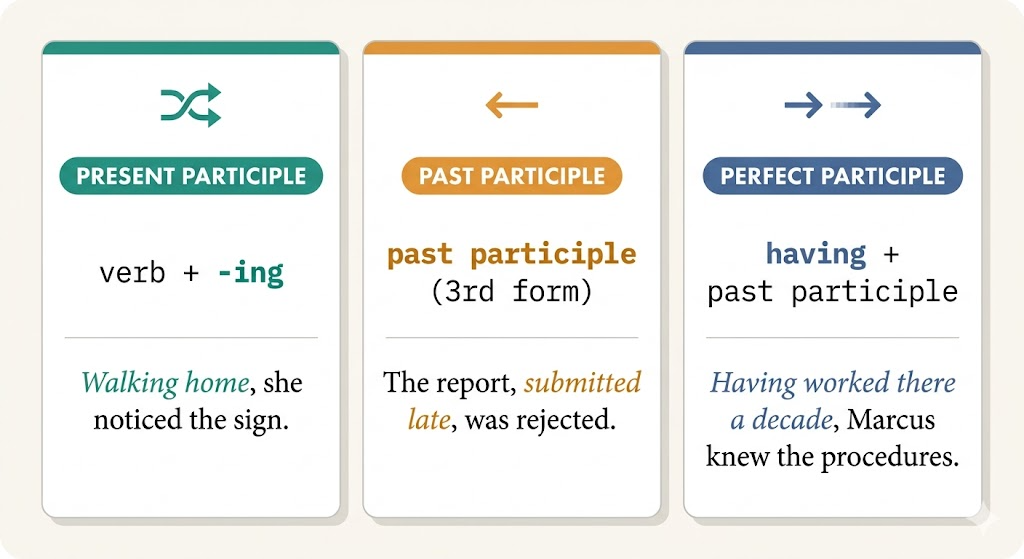
Participle clauses are built from one of three participle forms. The choice of form signals the temporal and active/passive relationship between the participle clause and the main clause.
| Type | Form | Example |
|---|---|---|
| Present participle | verb + -ing | Walking home, she noticed the closed sign on the door. |
| Past participle | past participle (3rd form) | The report, submitted late, was not considered. |
| Perfect participle | having + past participle | Having worked there for a decade, Marcus knew every procedure. |
The Subject Rule
This is the central rule of participle clauses, and the most frequently broken. The implied subject of the participle clause must be the same as the subject of the main clause. The participle clause has no stated subject of its own — it borrows from the main clause.
- Turning the corner, David saw the car. ✓ — David turns the corner; David sees the car.
- Reviewing the draft, the editor found three inconsistencies. ✓ — The editor reviews; the editor finds.
- Turning the corner, the car came into view. ✗ — The car cannot turn the corner on its own.
Uses
Simultaneous actions
A present participle clause can describe an action happening at the same time as the main verb. The subject performs both actions simultaneously.
- Listening to the presentation, she took detailed notes.
- He stood at the window, watching the street below.
- She sat at her desk, reading through the proposals one by one.
Sequential actions
When one action immediately precedes another, the perfect participle makes the sequence explicit. The participle clause action is completed first.
- Having finished the report, she sent it to the board.
- Having lived abroad for three years, Omar found the transition back difficult.
Reason or cause
A participle clause at the start of a sentence often gives the reason for the main clause. This is the participle equivalent of a because or since clause, and considerably more compact.
- Not knowing the area well, they hired a local guide.
- Having missed the deadline, the application was automatically rejected.
Condition
A participle clause can function as a conditional, equivalent to an if clause. This works with both present and past participle forms.
- Turning left at the lights, you'll find the office on the right. (If you turn left…)
- Taken in large doses, the medication causes serious side effects. (If it is taken…)
- Handled correctly, the situation need not escalate. (If it is handled…)
Result
A present participle clause placed after the main clause can express a result or consequence. The participle follows naturally from what the main clause states.
- The storm knocked out the power, leaving the whole district without electricity.
- She accepted the offer, effectively ending the negotiation.
Passive meaning with past participles
Past participle clauses always carry a passive meaning. The subject of the main clause receives the action described in the participle clause. No auxiliary is needed — the past participle form does the work alone.
- Written in 1847, the novel remains widely read today. (The novel was written in 1847.)
- The package, damaged in transit, was returned to the sender.
Participle Clause vs. Full Subordinate Clause
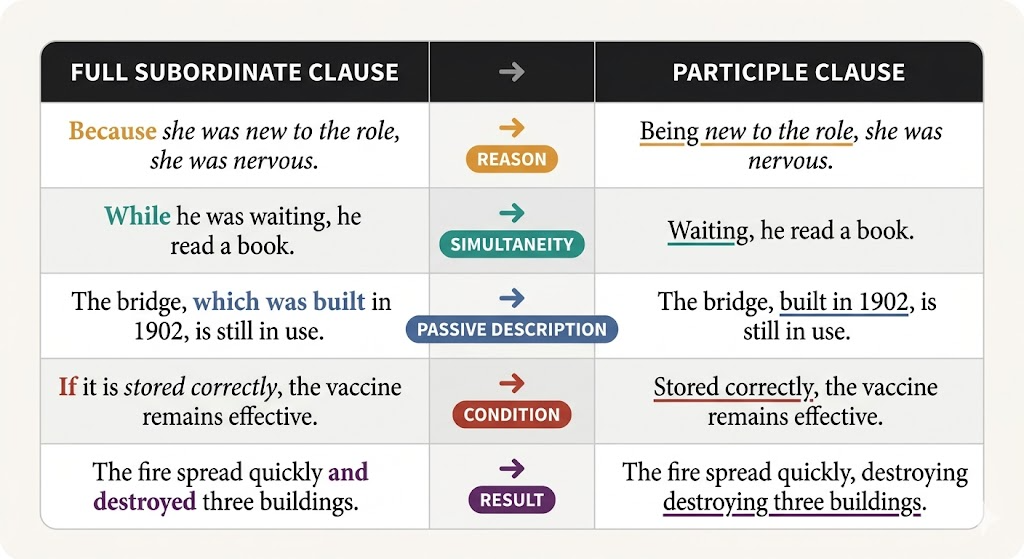
Participle clauses are compressed subordinate clauses. Understanding the full clause behind a participle clause is the most reliable way to use them correctly — and to spot a dangling participle before it reaches the page.
| Full clause | Participle clause | Function |
|---|---|---|
| Because she was new to the role, she was nervous. | Being new to the role, she was nervous. | Reason |
| While he was waiting, he read a book. | Waiting, he read a book. | Simultaneity |
| The bridge, which was built in 1902, is still in use. | The bridge, built in 1902, is still in use. | Passive description |
| If it is stored correctly, the vaccine remains effective. | Stored correctly, the vaccine remains effective. | Condition |
| The fire spread quickly and destroyed three buildings. | The fire spread quickly, destroying three buildings. | Result |
Common Mistakes
Dangling participles
The most serious error. The participle clause refers to a subject that is not the subject of the main clause.
| Wrong | Correct |
|---|---|
| Walking into the room, the lights went off. | Walking into the room, she noticed the lights had gone off. |
| Having studied all night, the exam seemed easy. | Having studied all night, she found the exam straightforward. |
| Printed in red, readers notice the warning immediately. | Printed in red, the warning immediately catches the reader's eye. |
Using a present participle when the perfect is needed
The present participle implies simultaneity. When the participle clause action clearly happened first and is now complete, the perfect participle is the accurate choice.
| Imprecise | Precise |
|---|---|
| Working at the company for ten years, he retired. | Having worked at the company for ten years, he retired. |
| Reading the report, she submitted her recommendations. | Having read the report, she submitted her recommendations. |
Adding an auxiliary to a past participle clause
Past participle clauses do not use been as an auxiliary. The passive meaning is already contained in the past participle form itself.
| Wrong | Correct |
|---|---|
| Been written in 1901, the letter survived two world wars. | Written in 1901, the letter survived two world wars. |
| Been translated into forty languages, the book is widely studied. | Translated into forty languages, the book is widely studied. |
Summary
- Present participle (-ing): simultaneous action, reason, result, or condition.
- Past participle: passive meaning — the subject receives the action described.
- Perfect participle (having + past participle): the participle clause action is completed before the main clause.
- The implied subject of the participle clause must match the subject of the main clause. A mismatch produces a dangling participle.
- Participle clauses are a written register feature — formal essays, reports, and academic writing. In conversation, full subordinate clauses are the natural choice.
Frequently Asked Questions
What is a participle clause in English?
A participle clause is a subordinate clause built from a participle form — present (-ing), past (3rd form), or perfect (having + past participle) — rather than a full finite verb. It compresses a longer clause into a more economical structure: Because she had reviewed the data becomes Having reviewed the data, she presented her findings. Participle clauses are especially common in formal written English.
What is a dangling participle?
A dangling participle occurs when the implied subject of the participle clause does not match the subject of the main clause. In Walking into the room, the lights went off, the participle clause implies that the lights were walking — which is clearly unintended. The correct version names the right subject in the main clause: Walking into the room, she noticed the lights had gone off. Dangling participles are considered a serious error in formal writing.
What is the difference between a present and a perfect participle clause?
A present participle clause (-ing) typically describes an action happening at the same time as the main clause: Waiting for the bus, he checked his phone. A perfect participle clause (having + past participle) shows that the participle clause action was completed before the main clause: Having missed the bus, he called a taxi. Use the perfect form whenever the sequence — first one action, then another — is the point you need to make.
Can I use a participle clause at the start of a sentence?
Yes — and this is one of the most common positions for a participle clause. When a participle clause opens the sentence, it is separated from the main clause by a comma: Having considered all the options, the board made its decision. The subject of the main clause must immediately follow the comma, because that is the subject the participle clause refers to. Participle clauses can also appear mid-sentence or at the end.
How do I avoid dangling participles?
Before using a participle clause, ask: who or what performs the action in the participle clause? That entity must be the grammatical subject of the main clause. If you wrote Reviewing the application, several errors were found, ask who is reviewing — it cannot be the errors. Fix it by making the reviewer the subject: Reviewing the application, the committee found several errors. If the subjects cannot be made to match, rewrite using a full subordinate clause instead.
What is the difference between "walking" and "having walked" in a participle clause?
Walking (present participle) implies the action is simultaneous with the main verb: Walking to the station, she called her manager — the walking and the calling happen at the same time. Having walked (perfect participle) implies the walking was completed before the main clause action: Having walked for two hours, they stopped to rest — the walking is finished when the stopping begins. The distinction matters in formal writing, where using the wrong form misrepresents the sequence of events.
Related Topics
- Relative Clauses — past participle clauses often reduce a defining or non-defining relative clause; understanding both structures together sharpens the distinction.
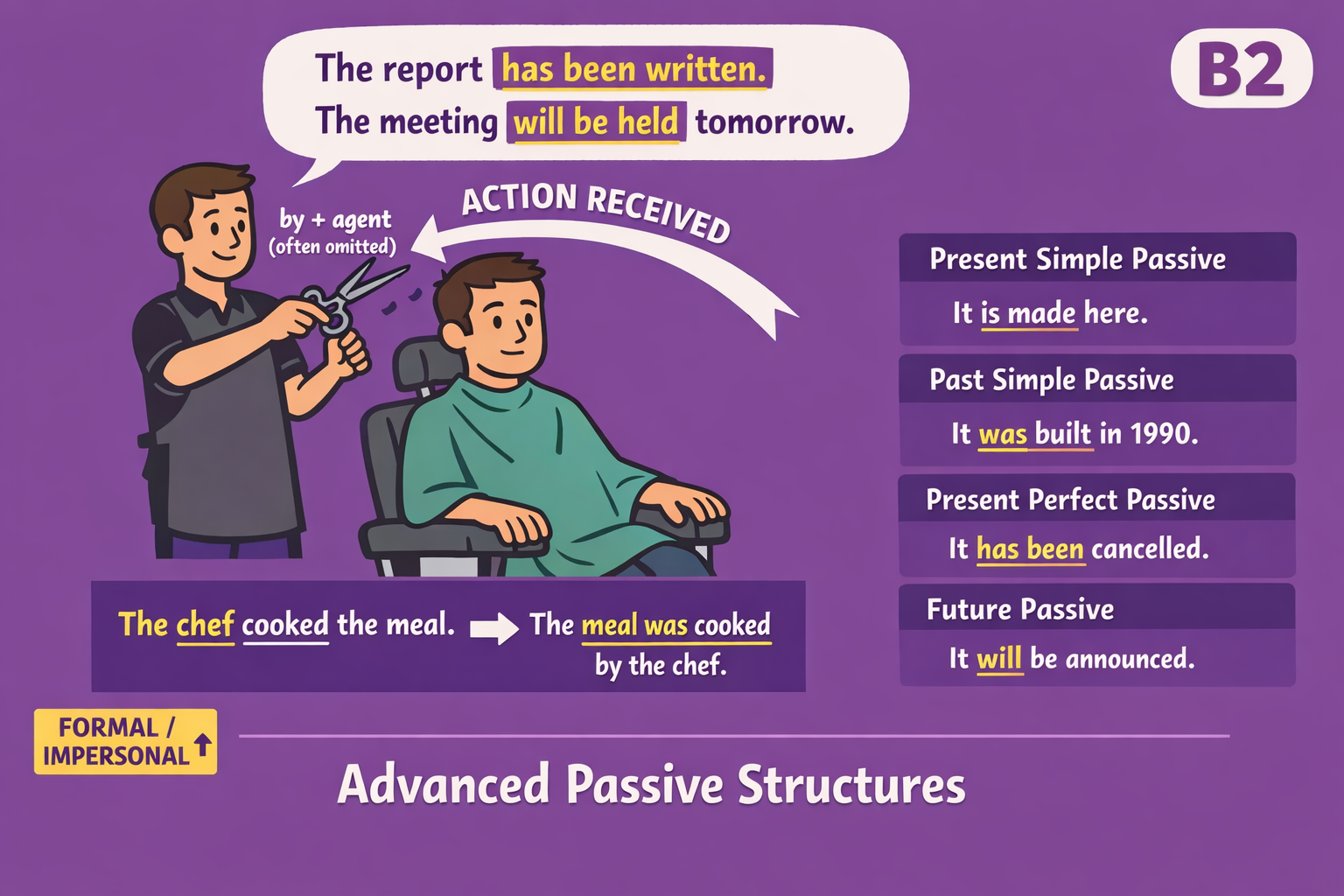
- Advanced Passive Structures — past participle clauses are closely tied to passive grammar; this topic covers the full range of passive constructions at B2 level.
- The Present Participle — covers the -ing form in detail, including its use after verbs of perception and in gerund constructions.
Comments