
Advanced Conditionals— C1 Grammar Exercises
Published March 14, 2026
Exercise 1 — Gap Fill Select
If I known about the meeting, I would have prepared better.
If she earlier, she wouldn't be stuck in traffic now.
If they harder, they might have passed the exam.
If he to the party, he would have met her.
If I you, I would reconsider the offer.
If they more carefully, they wouldn’t have made that mistake.
If you me earlier, I could have helped you.
If he more experience, he would be considered for the job.
If we earlier, we wouldn’t be in this situation now.
If she the instructions, she wouldn’t have made that error.
A contract clause reads: "Should either party fail to meet its obligations, the agreement shall be deemed void." A diplomat says: "Were the sanctions to be lifted, the economic consequences would be far-reaching." A lawyer writes: "But for the defendant's negligence, no loss would have occurred." These are not stylistic flourishes — they are precise, register-appropriate applications of conditional grammar that go well beyond the standard four types. The standard types — which you can review on the conditionals hub page — establish the basic framework. At C1, the work is expanding that framework with mixed time references, formal inversion, a wider set of conditional connectors, and implied conditions that carry no if at all.
Mixed conditionals
A mixed conditional combines condition and result clauses from different time frames. The standard third conditional keeps both clauses in the past; mixed conditionals break that symmetry when the logic demands it.
Past condition → present result
Use this when a past event (or its absence) has a consequence that is still true now.
If she had studied law, she would be a partner at the firm by now.
The condition is past (she didn't study law); the result is present (she is not a partner now). The signal by now often marks this type.
If they hadn't merged the two departments, we would have more budget flexibility today.
Present/permanent condition → past result
Use this when a present state or permanent characteristic explains why something did or did not happen in the past.
If I weren't so risk-averse, I would have invested in that company years ago.
The condition is a present permanent trait (I am risk-averse); the result is past (I didn't invest).
If he spoke better Mandarin, he would have taken the Shanghai posting.
Conditional inversion
In formal and written English, the conjunction if can be replaced by inverting the subject and auxiliary. This construction is a subtype of negative and conditional inversion and is frequent in legal, academic, and professional writing.
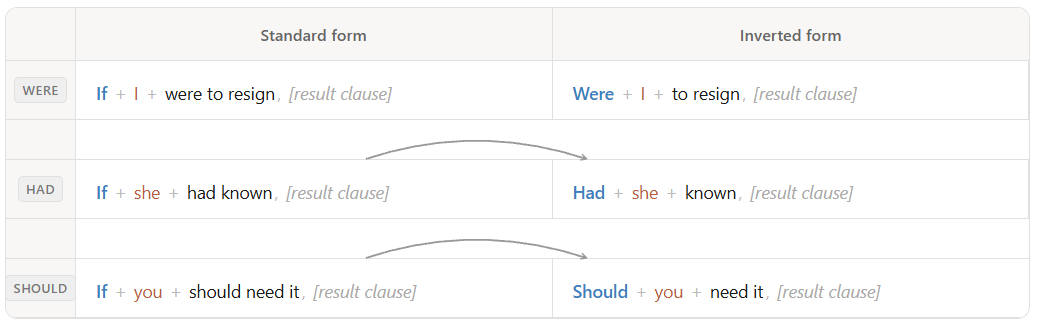
Three auxiliary verbs allow this inversion: were, had, and should.
| Standard form | Inverted form | Equivalent type |
|---|---|---|
| If I were to resign… | Were I to resign… | Second conditional |
| If she had known… | Had she known… | Third conditional |
| If you should need assistance… | Should you need assistance… | First conditional (formal) |
- Were the government to intervene, market confidence would collapse immediately.
- Had the contract been signed earlier, these disputes would never have arisen.
- Should you require further information, do not hesitate to contact us.
Alternative conditional connectors
Several conjunctions and phrases can replace if to introduce conditions. Each carries a slightly different logical weight.
Unless
Unless means if … not. It introduces the only condition under which the result will not hold. Crucially, the verb after unless is not negated — the negation is already inside unless itself.
Unless the board approves the budget, the project cannot proceed. = If the board does not approve…
Unless the board doesn't approve — the double negation creates the opposite meaning.
Provided (that) / providing (that) / as long as / so long as
These all express a condition that must be satisfied for the result to follow — but they are more restrictive than if: they imply the speaker considers the condition achievable and the result likely if it is met.
- You can use the data, provided that you acknowledge the source.
- The arrangement works as long as both parties honour the terms.
Provided that is slightly more formal than as long as; both are common in contracts and agreements.
On condition that
More formal still. Common in legal and negotiation contexts where a condition is explicitly imposed by one party.
- The loan was approved on condition that the company provide quarterly audits.
- He agreed to testify on condition that his identity would be protected.
Note the second example: on condition that appears frequently in reported speech and indirect legal contexts, where the condition was imposed at a prior moment. This is a syntactic environment where provided that would be an awkward substitute.
Supposing (that) / imagine (that)
Used to introduce a hypothetical for discussion. Both are informal — supposing is primarily spoken; imagine is even more conversational and often rhetorical, inviting the listener to picture the scenario rather than formally assess it. Neither would appear in legal or academic writing.
- Supposing the deal falls through — what is the contingency plan?
- Imagine you had accepted that job offer. Where would you be now?
In case
Expresses precaution — an action taken in anticipation of a possible event. Unlike if, the action happens before knowing whether the condition will be true.
Take the documents with you in case they ask for proof of address.
The difference: Take the documents if they ask means you wait to see if they ask. In case they ask means you take them now, as a precaution.
Implied conditions: but for, without, with, given
A conditional relationship does not require a conditional clause. Certain prepositions and phrases carry the entire condition without if or any subordinating conjunction.
But for
But for + noun phrase means if it had not been for. It always refers to a past condition and pairs with a would have result.
But for her intervention, the project would have been cancelled.
= If it had not been for her intervention…
Without
Without can imply either a past or present condition depending on the result clause tense.
- Without his support, we could never have launched on time. — past implied condition
- Without a reliable internet connection, remote work becomes impossible. — present/general condition
Given (that)
Given introduces a condition treated as an accepted fact — a real, not hypothetical, premise. The speaker takes the premise as established and draws a conclusion from it. This distinguishes it sharply from second or third conditional structures, which treat the condition as contrary to fact.
- Given the complexity of the situation, a swift resolution seems unlikely.
- Given that the deadline has already passed, there is little point in submitting now.
Compare: If the deadline had passed, there would be little point in submitting — hypothetical. Given that the deadline has passed — the deadline has passed; this is a fact.
Modal variation in result clauses
The result clause of a conditional does not always require would. Choosing a different modal changes the meaning precisely, and at C1 this choice is expected. The full range of modal behaviour at this level is covered on the advanced modal verbs page.
| Modal in result clause | Meaning added | Example |
|---|---|---|
| would | Neutral hypothetical result | If she left now, she would arrive on time. |
| could | Hypothetical ability or possibility | If he trained harder, he could compete at national level. |
| might | Weaker possibility — less certain than would | If we relaunch the product, sales might recover. |
| should | Logical expectation given the condition | If the data is accurate, this should work. |
| must | Logical necessity — strong inference | If they rejected the offer, there must be a reason. |
All of these modals can be negated in the result clause. The choice of negative form carries the same precision as the positive: If she had applied, she might not have got the job anyway (weaker doubt) differs meaningfully from she wouldn't have got the job (confident counterfactual).
| Wrong | Correct | Why |
|---|---|---|
| If I would have known, I would have called. | If I had known, I would have called. | Would cannot appear in the if-clause. The condition takes the past perfect. |
| Were she would resign, we'd be in trouble. | Were she to resign, we'd be in trouble. | Inverted conditionals with were use the to-infinitive, not would. |
| Unless you don't submit the form, access is denied. | Unless you submit the form, access is denied. | Unless already contains the negation. Adding don't reverses the intended meaning. |
| But for her help, the project would cancel. | But for her help, the project would have been cancelled. | But for refers to a past counterfactual and requires would have + past participle. |
| In case it rains, take an umbrella if you go out. | Take an umbrella in case it rains. | The precautionary action (take an umbrella) has already been expressed with in case. Adding if you go out as a second condition is redundant — the in case clause implies the action applies whenever the risk exists. |
| Provided that he doesn't pass the assessment, his contract will be terminated. | Unless he passes the assessment, his contract will be terminated. | Provided that introduces a condition whose fulfilment enables a positive result. It is the wrong connector when the condition is a failure. Unless — meaning if … not — is the correct choice when the result follows from the condition not being met. |
Quick summary
- Mixed conditionals combine different time frames: past condition + present result, or present state + past result.
- Conditional inversion (Were I to…, Had she…, Should you…) replaces if in formal register. The subject and auxiliary switch positions.
- Unless = if … not — never add a second negative after it.
- Provided that, as long as, on condition that all introduce conditions that must be met — each with a different degree of formality.
- But for, without, given express implied conditions with no if-clause at all.
- The modal in the result clause is a precision tool: could signals ability, might signals weaker probability, should signals logical expectation.
Frequently asked questions
What is the difference between a mixed conditional and a third conditional?
A third conditional keeps both clauses in the same time frame — past condition, past result: If she had applied, she would have got the job. A mixed conditional crosses time frames. The most common type has a past condition with a present result: If she had studied medicine, she would be a doctor now. Use the third conditional when both the condition and its consequence are entirely in the past. Use the mixed form when the consequence is still true or relevant in the present.
When should I use conditional inversion instead of a standard if-clause?
Conditional inversion (Were I to…, Had she…, Should you…) is a formal register choice, not a grammatical requirement. Use it in written professional or academic contexts — legal documents, formal reports, business correspondence — where the elevated register is appropriate. In conversation or informal writing, a standard if-clause is always the safer choice. The inversion adds no new meaning; it signals formality and a high degree of grammatical precision.
What is the difference between unless and if not?
Unless and if … not are often interchangeable, but not always. Unless presents the condition as the single exception that prevents a result: I'll come unless it rains = the only thing that will stop me is rain. If … not is a neutral negated condition without that exclusive implication. In sentences where the condition is just one of several possible reasons, if … not is more accurate. Additionally, unless rarely works with already-established facts; for those, use if … not.
What does but for mean in grammar?
But for + noun phrase is a formal way of expressing a past counterfactual condition: it means if it had not been for. It always implies that the named factor prevented a negative outcome, and the result clause always uses would have + past participle. But for the safety net, the fall would have been fatal = if the safety net had not been there. It is common in legal writing, formal narrative, and academic argument.
Can would appear in an if-clause?
In standard grammar, no — would belongs in the result clause, not the condition. If I would have known is a very common error, particularly among learners whose first language uses a future or conditional form in both clauses. The correct form is If I had known. The one exception: would can appear in an if-clause when it expresses willingness rather than a conditional, as in If you would be so kind as to wait… — but this is a different grammatical function entirely.
What is the difference between provided that and as long as?
Both introduce a condition that must be met for the result to follow, and in most contexts they are interchangeable. The distinction is register: provided that is more formal and is the standard choice in written contracts, legal clauses, and academic writing. As long as and so long as are more neutral and suit both formal and informal contexts. One practical distinction: when the condition is a constraint imposed on another party, provided that is the stronger choice — it implies the speaker's authority to set the condition. As long as feels more like a shared understanding.
Related topics
- Inversion: all types — conditional inversion is one of several inversion patterns used for emphasis and formality at C1.
- Advanced modal verbs — choosing the right modal in a result clause is inseparable from understanding modal meaning at this level.
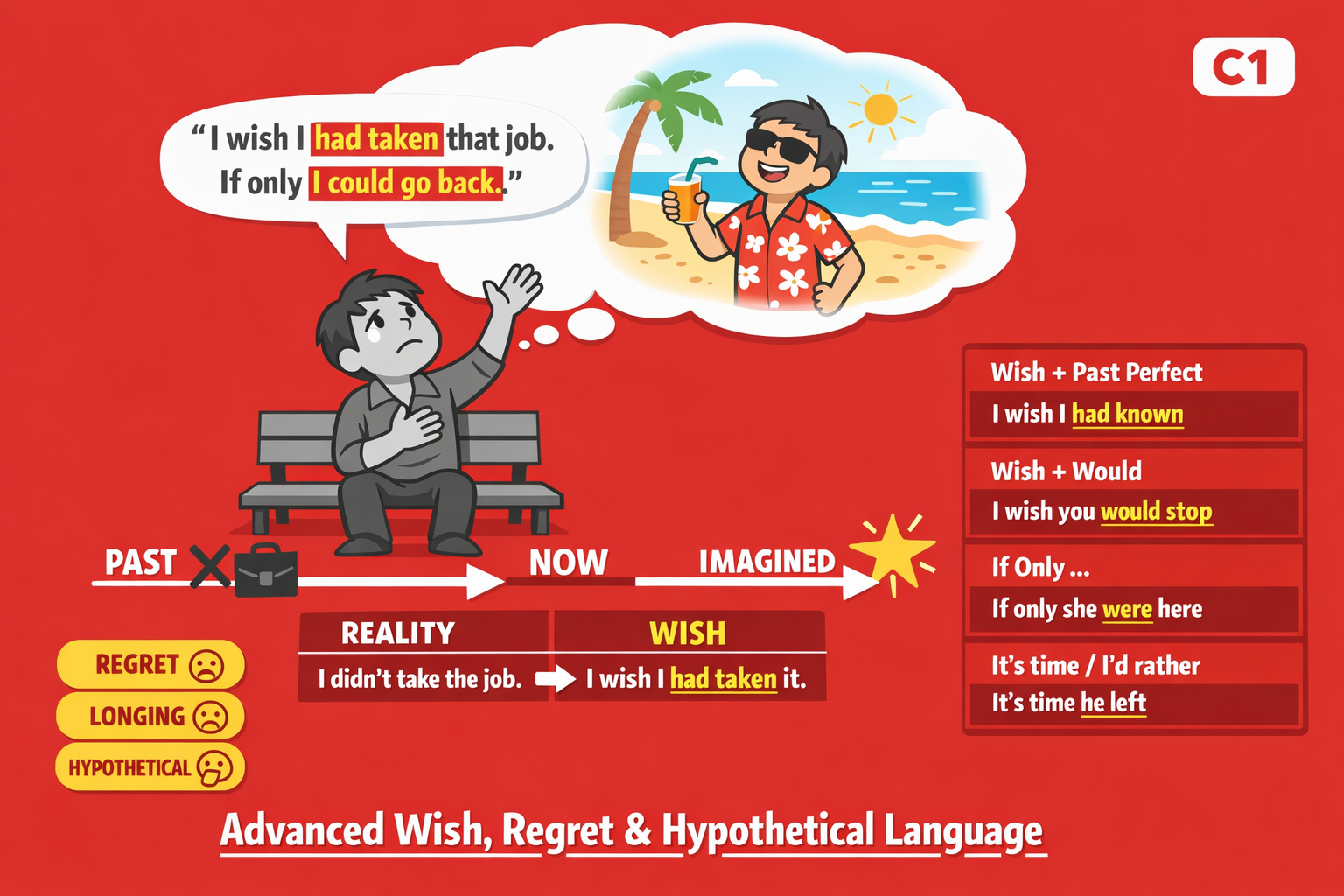
- Advanced wish and regret — wish, if only, and I'd rather use the same tense backshift logic as hypothetical conditionals and are closely related in structure.


Comments