
C1 modal verbs: nuance & tone— C1 Grammar Exercises
Published March 23, 2026
Exercise 1 — Gap Fill Select
She have left early, but I’m not sure.
You have told me about the meeting earlier.
He be joking; I don’t think he’s serious.
You have warned me about the risks involved.
They be at the airport by now; the flight landed an hour ago.
You not smoke in here; it’s against the rules.
He have forgotten the appointment; he’s usually very punctual.
If you’re tired, you take a break.
She be working late tonight; she has a lot to finish.
You have told me the truth from the start.
Two colleagues arrive late to the same meeting. One says "You should have told me it was moved." The other says "You might have told me it was moved." The grammar is nearly identical — modal + have + past participle — but the tone is not. The first is a mild reproach. The second carries an edge of irritation. That gap between them is what this page is about.
At C1, the issue with modals is rarely form. It is precision: knowing not just that a modal is grammatically possible in a slot, but what it implies about certainty, obligation, stance, and relationship. Test your accuracy with the C1 modal verbs practice exercises once you have worked through the explanation below.
Epistemic and Deontic Modality
Every modal verb operates in one of two broad modes. Epistemic use expresses the speaker's assessment of probability or logical necessity — what must, might, or cannot be the case. Deontic use expresses obligation, permission, or volition — what someone must, should, or is allowed to do. The same modal word can carry either meaning, and context, sometimes only context, distinguishes them.
| Modal | Epistemic (probability / deduction) | Deontic (obligation / permission) |
|---|---|---|
| must | She must be exhausted — she has been up since 4am. (logical conclusion) | You must submit the form by Friday. (obligation) |
| can't | That can't be right — I checked the figures twice. (near-certain denial) | You can't park here after 6pm. (prohibition) |
| should | The package should arrive by Thursday. (reasonable expectation) | You should notify your manager in advance. (advice / mild obligation) |
| may | The delay may affect the final deadline. (open possibility) | Visitors may use the car park on Saturdays. (permission) |
The ambiguity is not a problem to solve — it is a feature. Skilled writers exploit it deliberately. "The committee should note this finding" hovers between advice and expectation in a way that is strategically vague. Recognising which reading is active — and controlling which one you produce — is a core C1 competence.
The Epistemic Scale: Degrees of Certainty
Epistemic modals are not interchangeable. They sit on a scale of confidence, and choosing the wrong one misrepresents how certain the speaker actually is.
must / can't → near-certain conclusion | should / ought to → reasonable expectation | may / might / could → open possibility
To see how the scale works in practice, consider this short passage about a missing colleague:
Marcus must have left already — his coat isn't on the rack. He should be on the train by now. He might have stopped for coffee on the way, but he could just as easily have gone straight to the station.
Must draws a near-certain inference from direct evidence (the missing coat). Should marks a reasonable expectation based on what normally happens at that time — not evidence, just probability. Might and could both float possibilities with no supporting evidence at all; the speaker is simply speculating. Using must in the third sentence would overclaim certainty the speaker does not have. Using might in the first would understate a conclusion the coat makes almost unavoidable.
Should in the epistemic sense differs from must in one important way: it carries an implicit if things go as expected. "The report should be ready by noon" leaves room for something to go wrong. "The report must be ready by noon — she said she finished it last night" treats it as a logical near-certainty. For deeper practice with epistemic deduction, see the B2 speculation and deduction exercises.
The Deontic Scale: Obligation, Advice, and Permission
The same gradient applies to obligation. Modal choice signals how much weight you are placing on a requirement — and where that requirement originates.
| Modal | Strength / Source | Example |
|---|---|---|
| shall | Absolute — legal, contractual, or formal rule | The contractor shall deliver all materials within 30 days of signing. |
| must | Strong — internal or authoritative imposition | All data must be encrypted before transmission. |
| need to | Strong — practical necessity, less authoritative tone | You need to restart the server for the changes to take effect. |
| should / ought to | Moderate — advice, expectation, or moral weight | Applicants should include a cover letter with their submission. |
| could / might | Weak — suggestion with no pressure | You could mention the previous project in the interview. |
To see how the deontic scale operates in a single context, consider a manager communicating a policy change to her team:
All expenses over £500 must be approved before submission — no exceptions. Receipts should be attached within five working days of the purchase. If you are unsure about a borderline item, you could run it by your line manager first.
Must sets a non-negotiable rule — the authority behind it is institutional. Should marks a strong expectation: there is flexibility in principle, but deviation requires justification. Could is a low-pressure suggestion with no obligation attached; the employee is free to ignore it. A reader who replaced must with should in the first sentence would soften an absolute rule into a recommendation — a significant change in meaning with no change in form.
Ought to and should overlap heavily in deontic use, but ought to carries a slightly more external, moral flavour — the right or proper thing to do. "You ought to apologise" implies a moral duty; "you should apologise" can read as purely pragmatic advice. In most professional writing, should is the default. Ought to sounds slightly old-fashioned in neutral contexts and is often reserved for deliberate moral emphasis.
Shall survives in contemporary English mainly in legal and highly formal documents — where it marks a binding obligation — and in first-person offers ("Shall I call them?") and formal suggestions ("Shall we proceed?"). Outside those contexts, it sounds archaic. For a full treatment of register-level choices, see the page on formal and informal register at C1.
Tone, Register, and Pragmatic Effect
Will for characteristic behaviour and annoyance
Will is not only future. Used with a habitual present action, it comments on a predictable pattern — and the tone is controlled by context and stress. Neutral description and exasperated complaint look structurally identical on the page.
- He'll sit for hours without speaking. (neutral characteristic — could appear in a profile or reference)
- She will leave her notes all over the desk. (irritation — depends on context to activate)
- He will insist on copying in the entire department. (complaint — reporting speech in a professional context)
In speech, emphatic stress on will signals annoyance: "He will interrupt people." In writing, the irritation reading is activated by the surrounding context — a complaint email versus a neutral report. The risk at C1 is producing this pattern accidentally in professional writing where neutral description was intended. If a habitual will appears in a formal document without an evaluative frame, readers may infer criticism that was not meant.
Would for distancing and politeness
Replacing can with could, or will with would, in requests and offers creates pragmatic distance. The modal signals tentativeness and respect for the other person's autonomy — the mechanism behind most formal request-making in English.
- Send me the file. (imperative — direct, potentially abrupt)
- Can you send me the file? (direct, neutral)
- Could you send me the file? (polite, more formal)
- Would you be able to send me the file? (formal — allows easy refusal)
- I wonder if you might send me the file. (highly formal / deferential)
The same distancing applies to negative requests and offers. "Don't mention this" is direct; "I would ask you not to mention this" creates formal distance while still making the request firm. "Would you mind not forwarding this externally?" softens a prohibition into a polite request. Choosing the right point on this scale is a mark of C1 professional register. See also formal and informal English at B2 for the broader register patterns these modals slot into.
May and might in concessive clauses
May and might function as concession markers when paired with a contrasting clause. The structure acknowledges one point in order to dismiss or override it.
The proposal might have merit, but the timing is wrong.
That may be true, yet the evidence points in the opposite direction.
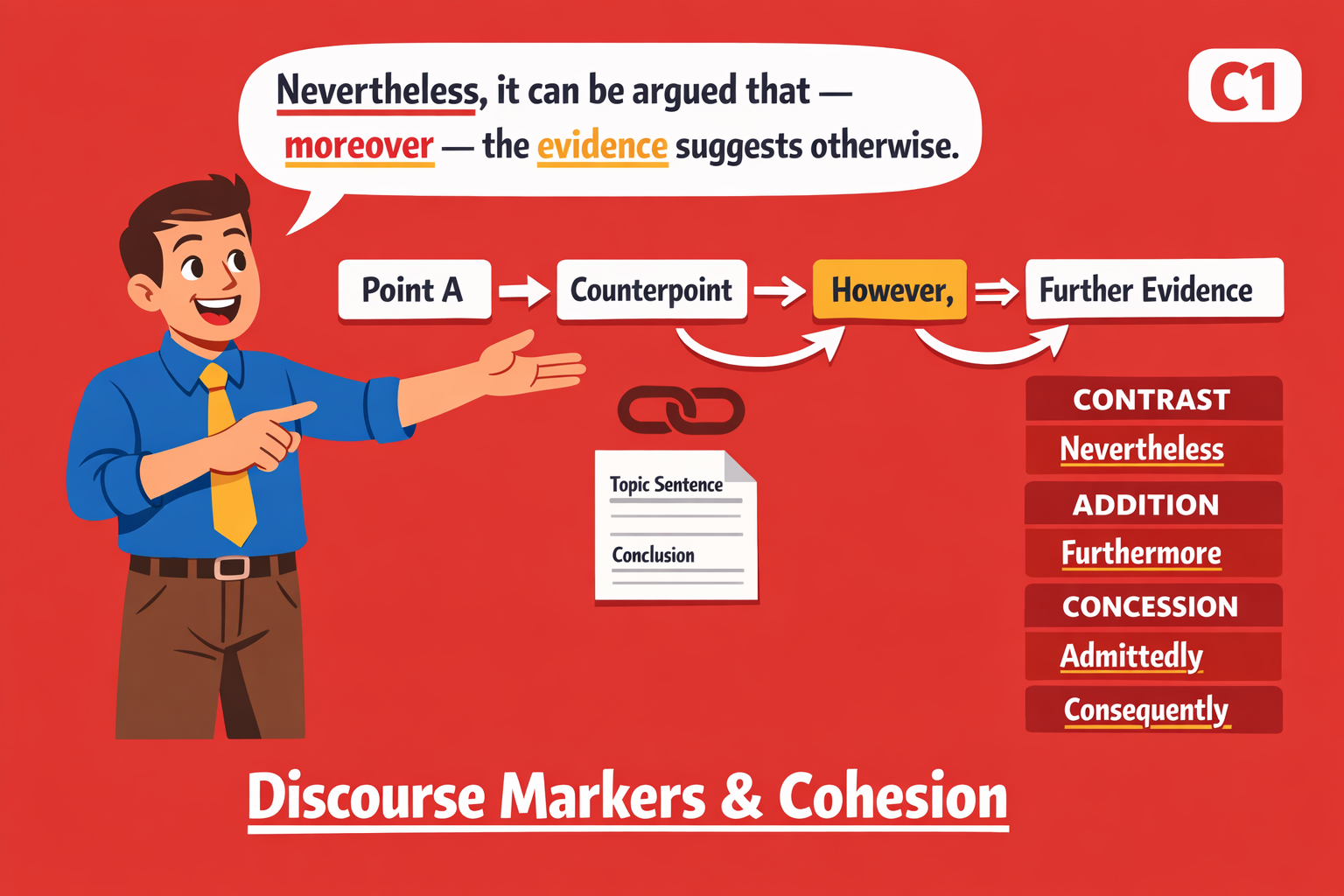
The concession is real — the speaker grants the point — but the second clause carries the actual argument. This pattern is common in formal academic and professional writing. Note that the concessive may/might works in the main clause; although she may be clever, her work is poor is equally standard, with the concessive clause fronted. What creates a structural problem is placing although as a mid-sentence coordinator after the modal clause — it produces a double concession marker where one is doing redundant work.
Modal Perfects: Criticism, Regret, and Missed Possibility
The modal perfect (modal + have + past participle) operates exclusively in retrospect. The nuance shifts considerably depending on which modal is chosen — they are not stylistic variants of the same meaning.
| Structure | Function | Example |
|---|---|---|
| should have | Criticism or regret — the right thing was not done | They should have consulted the team before deciding. |
| ought to have | As above, with stronger moral weight | He ought to have declared the conflict of interest. |
| could have | Unrealised possibility — it was possible but did not happen | The project could have been completed on time with better planning. |
| might have | Mild reproach, or speculative past possibility | You might have warned me the meeting was cancelled. |
| would have | Hypothetical past result — the outcome of an unreal condition | With more time, she would have produced a stronger argument. |
| must have | Confident past deduction from evidence | The invoice must have been sent to the wrong address. |
| needn't have | Action happened but was unnecessary | You needn't have prepared a full report — a summary was fine. |
| didn't need to | Necessity was absent — action may or may not have happened | We didn't need to stay late after all. (whether they did is unstated) |
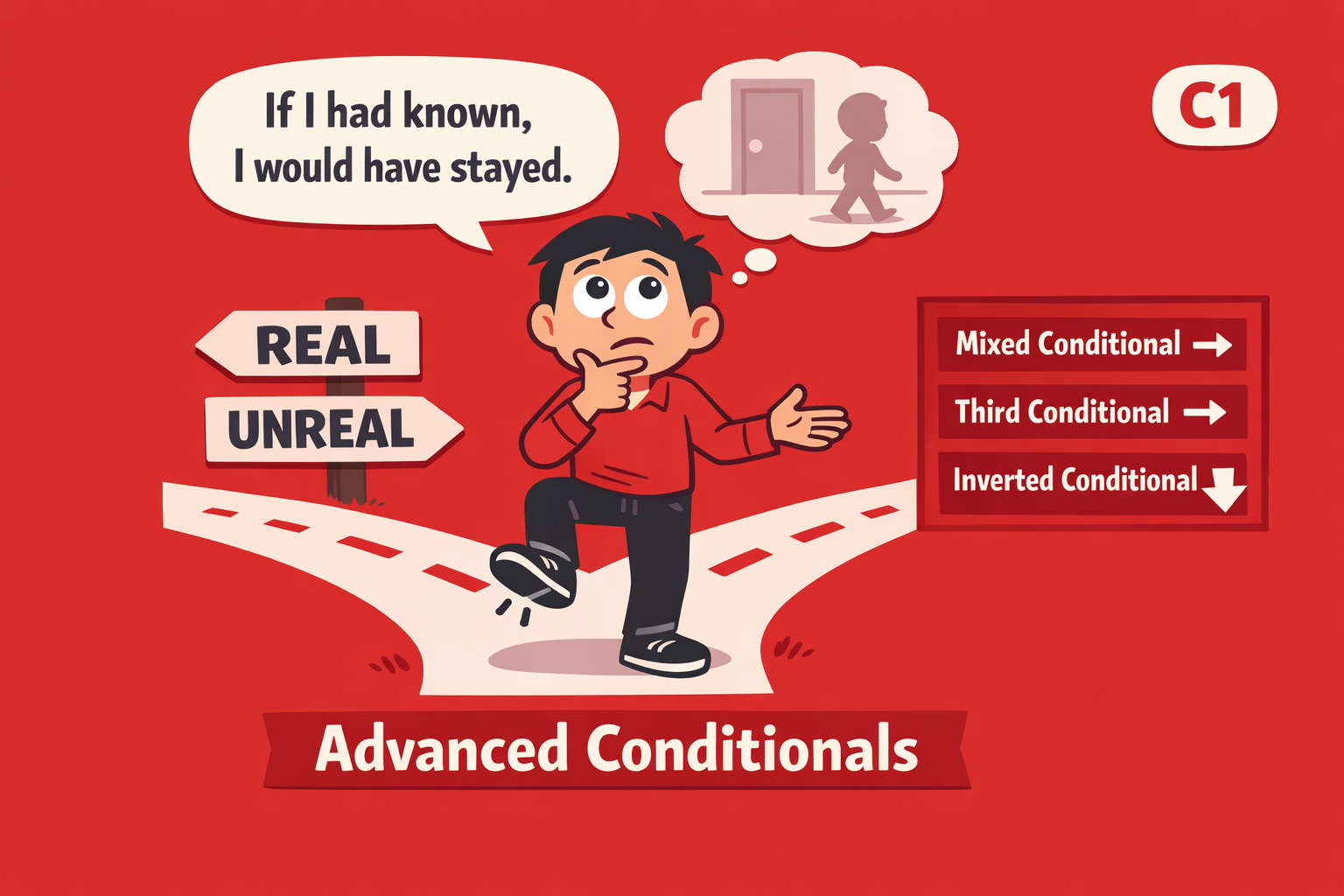
Would have differs from the others in this table: it marks a hypothetical outcome, not a retrospective judgement. It is the result clause in a third conditional or mixed conditional structure — "If they had started earlier, they would have finished on time" — rather than a comment on what was or was not done. Confusing it with should have ("They would have started earlier" instead of "They should have started earlier") produces a sentence about a hypothetical outcome rather than a criticism. For the full conditional framework these structures sit inside, see advanced conditionals at C1.
Might have carries a mild reproach that could have does not. "You might have told me" implies that the speaker is irritated by the omission. "You could have told me" is a neutral observation about a missed opportunity. This is the same contrast that separates the two colleagues in the opening paragraph — and getting it wrong in professional communication changes the register of an entire message. The connection to wish and regret structures built on the same modal perfect forms is explored on the advanced wish and regret page.
Common Mistakes
| Incorrect | Correct | Note |
|---|---|---|
| It must be a mistake, I think. | It might be a mistake, I think. | Must is a strong deduction — hedging it with I think is a contradiction. Use might or could when genuine uncertainty is intended. |
| You should have not said that. | You shouldn't have said that. | Negation in modal perfects attaches to the modal, not to have. |
| He may be right, although his tone is inappropriate. | He may be right, but his tone is inappropriate. | With a concessive modal in the main clause, although in the following coordinate position creates a double concession — the clause already concedes; although concedes again, making one marker redundant. Use a contrastive connector (but, yet, however) in the second clause. Note: Although he may be right, his tone is inappropriate — with although fronting the concession — is perfectly grammatical. |
| He didn't need to book, and he did. | He needn't have booked. | When the action happened but was unnecessary, needn't have is the correct form. Didn't need to leaves the outcome open. |
| The report could have showed different results. | The report could have shown different results. | Modal perfects require the past participle, not the past simple. Showed is past simple; the past participle of show is shown. |
| Shall you be attending the conference? | Will you be attending the conference? | Shall in questions is restricted to first-person offers and formal suggestions. Second and third-person questions use will. |
| You might have told me earlier. (neutral) | You could have told me earlier. (neutral) | Might have in this structure activates mild reproach. For a neutral statement of missed possibility, use could have. |
| You mustn't submit it today. (meaning: you are not required to) | You don't have to submit it today. | Mustn't signals prohibition — you are not allowed. Don't have to signals absence of obligation — it is not required, but you may if you wish. Swapping them reverses the meaning entirely. See must, might, may and have to for the full contrast. |
Quick Summary
- The same modal carries different meanings in epistemic (probability) and deontic (obligation) use. Context — not form — determines which reading is active.
- Epistemic certainty runs from must / can't (near-certain) through should (expected) to may / might / could (possible). Match the modal to your actual level of confidence.
- Will marks habitual behaviour — sometimes neutral, sometimes irritated. In professional writing, context determines the reading; use it carefully outside speech.
- Would / could in requests create pragmatic distance. The more formal the context or relationship, the further along the scale toward I wonder if you might… you should move.
- Needn't have confirms the action happened but was unnecessary. Didn't need to states that necessity was absent without confirming whether the action occurred.
- In modal perfects: should have criticises; could have states a missed possibility neutrally; might have reproaches; would have describes a hypothetical outcome. These are not interchangeable.
- Shall marks binding obligation in formal and legal contexts ("The contractor shall deliver…") and survives in first-person offers ("Shall I call them?"). Outside these uses, will or must is correct.
Frequently Asked Questions
What is the difference between must have and should have?
Must have expresses a confident past deduction based on evidence: the speaker concludes something almost certainly happened. Should have expresses criticism or regret: the right action was not taken. "She must have missed the train" is an inference. "She should have left earlier" is a judgement about what the correct behaviour would have been. The two are never interchangeable: one is epistemic (about probability), the other is deontic (about obligation).
When do you use might have vs could have?
Both express a past possibility that did not materialise, but they carry different tones. Could have is neutral — it simply states that something was possible: "We could have taken a different approach." Might have in the same structure implies mild reproach or irritation: "You might have told me sooner" signals that the speaker is not entirely pleased. In epistemic use (speculating about what happened), the two are closer to interchangeable, though might have is marginally more tentative.
What does needn't have mean compared to didn't need to?
Needn't have confirms that the action happened but was unnecessary: "You needn't have waited — the meeting was cancelled" means you did wait, and it was wasted effort. Didn't need to reports that necessity was absent, without stating whether the action occurred: "I didn't need to book in advance" leaves open whether a booking was made. Only needn't have contains information about what actually happened.
What is the difference between must and have to at C1?
Both express strong obligation, but they differ in source and tone. Must typically signals that the obligation comes from the speaker — an internal judgement, a rule the speaker is imposing or endorsing: "You must see a doctor." Have to signals external necessity — a rule or circumstance outside the speaker's control: "I have to submit this by Friday — it's the deadline." The distinction matters most in the negative: mustn't is a prohibition (not allowed), while don't have to means absence of obligation (not required). These are opposite meanings carried by what looks like a near-synonym pair.
How do modal verbs express politeness in English?
Politeness in English requests is largely a function of modal choice and modal distance. Replacing can with could, or will with would, softens a request by signalling tentativeness and respect for the other person's decision-making autonomy. Adding further hedges ("I wonder if you might…", "Would you be able to…?") increases the formality and deference further. The mechanism is pragmatic distance: the more conditional and tentative the phrasing, the more room the other person has to decline without awkwardness.
What is the difference between may and might in formal writing?
In formal and academic English, many writers treat might as marginally more tentative than may, suggesting a remoter or more conditional possibility. In practice, the distinction has weakened considerably in modern standard English, and the two are widely used interchangeably — but the differentiation still carries weight in legal and academic writing where precision of likelihood matters. "This may affect the outcome" treats the possibility as real and open; "this might affect the outcome" implies a more conditional or remote scenario. Might also tends to appear in more deferential registers — hypotheticals, concessions, and polite suggestions — more often than may.
Related Topics
- Advanced modal verbs: will, would and should — structural forms in depth, with focus on hypothetical and future uses.
- Speculation and deduction with modal verbs — the B2 foundation for epistemic modality across present and past forms.
- Advanced wish, regret and hypothetical language — how modal perfects connect to wish, if only, and other retrospective structures.
Comments