
Advanced Gerunds and Infinitives: All Patterns— C1 Grammar Exercises
Published March 23, 2026
Exercise 1 — Gap Fill Select
She admitted the mistake during the meeting.
They decided abroad for their studies.
He is interested in new languages.
She promised me as soon as she arrived.
They avoided the issue during the discussion.
I regret you that the project has been delayed.
She managed all the tasks before the deadline.
He denied anything wrong.
We expect the results by next week.
She suggested a break after two hours of work.
The board proposed holding a review — a suggestion put to the group. The board proposed to hold a review — the board itself intends to act. At C1, the choice between gerund and infinitive is not a vocabulary matter. It encodes aspect, voice, and temporal reference, and collapsing those distinctions produces errors precise enough to change meaning in formal written English.
The Eight Non-Finite Forms
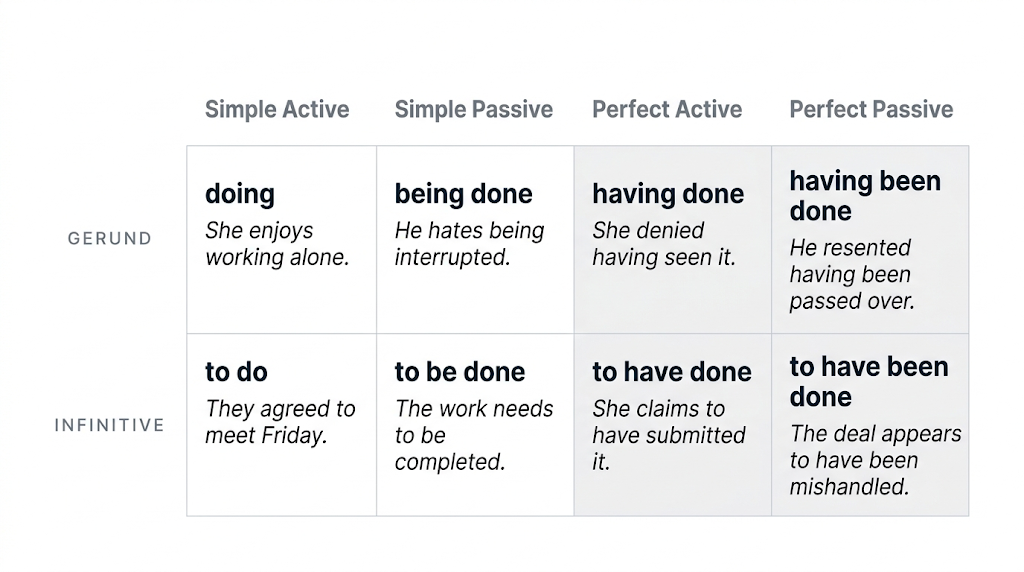
Gerunds and infinitives each have four forms — simple active, simple passive, perfect active, and perfect passive — giving eight non-finite forms in total. Most learners are confident with the simple active forms by B2; the remaining six require deliberate control at C1.
| Form | Active | Passive |
|---|---|---|
| Simple gerund | doing — She enjoys working alone. | being done — He hates being interrupted. |
| Perfect gerund | having done — She denied having seen the report. | having been done — He resented having been passed over. |
| Simple infinitive | to do — They agreed to meet on Friday. | to be done — The work needs to be completed. |
| Perfect infinitive | to have done — She claims to have submitted the form. | to have been done — The deal appears to have been mishandled. |
Perfect Forms: Marking Earlier Actions
The perfect gerund and perfect infinitive both signal that the non-finite action occurred before the action of the main verb. This is their primary function — not emphasis, not formality, but temporal priority.
The perfect gerund is common after verbs of reporting, admitting, denying, and acknowledging:
He admitted having taken the files. — She denied having been present. — They regretted having agreed so quickly.
The perfect infinitive appears after verbs of appearance, reporting, and claiming — and after modal verbs expressing past deduction or criticism:
The situation appears to have deteriorated sharply. — He is thought to have left the country. — She claims to have warned management three months ago.
Passive Forms
The passive gerund (being done) and passive infinitive (to be done) follow the same logic as their active counterparts — the subject of the non-finite verb is the receiver, not the doer, of the action.
He hates being corrected in public. — She expected to be offered the position. — The contract appears to have been altered.
One structure specific to passive infinitives deserves attention. After perception verbs in an active clause, the bare infinitive is used. In the corresponding passive clause, the full infinitive with to is required:
Active: They saw him leave the building.
Passive: He was seen to leave the building.
Active: Witnesses heard her argue with a
colleague.
Passive: She was heard to argue with a
colleague.
Verbs That Change Meaning
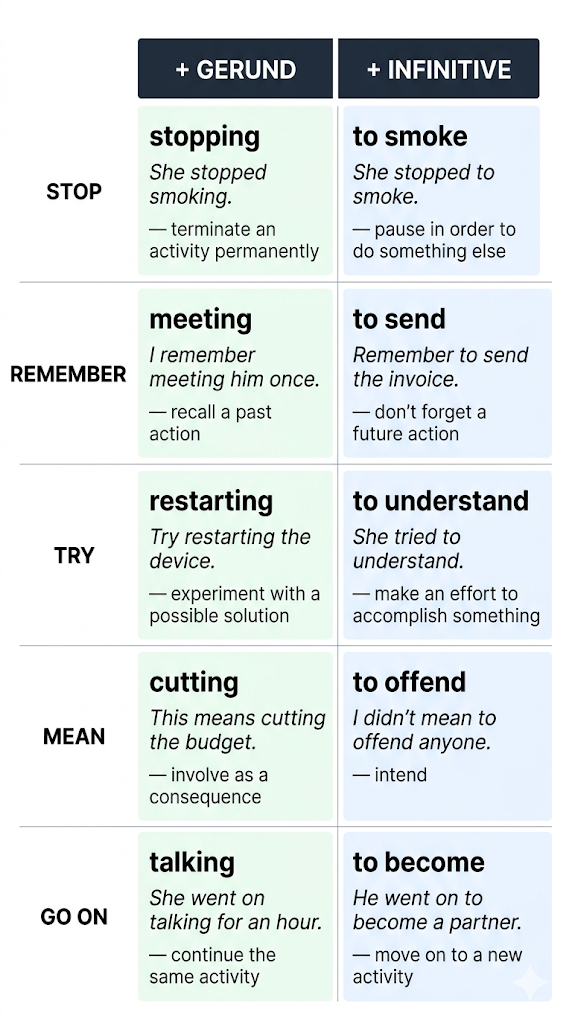
A defined set of verbs takes either a gerund or an infinitive, but with distinct meanings. At C1, control of this set must be complete.
| Verb | + Gerund | + Infinitive |
|---|---|---|
| stop |
terminate an activity She stopped smoking. |
pause to perform a different action She stopped to smoke. |
| remember |
recall a past action I remember meeting him once. |
not forget a future action Remember to send the invoice. |
| forget |
fail to recall something that happened I'll never forget hearing that. |
fail to perform a future action She forgot to lock the door. |
| regret |
feel sorry about a past action He regrets leaving so abruptly. |
feel sorry to announce (formal only) We regret to inform you that… |
| try |
experiment with a possible solution Try restarting the device. |
make an effort to accomplish something She tried to understand. |
| mean |
involve as a consequence This means cutting the budget. |
intend I didn't mean to offend anyone. |
| go on |
continue the same activity She went on talking for an hour. |
move on to a new activity He went on to become a senior partner. |
| need |
require — passive sense; thing as subject The report needs updating. |
have an obligation — person as subject You need to update the report. |
| dread |
have an ongoing fear of a situation She dreads attending the reviews. |
idiomatic — expresses reluctance to contemplate something (fixed
phrase only) I dread to think what it cost. |
| propose |
suggest to others He proposed holding the vote online. |
personally intend She proposed to address the committee. |
Bare Infinitive After Causative and Perception Verbs
Causative verbs: make and let take the bare infinitive after an object — never the full infinitive.
The manager made the team redo the presentation. — She let her assistant handle the correspondence.
Perception verbs: see, hear, watch, feel, notice, observe take either the bare infinitive or the present participle after an object, and the choice carries a meaning difference.
I watched her cross the street. — the complete action, start to finish
I watched her crossing the street. — an action caught in progress
The Preposition "To" Before a Gerund
The most persistent error at C1 is treating to as an infinitive marker when it is functioning as a preposition. Prepositions are always followed by the gerund — never the infinitive — and to is no exception when it is prepositional.
Expressions where to is a preposition, not an infinitive marker:
look forward to hearing from you — be accustomed to working independently — object to being overlooked — be committed to improving standards — in addition to holding a degree — be used to dealing with pressure — resort to fabricating evidence — dedicate oneself to achieving results
Possessive and Object Pronoun Before the Gerund
When a pronoun or noun phrase precedes a gerund as its logical subject, formal grammar requires the possessive form. In informal speech and writing, the object form is widely accepted.
Formal — She
appreciated his arriving on time.
Informal — She
appreciated him arriving on time.
Formal — The
committee objected to the director's chairing
the meeting.
Informal — The
committee objected to the director chairing
the meeting.
In formal written English and academic prose, the possessive + gerund construction is the expected form. Recognising when register demands it — and producing it consistently — is one of the markers of C1 competence. For broader treatment of this distinction, see formal and informal register.
Fixed Expressions with Gerunds
A set of high-frequency expressions takes the gerund as a fixed pattern. These cannot be derived from the meaning of an individual verb — they must be learnt as units.
| Expression | Example |
|---|---|
| it's no use / there's no point (in) | There's no point in appealing — the decision is final. |
| can't help | She couldn't help noticing the discrepancy. |
| (not) worth | The case isn't worth pursuing any further. |
| have difficulty / trouble (in) | He had considerable difficulty persuading the board. |
| spend / waste time | They spent three weeks renegotiating the terms. |
| be busy | The team is busy finalising the proposal. |
| feel like | I don't feel like going over this again. |
Gerunds functioning as the subject or complement of a clause — Renegotiating the terms took three weeks — approach nominal function. The boundary between gerund and abstract noun is explored in nominalisation.
Common Mistakes
| ✗ Wrong | ✓ Correct | Why |
|---|---|---|
| I look forward to hear from you. | I look forward to hearing from you. | To is a preposition here, not an infinitive marker. Prepositions always precede the gerund. |
| He was seen leave the building. | He was seen to leave the building. | In the passive, the bare infinitive after perception verbs becomes a full infinitive with to. |
| She denied to take the documents. | She denied taking the documents. | Deny is always followed by a gerund. Review the B2 verb pattern list if the core inventory is uncertain. |
| I regret to have said that to her. | I regret having said that to her. | Regret + perfect gerund refers to a past action the speaker feels remorse about. Regret + infinitive is used only in formal speech-act formulas — We regret to inform you…, I regret to say… — never to express remorse about a past action. |
| The system needs to update. | The system needs updating. or The system needs to be updated. | When the subject cannot perform the action itself, need + gerund (passive sense) or need + passive infinitive are both correct. The active infinitive implies a human agent who is obliged to act — it doesn't fit an inanimate subject. |
| She proposed to hold a vote, but nobody seconded it. | She proposed holding a vote, but nobody seconded it. | Propose + infinitive expresses personal intention. A suggestion put to others requires the gerund. |
Frequently Asked Questions
What is the difference between gerund and infinitive at C1?
At C1, the gerund and infinitive are not interchangeable — each encodes a distinct relationship between the non-finite action and the main verb in terms of aspect, voice, and temporal reference. The choice determines whether an action is presented as ongoing, completed, active, or passive, and a set of ten verbs change meaning entirely depending on which form follows them.
What does "having done" mean in grammar?
The perfect gerund (having done) signals that the gerund action occurred before the action of the main verb. In She denied having seen the report, the seeing predates the denying. Where the simple gerund (denying seeing) leaves the temporal relationship implicit, the perfect gerund makes it explicit — a distinction that matters in formal written English.
Why do we say "to leave" not "leave" in the passive after perception verbs?
In active clauses, perception verbs take the bare infinitive: They saw him leave. In the passive, the bare infinitive must become a full infinitive with to: He was seen to leave. The bare infinitive is not possible in passive constructions — this is a consistent rule with no exceptions across all perception verbs.
What verbs change meaning with gerund or infinitive?
Ten verbs carry distinct meanings depending on which form follows: stop, remember, forget, regret, try, mean, go on, need, dread, and propose. The most important distinction applies to remember, forget, and regret: gerund = the non-finite action came before the main verb; infinitive = it comes after, or the infinitive is part of a fixed formal formula.
Is "to" always an infinitive marker?
No. In many fixed collocations, to functions as a preposition, not as part of the infinitive construction — and prepositions must be followed by the gerund. The reliable test is whether to follows a verb, adjective, or noun directly and completes a fixed phrase: look forward to, object to, be accustomed to, be committed to, resort to. In all of these, the gerund is required after to.
When do you use the possessive before a gerund?
Formal grammar requires the possessive when a pronoun or noun phrase precedes a gerund as its logical subject: I appreciated his arriving on time rather than him arriving. In informal speech and writing, the object pronoun form is widely accepted. In academic prose, formal correspondence, and C1+ writing tasks, the possessive is the expected form.
Quick Summary
- There are eight non-finite forms: simple and perfect × active and passive, for both gerund and infinitive. The simple active forms are not enough at C1.
- The perfect forms (having done, to have done) mark an action that precedes the main verb in time.
- In the passive, bare infinitives after perception verbs become full infinitives: was seen to leave, not was seen leave.
- Ten verbs change meaning depending on whether they take a gerund or infinitive: stop, remember, forget, regret, try, mean, go on, need, dread, propose. For remember, forget, and regret: gerund = before the main verb action; infinitive = after it.
- When to is a preposition — look forward to, be used to, object to, be committed to — it is always followed by a gerund, never an infinitive.
- In formal written English, use the possessive before a gerund: his arriving, the director's chairing. The object pronoun form is informal.
- Fixed expressions with gerunds — can't help, it's worth, there's no point, have difficulty — must be learnt as units.
Related Topics
- Gerunds vs infinitives (B1) — the foundational verb lists this topic builds on
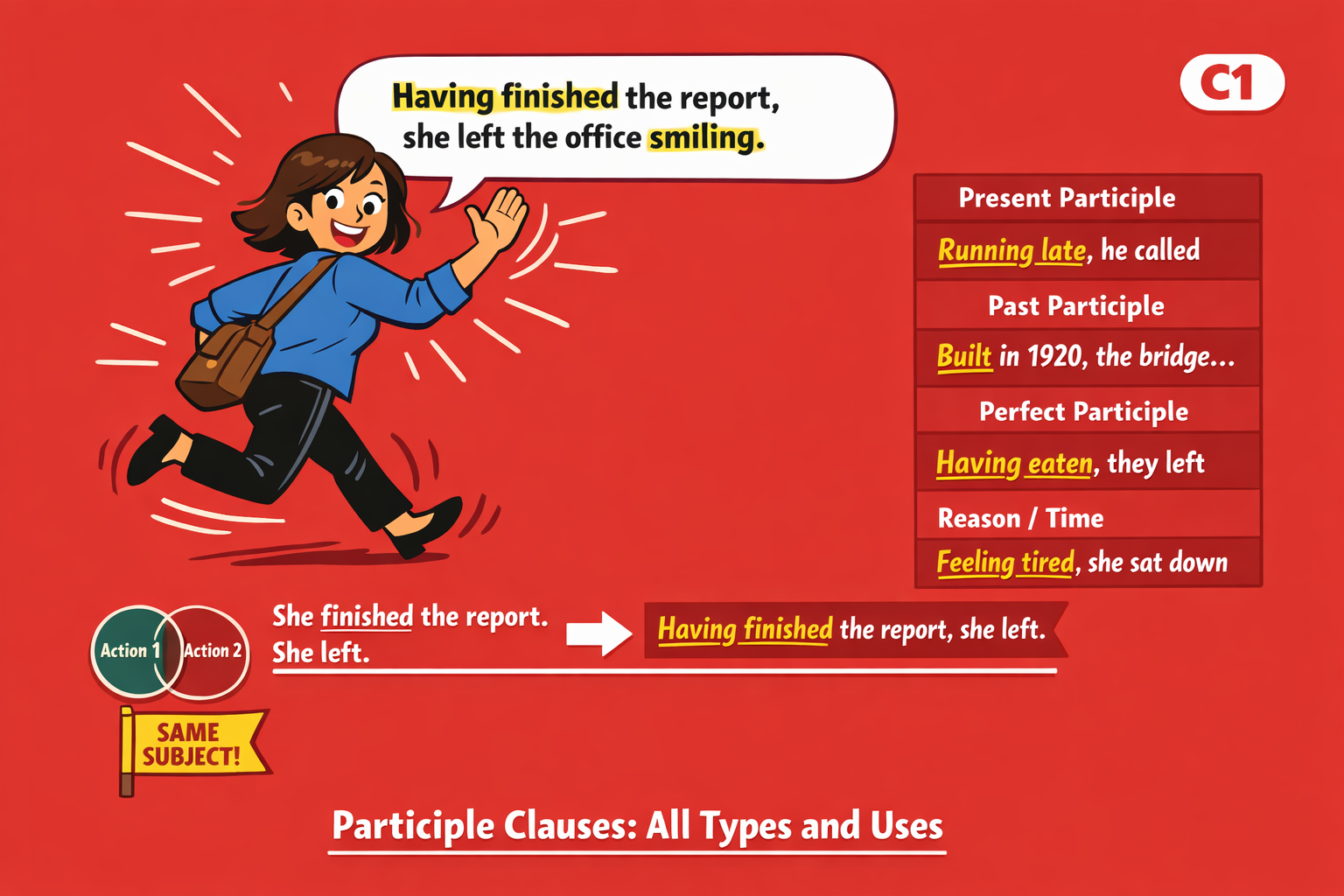
- Advanced participle clauses — related non-finite structures in formal written English
- Nominalisation — gerunds functioning as abstract nouns in formal and academic register
Comments