
The subjunctive in English— C1 Grammar Exercises
Published March 23, 2026
Exercise 1 — Gap Fill Select
It is essential that he present at the meeting tomorrow.
If I you, I would reconsider that decision immediately.
She demanded that the report finished by Friday.
It is important that every student on time for the exam.
If he to the interview, he would have been offered the job.
The teacher requested that the students their assignments by Monday.
It is crucial that everyone their ID badges at all times.
If I rich, I would travel the world.
The manager insisted that the meeting postponed until next week.
If she to the conference, she would have learned a lot.
The committee recommends that she be promoted. The bare be is not a typo: it's the present subjunctive, the form English uses after verbs and adjectives of demand, recommendation, and necessity. At C1, producing this mood without hesitation is what separates polished academic and professional writing from learner-style English.
The subjunctive is a verb mood, not a tense. It expresses what is hypothetical, demanded, or required rather than what factually is. Modern English has reduced its subjunctive forms to two patterns: the bare base verb after triggers of necessity, and were across all persons in hypothetical statements with be. Both are alive in formal English; both are routinely mishandled.
How the subjunctive is formed
The two surviving subjunctives are easy to describe and easy to miss. They look like ordinary verb forms, but they appear in places where you would expect something else.
Present subjunctive (mandative) → base form for all subjects, all tenses
Past subjunctive (with be) → were for all subjects
| Indicative (factual) | Subjunctive |
|---|---|
| She is on time. | It is essential that she be on time. |
| He leaves at six. | I demand that he leave at six. |
| I was there yesterday. | If I were there now, I would help. |
| She was the chair. | I wish she were the chair. |
The subjunctive form does not change with the tense of the main clause. I suggest that he leave and I suggested that he leave use exactly the same form. This is a frequent stumble for learners who try to back-shift the subjunctive after a past matrix verb.
The mandative subjunctive
The present subjunctive appears most often in that-clauses governed by verbs, adjectives, and nouns of demand, recommendation, suggestion, or necessity. The base form is used regardless of person, number, or tense.
Triggering verbs
The most common are demand, insist, recommend, suggest, propose, request, require, urge, ask, advise, order, command, move.
- The committee insisted that the proposal be reconsidered.
- She recommended that I take the position.
- The judge ordered that the defendant remain in custody.
- We propose that the policy apply to all departments equally.
Triggering adjectives
Common in the pattern It is + adjective + that…: essential, important, vital, crucial, necessary, imperative, advisable, desirable, urgent, mandatory.
- It is essential that every employee complete the training by Friday.
- It was vital that the document be signed before noon.
- It is imperative that the report remain confidential.
- It is advisable that all candidates arrive thirty minutes before the interview.
- It is essential that he not be informed of the decision until Monday. (negative subjunctive: place not directly before the base verb)
Triggering nouns
Nouns derived from the verbs above carry the same trigger: demand, requirement, recommendation, proposal, request, suggestion, insistence, condition.
- Her demand that he resign was eventually accepted.
- The proposal that taxes be raised met fierce resistance.
- The condition that all members attend in person was relaxed during the pandemic.
- The board's insistence that the CEO step down forced an emergency meeting.
The "were" subjunctive
For the verb be, English preserves a distinct past subjunctive form: were for all persons. This is the only past subjunctive that survives clearly, and it appears in a small but stable set of contexts where the meaning is hypothetical or contrary to fact.
After if in unreal conditionals
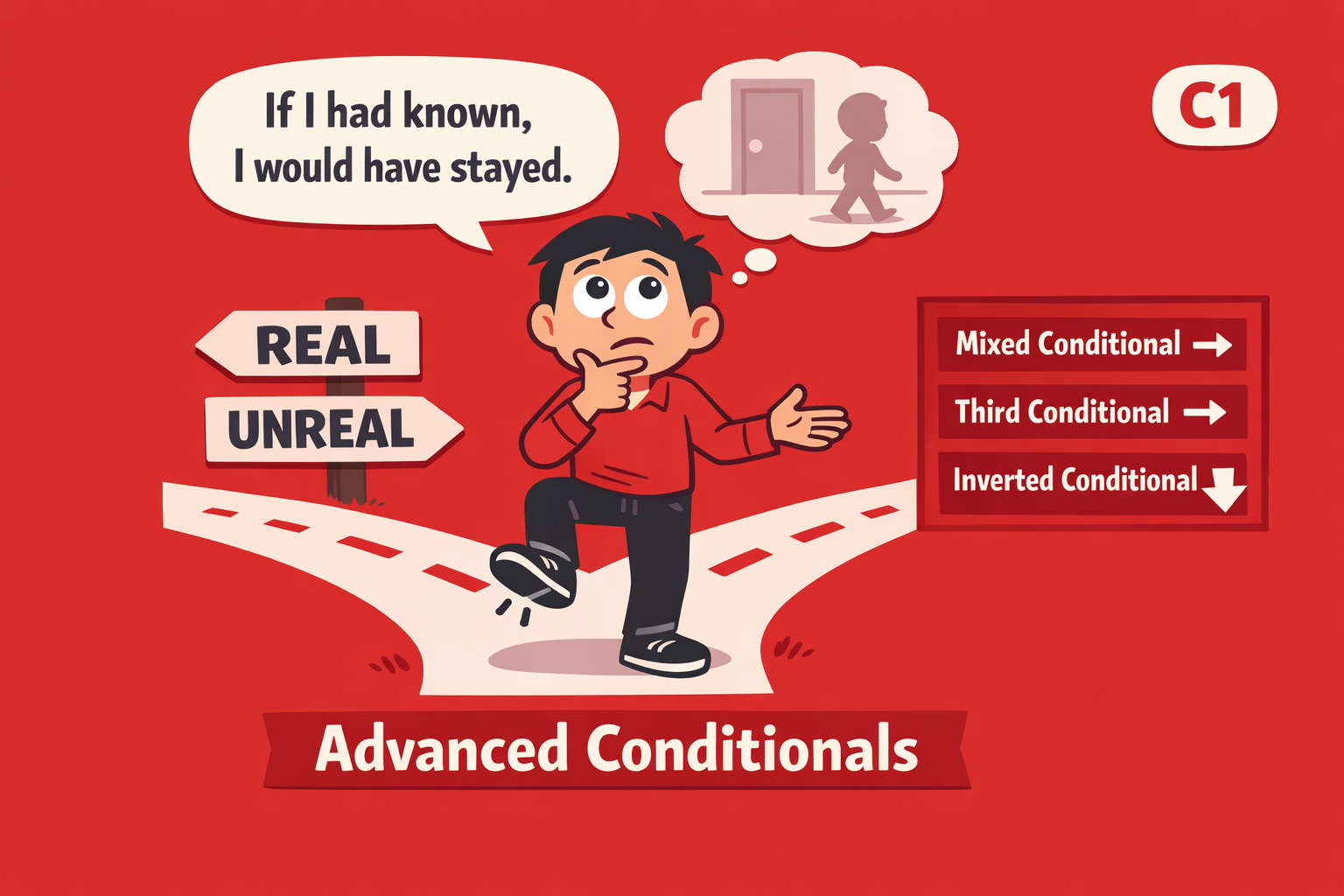
The standard form for the second conditional with be is were, not was, particularly in formal writing. Was is increasingly accepted in informal speech but flagged in academic and professional registers. See advanced conditionals for the full pattern.
- If I were in your position, I would resign immediately.
- If she were still alive, she would be appalled.
- If the policy were applied retroactively, thousands of cases would need review.
- Fixed If I were you… (always were, never was)
After wish, as if/as though, would rather, and it's (high) time
These structures all express hypothetical or unreal states. With be, the past subjunctive form is were. For the broader pattern of unreal-past usage, see advanced wish and regret.
- I wish I were better at small talk.
- He speaks as if he were the only expert in the room.
- I would rather she were here to discuss it herself. (she isn't here; the past form expresses a present hypothetical; see would rather / would prefer)
- It's high time he were held accountable for the decision.
Note that it's high time more often takes a past simple verb (It's high time we left); it triggers the were-subjunctive only when the main verb is be.
Formulaic subjunctives
A handful of fixed expressions preserve the subjunctive in fossilized form. They function as set phrases: you don't analyze them; you memorize them.
- God save the Queen.
- Long live the king.
- So be it.
- Heaven forbid.
- Suffice it to say…
- Be that as it may…
- Come what may…
- If need be…
- Far be it from me to…
These persist in writing and ceremonial language but rarely produce new subjunctive forms elsewhere in the language. Treat them as vocabulary, not grammar.
Subjunctive vs should + base form
British English often expresses mandative meaning with should + base form instead of the bare subjunctive, sometimes called the putative should in reference grammars. American English strongly prefers the bare subjunctive. Both options are grammatical; the choice signals register and regional preference.
| Bare subjunctive | Should + base form |
|---|---|
| I suggest that he leave immediately. | I suggest that he should leave immediately. |
| It is essential that she be informed. | It is essential that she should be informed. |
| More AmE; formal BrE | Common in BrE |
For a fuller treatment of should in advisory and hypothetical uses, see advanced modal verbs.
When NOT to use the subjunctive
The same triggering verb can be followed by either the subjunctive or the indicative; the choice depends on whether the matrix verb is making a recommendation or reporting a fact. This distinction is invisible to many learners and is the source of the most frequent C1 errors.
| Subjunctive (recommendation) | Indicative (observation / fact) |
|---|---|
| I suggest that he be more careful. (I am recommending) | His behaviour suggests that he is hiding something. (it is evidence) |
| She insists that he leave the room. (she demands) | She insists that he is innocent. (she maintains) |
| The board moved that the motion be passed. (formal proposal) | The evidence indicates that the motion was passed. (report) |
The test is straightforward: can you replace the matrix verb with recommend / demand / require without changing the meaning? If yes, use the subjunctive. If the verb is reporting a belief or observation, use the indicative.
Common mistakes
It's important that she comes early. The adjective important triggers the mandative subjunctive (base form, no -s for third person): It's important that she come early.
If I was the manager, I would change the policy. In formal usage, the past subjunctive of be is were for all persons in unreal conditionals: If I were the manager…. Was is acceptable informally but flagged in academic and professional writing.
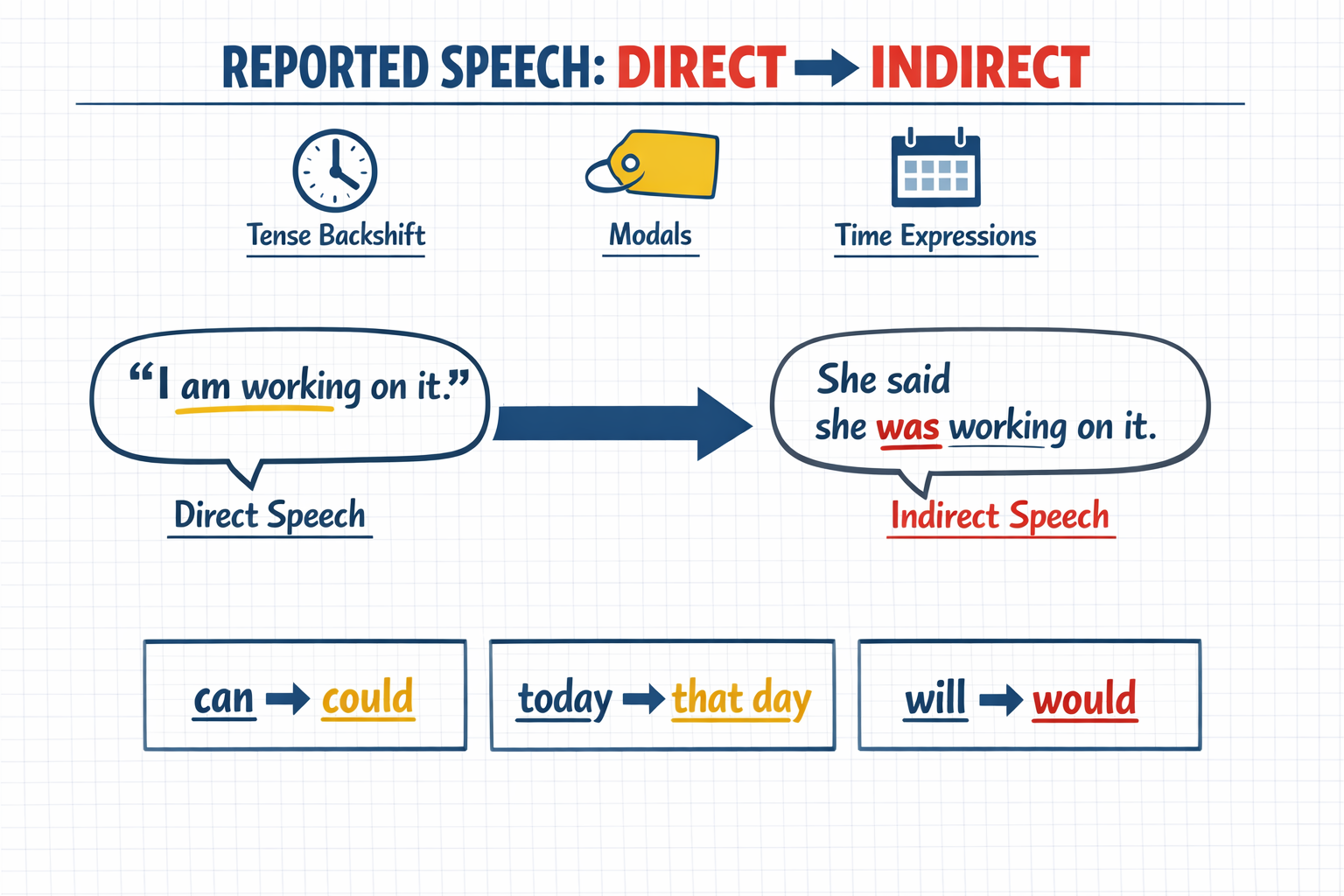
I suggested that he left immediately. A past matrix verb does not back-shift the subjunctive; the form is identical whether the main verb is past, present, or future: I suggested that he leave immediately. (Suggested he left is grammatical, but it means I implied he had already left, a different sense entirely. For the rules of backshifting in reported speech, see the dedicated topic.)
| Wrong | Right | Why |
|---|---|---|
| We require that every applicant submits two references. | We require that every applicant submit two references. | Mandative trigger require takes the base form, with no third-person -s. |
| It's vital that the team is informed. | It's vital that the team be informed. | Be is the base form of is/are/was/were in the present subjunctive. |
| I wish I was taller. (formal context) | I wish I were taller. | Standard formal English uses were after wish for all persons. |
| The recommendation that taxes are raised was rejected. | The recommendation that taxes be raised was rejected. | The noun recommendation triggers the subjunctive in the that-clause. |
| She insists that he goes to therapy. (she demands it) | She insists that he go to therapy. | If insist means demand, the subjunctive is correct. If it means maintain a fact, the indicative is correct. |
Register at a glance
The same recommendation can be expressed at different registers. The bare subjunctive is the marked, formal choice; using it appropriately is a reliable signal of advanced English.
| Register | Example |
|---|---|
| Informal | I think he should leave. |
| Neutral / common BrE | I suggest that he should leave. |
| Formal / academic / AmE | I suggest that he leave. |
Overusing the bare subjunctive in casual contexts sounds stiff. For more on calibrating formality, see formal and informal register.
Practice
Recognising the subjunctive is one thing; producing it under timed conditions is another. Test the patterns above: mandative triggers, the were-subjunctive, and the recommendation-vs-observation distinction, with the subjunctive practice exercises.
Frequently asked questions
What is the subjunctive in English?
The subjunctive is a verb mood used to express what is hypothetical, recommended, demanded, or required, rather than what factually is. Modern English uses two main forms: the bare base verb after triggers of necessity (I demand that he leave), and were for all persons after unreal-past triggers (If I were you). It is a feature of formal and academic English in particular.
When do you use the subjunctive mood?
The two main contexts are mandative, covering verbs, adjectives, and nouns expressing demand, recommendation, or necessity (recommend, suggest, essential, important, demand) and hypothetical, with be, after if, wish, as if, would rather, and it's high time. A small set of fixed expressions like so be it and God save the Queen also preserve subjunctive forms.
Is "If I was" or "If I were" correct?
Both occur, but they have different registers. If I were is the standard formal form, required in academic, professional, and exam writing, and obligatory in fixed phrases like If I were you. If I was is widely used in informal speech and increasingly accepted, but it is still flagged as non-standard in formal writing.
Why is "I suggest that he be promoted" not "is promoted"?
Suggest here is a mandative verb: it is making a recommendation, not reporting a fact. After mandative triggers, English uses the bare base form regardless of subject or tense. He is promoted is the indicative, which would mean you are stating that the promotion has occurred, not recommending that it should.
Is the subjunctive still used in modern English?
Yes, particularly in formal, academic, legal, and journalistic writing. The mandative subjunctive is more common in American English than in British English, where should + base form is a frequent alternative. The were subjunctive is alive in both varieties in formal contexts and in fixed expressions like if I were you.
What's the difference between the subjunctive and the conditional?
The subjunctive is a verb mood, while the conditional is a clause structure; they overlap but operate at different levels of grammar. The past subjunctive were appears inside second and third conditional sentences, but the subjunctive is the verb form, while the conditional is the broader sentence pattern. Put another way: not every subjunctive is conditional, and not every conditional uses the subjunctive.
Quick summary
- Mandative subjunctive: bare base form (no -s, no is/was/are) after demand, recommend, suggest, essential, important, vital, etc.
- The subjunctive form does not change with the tense of the main clause.
- Past subjunctive of be: were for all persons after if, wish, as if, would rather, it's high time.
- British English often uses should + base form (the putative should) as an alternative; American English prefers the bare subjunctive.
- The same matrix verb can take the subjunctive (recommendation) or the indicative (observation): meaning decides.
- Memorize the fossilized phrases: so be it, be that as it may, suffice it to say, if need be, come what may.
Related topics
- Advanced conditionals: where the were subjunctive lives in second and third conditionals.
- Advanced wish and regret: extends the past subjunctive into hypothetical and counterfactual contexts.
- Formal and informal register: calibrates when the subjunctive is the right register choice.
Comments