
The Imperative— A1 Grammar Exercises
Published March 14, 2026
Exercise 1 — Multiple Choice
____ the window, please.
____ your homework before dinner.
____ your hands before eating.
____ the light when you leave.
____ your shoes before entering.
____ the door quietly.
____ the book on the table.
____ the music, please.
____ your coat, it's cold outside.
____ the trash, please.
- A GPS says "Turn left."
- A cooking video says "Add the garlic and stir."
- A fire exit sign says "Do not use the lift" - the formal written form of Don't.
All of these are imperatives. The imperative tells someone to do something, or not to do something, directly and without a subject.
Form
The imperative uses the base form of the verb. The base form is the verb as it appears in a dictionary: open, sit, be, go, turn. There is no subject. You do not say you before the verb.
Negative: Don't + base verb + rest of sentence
| Positive — do it | Negative — don't do it |
|---|---|
| Sit down. | Don't sit there. |
| Close the window. | Don't close the door. |
| Be quiet. | Don't be late. |
The verb be follows the same rule. Be careful! and Don't be rude! — not Are careful! See the verb to be if you need to review its base form.
No Subject
The imperative has no subject. The subject is always understood to be you — the person you are speaking to directly — so there is no need to say it. This is the key difference from a normal present simple sentence.
| Present simple (fact or habit) | Imperative (instruction or warning) |
|---|---|
| You open the door. ← statement | Open the door. ← instruction |
| You eat here. ← statement | Eat here. ← instruction |
| You don't eat here. ← statement | Don't eat here. ← warning |
If you are not sure about subjects and objects in English sentences, review subject and object pronouns.
When to Use the Imperative
Instructions
Use the imperative to tell someone what to do. This is common in classrooms, recipes, and written guides.
- Read the question carefully.
- Mix the flour and water.
- Write your name at the top of the page.
- Press the red button to start.
Directions
Use the imperative to show someone the way.
- Turn left at the traffic lights.
- Go straight and take the second right.
- Cross the bridge and walk for five minutes.
- Follow the signs to the exit.
Warnings
Use the negative imperative to warn someone or stop them from doing something.
- Don't touch that — it's very hot.
- Don't run near the pool.
- Don't leave your bag here.
- Don't forget your passport.
Invitations and Offers
The imperative is also used to invite or offer something. The tone is warm and friendly here.
- Have some coffee.
- Come in, please.
- Take a seat.
- Help yourself to some food.
Using "Please"
Please makes the imperative more polite. It can go at the start or the end of the sentence — both are correct.
Please sit down.
Sit down, please.
Common Mistakes
| Wrong | Correct | Why |
|---|---|---|
| You open the window. | Open the window. | The imperative has no subject. Remove you. |
| To sit down, please. | Sit down, please. | Do not use to before the verb. Use the base form directly. |
| Not open the door. | Don't open the door. | The negative imperative uses Don't, not Not alone. |
| Don't to touch that. | Don't touch that. | After Don't, use the base verb directly — no to. |
| Opens your books. | Open your books. | Never add -s to the imperative verb. The base form never changes. |
Quick Summary
- Use the base verb — no to, no -s, no subject.
- Positive: Sit down. Close the door. Be quiet.
- Negative: Don't run. Don't be late.
- Use it for instructions, directions, warnings, and invitations.
- Add please at the start or end to sound more polite.
- Note You may hear Do sit down or Do be careful in speech — this is the emphatic form, used for strong encouragement. It will be covered fully at A2.
Frequently Asked Questions
How do you form the imperative in English?
Use the base form of the verb with no subject. For a positive imperative, start directly with the verb: Open the door. For a negative imperative, add Don't before the verb: Don't open the door.
What is the difference between the imperative and the present simple?
The present simple has a subject and describes a fact or habit: You open the window every morning. The imperative has no subject and gives a direct instruction or warning: Open the window.
How do you make an imperative negative?
Put Don't before the base verb. Do not use Not alone. Don't sit here. is correct; Not sit here. is not.
Can you use "please" with the imperative?
Yes. Please makes the imperative more polite and can go at the start or end of the sentence: Please sit down. or Sit down, please. Use a comma before please when it comes at the end.
Why is there no subject in the imperative?
The subject is always you — the person you are speaking to directly. Because this is always understood from context, there is no need to say it.
What are some examples of imperative sentences?
Imperatives are used for instructions, directions, warnings, and invitations — here are examples of each. Instructions: Read the question. Press the button. Directions: Turn left. Go straight. Warnings: Don't touch that. Don't run. Invitations: Come in. Have some coffee.
Related Topics
- The verb to be A1 — needed for imperatives like Be careful! and Don't be late!
- Subject and object pronouns A1 — understand why the imperative drops the subject.
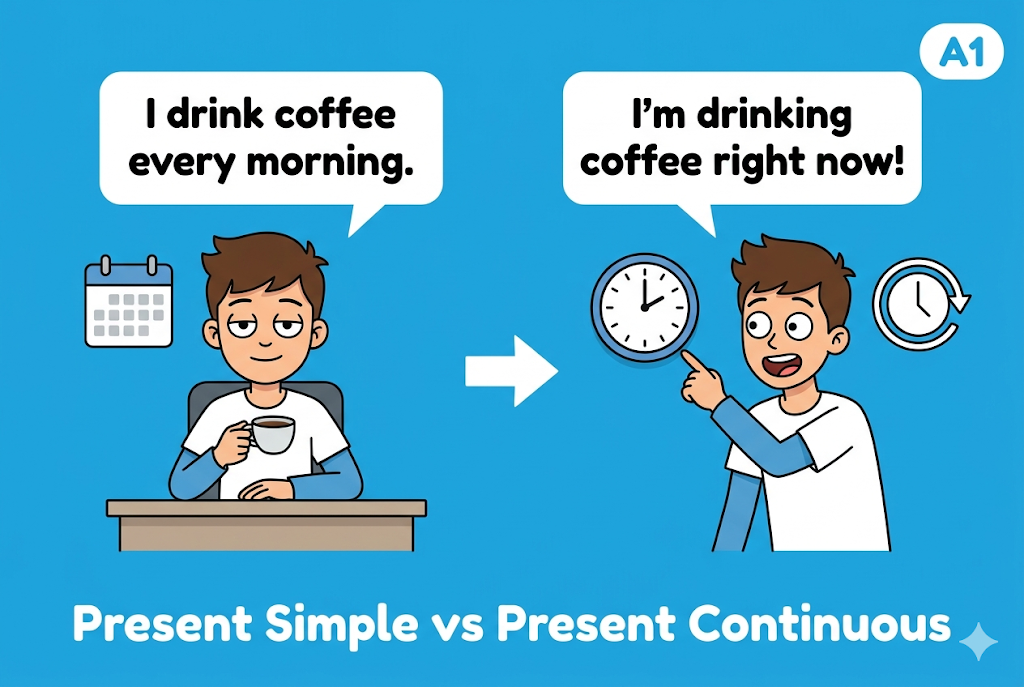
- Present simple vs present continuous A1 — the next key sentence structures to study.
- Modal verbs: can, could, should A2 — polite alternatives to the imperative: Could you open the window?

Comments